
Great Zimbabwe’s stone city above the Masvingo lowveld
Published on 08/31/2026 at 15:48 | Editorial responsibility: Rafael Müller, Editor-in-Chief AD HOC NEWS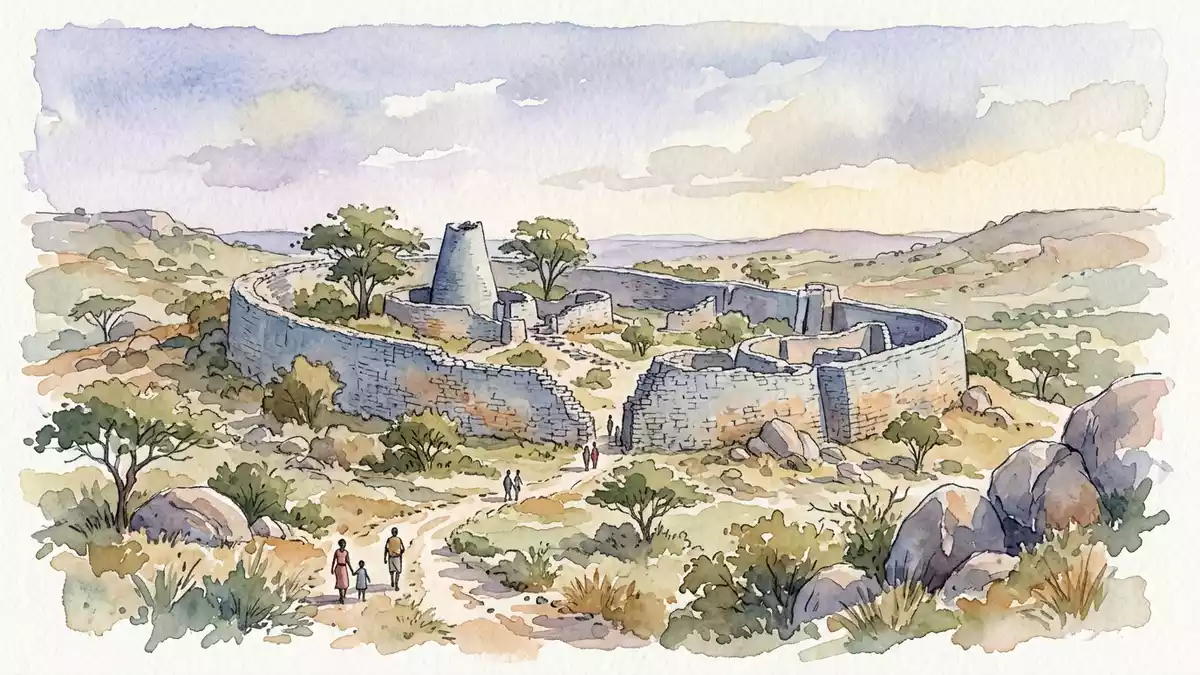
South-east of Masvingo, Great Zimbabwe spreads across a granite plateau as an extensive Iron Age stone city whose surviving walls still structure the surrounding landscape. Built between the eleventh and fifteenth centuries by ancestors of the Shona people, it became the centre of a powerful inland kingdom whose name later passed to the modern state of Zimbabwe.built and inhabited between roughly the 11th and 15th centuries CE
A granite plateau city of dry-stone walls
Great Zimbabwe occupies gently undulating country in south-eastern Zimbabwe, at an altitude of around 1,100 m (3,609 ft) above the lowveld near Masvingo. The ruins stand on and around an expanse of weathered granite, whose natural outcrops form a backdrop to the dry-stone structures.located in the lowveld at an altitude of some 1100 m The central zone of stone constructions covers around 80 hectares (198 acres), making it one of the largest concentrations of precolonial masonry in southern Africa.central area of ruins extends about 200 acres
The architecture of Great Zimbabwe is defined by long dry-stone walls built from locally quarried granite blocks, laid without mortar in carefully coursed patterns. In many stretches the outer faces display alternating bands of stone lengths, forming subtle horizontal motifs that catch the light differently across each course.It is the largest stone structure in precolonial Southern Africa Between the masonry enclosures lie traces of clay and timber dwellings; together, the stone and earth architecture once housed thousands of people in a dense urban landscape tied to long?distance trade.
Hill Ruins, Great Enclosure and Valley Ruins
The site divides into three main architectural zones: the Hill Ruins on the steep granite kopje, the Great Enclosure on its southern flank, and the Valley Ruins scattered across the lower ground.stone constructions can be categorized into roughly three areas The Hill Ruins form the oldest part of Great Zimbabwe, with occupation traces that reach back to the eleventh and thirteenth centuries.Hill Complex is the oldest part of Great Zimbabwe Terrace walls step around boulders and ledges, enclosing platforms and passages that once supported royal and ritual structures.
Below the hill stands the Great Enclosure, a vast walled precinct whose outer wall rises to about 11 m (36 ft) and runs in an almost continuous curve around its interior.outer perimeter of the Great Enclosure — rises 11 metres Inside, a freestanding stone cone known as the Conical Tower stands near one of the inner walls, while narrow passages run between masonry lines and open into small courts. Further out, the Valley Ruins fill the space between the hill and the enclosure with smaller stone complexes whose boundaries once surrounded clay houses and meeting spaces.divided into three groups: the Hill Ruins, the Great Enclosure and the Valley Ruins
Shona kingdom and World Heritage status
Archaeological and historical research links Great Zimbabwe to the Shona-speaking communities who dominated the region’s trade in the late Iron Age, connecting interior gold fields and cattle herds with coastal merchants along the Indian Ocean. By the thirteenth century the city had become the capital of the Kingdom of Great Zimbabwe, with political influence extending across much of present-day Zimbabwe and beyond.served as the capital of the Kingdom of Great Zimbabwe from the 13th century The settlement flourished until the fifteenth century, after which power shifted to other centres further north.
The ruins achieved international recognition in the twentieth century as evidence of a sophisticated indigenous stone-building tradition in southern Africa. In 1986 Great Zimbabwe National Monument was inscribed on the UNESCO World Heritage List as a cultural property representing Bantu civilisation between the eleventh and fifteenth centuries.built between 1100 and 1450 AD, extends over almost 800 ha The name “Zimbabwe”, derived from a Shona phrase for “stone houses”, was adopted by the independent country in 1980 in reference to this earlier centre of power.The name Zimbabwe refers to a big house of stone
Visiting Great Zimbabwe: what travellers from Western Europe should know
- Great Zimbabwe lies about 30 km (19 mi) south-east of Masvingo in south-central Zimbabwe, reached by road across lowveld countryside dotted with granite outcrops.
- The Hill Ruins rise above the surrounding terrain on a steep granite hill, with paths and stairways that involve sustained climbing over uneven stone and earth surfaces.
- The Great Enclosure and Valley Ruins occupy gentler ground below the hill, but exploring the stone walls and passages still requires walking over rough paths and occasional rock steps.
- The official language is English alongside indigenous languages such as Shona, and the currency is the Zimbabwean dollar.
- Entry requirements depend on your nationality; UK travellers can check the FCDO travel advice at gov.uk/foreign-travel-advice, Irish travellers the Department of Foreign Affairs at ireland.ie.
Searching for Great Zimbabwe on social platforms
These links open searches for Great Zimbabwe on each platform.
Frequently asked questions about Great Zimbabwe
Where is Great Zimbabwe located?
Great Zimbabwe stands on a granite plateau about 30 km (19 mi) south-east of Masvingo in south-central Zimbabwe, in lowveld terrain at around 1,100 m (3,609 ft) elevation.
What should visitors expect on a visit?
Visitors encounter extensive dry-stone walls, terraces and passages across a large archaeological landscape, with the Hill Ruins involving steep ascents and the Great Enclosure and Valley Ruins spread over gentler ground.
What makes Great Zimbabwe distinctive?
Great Zimbabwe is distinctive as a vast Shona-built stone city dating from the eleventh to fifteenth centuries, with monumental dry-stone architecture and a documented role as the capital of the Kingdom of Great Zimbabwe.


