
Great Ocean Road from Torquay to Allansford
Published on 08/21/2026 at 20:26 | Editorial responsibility: Rafael Müller, Editor-in-Chief AD HOC NEWS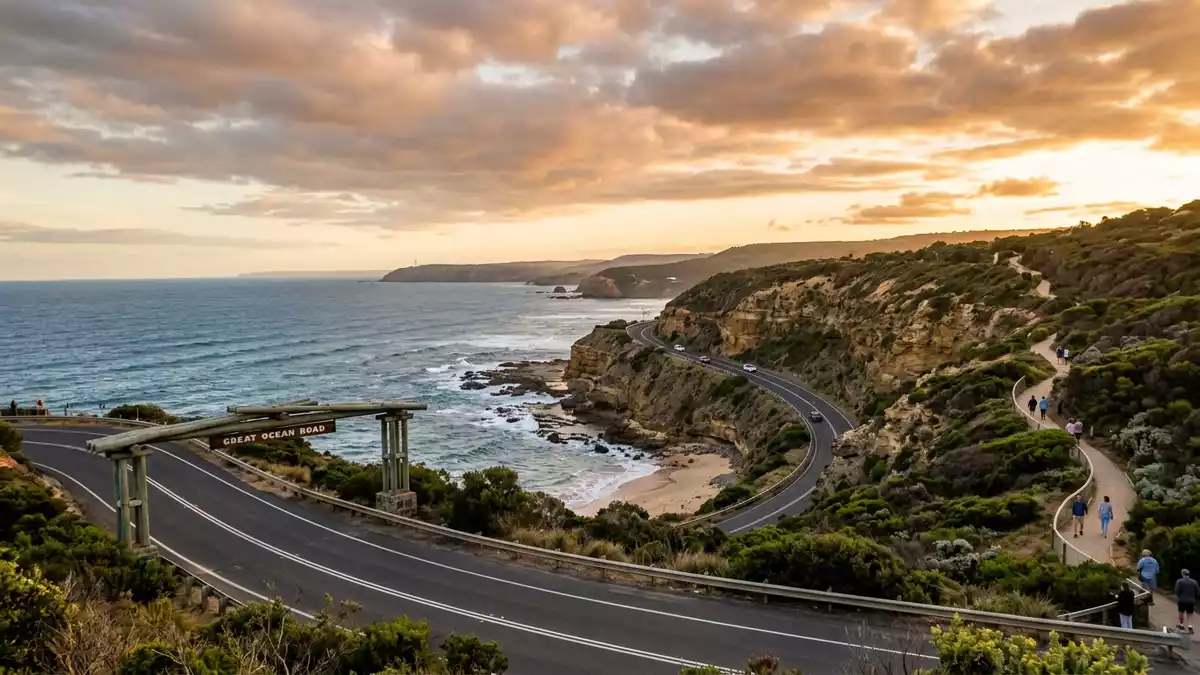
Running between Torquay and Allansford on Australia’s south?eastern coast, the Great Ocean Road is both a scenic coastal highway and a national memorial carved into rugged shoreline cliffs. Opened in 1932 after more than a decade of construction by returned First World War servicemen, it forms a long arc of bitumen and concrete that links surf beaches, forested headlands and small coastal towns along Victoria’s south?west coastline.
A coastal road built as a war memorial
The Great Ocean Road is formally recognised as an Australian National Heritage place and is widely described as the world’s largest war memorial, because the highway itself commemorates soldiers killed during the First World War.Australian National Heritage-listed Construction took place between 1919 and 1932, with thousands of returned servicemen working with hand tools along steep coastal slopes and cliff faces.returned servicemen between the years of 1919 and 1932 The road was officially opened on 26 November 1932, completing a project that had turned isolated communities into a connected coastal corridor.
The alignment follows around 240 km (about 150 mi) of coastline between the township of Torquay in the east and Allansford near Warrnambool in the west, with the modern touring route often extended further to nearby Port Fairy.242 kilometre stretch of road At its eastern end the highway links with the Surf Coast Highway near Torquay, forming a transition from inland farmland to the surf beaches and headlands that characterise the first section of the journey.Surf Coast Highway Torquay
From Torquay’s surf coast to forested headlands
Torquay is commonly regarded as Australia’s surf capital and acts as the gateway town at the beginning of the Great Ocean Road, with the highway leaving the Geelong area and turning towards the sea at this point.Torquay is Australia’s surf capital and the starting point The first section of the route passes near beaches and low coastal bluffs, including well?known surf breaks along the Surf Coast. Beyond Anglesea the road largely hugs the coastline, climbing and descending around headlands where forested slopes drop towards rock shelves and narrow sandy coves.commences south of Geelong at Torquay
Further west, near Aireys Inlet, travellers encounter the Memorial Arch, a timber structure spanning the roadside that marks the contribution of the servicemen who built the highway.Great Ocean Road Memorial Arch The route then continues through towns such as Lorne and Apollo Bay, where the road often clings to the base of forested hillsides or runs above rock platforms bordering Bass Strait. Inland from the highway, dense woodland and the elevated Otway Ranges form a contrasting backdrop to the open sea, creating a landscape in which surf beaches, cliffs and temperate rainforest stand within relatively short reach of one another.
Shipwreck Coast and landmark viewpoints
Beyond Apollo Bay the Great Ocean Road turns towards the western sections associated with the Shipwreck Coast, a name linked to the high number of vessels lost along this stretch between Moonlight Head and Port Fairy.Shipwreck Coast Along this part of the journey the highway provides access to coastal viewpoints over rock stacks, narrow gorges and sheer limestone cliffs, including locations such as Loch Ard Gorge and the broader area around Port Campbell where sea?eroded formations rise from the surf.
The wider region contains heritage structures and navigation aids that pre?date the highway, including lighthouses built on cliffs to warn shipping of the dangerous coastline. One notable example frequently associated with the route is Cape Otway Lightstation, regarded as the oldest surviving lighthouse on mainland Australia and standing on high cliffs that look over the Southern Ocean.Cape Otway Lightstation Near its western end the road connects with larger towns such as Warrnambool and the fishing village of Port Fairy, where the coastal drama gives way to a mix of harbourfronts and rolling hinterland.
Visiting Great Ocean Road: what travellers from Western Europe should know
- The highway begins at Torquay in Victoria, south?west of Melbourne, and runs along the south?eastern coast of Australia towards Allansford near Warrnambool, forming a continuous coastal driving route.
- Much of the road is built along headlands and above cliffs, with frequent bends and changes in gradient; some sections include narrow shoulders and short approaches on foot to reach cliff?edge viewpoints.
- The broader Great Ocean Road region includes towns such as Anglesea, Lorne, Apollo Bay, Port Campbell and Port Fairy, many of which lie directly beside surf beaches or harbour inlets.
- The official language is English and the currency is the Australian dollar.
- Entry requirements depend on your nationality; UK travellers can check the FCDO travel advice at gov.uk/foreign-travel-advice, Irish travellers the Department of Foreign Affairs at ireland.ie.
Searching for Great Ocean Road on social platforms
These links open searches for Great Ocean Road on each platform.
Frequently asked questions about Great Ocean Road
Where is the Great Ocean Road and where does it start?
The Great Ocean Road is in the Australian state of Victoria and runs along the south?eastern coast between Torquay in the east and Allansford near Warrnambool in the west.
What can travellers expect on a journey along the Great Ocean Road?
A journey along the Great Ocean Road combines surf beaches, forested headlands, cliff?top viewpoints, small coastal towns and sections of highway that closely follow the shoreline.
What makes the Great Ocean Road distinctive among coastal drives?
The Great Ocean Road is distinctive because it functions as both a long coastal touring route and a memorial highway built by returned First World War servicemen, recognised as a national heritage place.


