
Great Mosque of Kairouan and its vast stone courtyard
Published on 09/22/2026 at 11:23 | Editorial responsibility: Rafael Müller, Editor-in-Chief AD HOC NEWS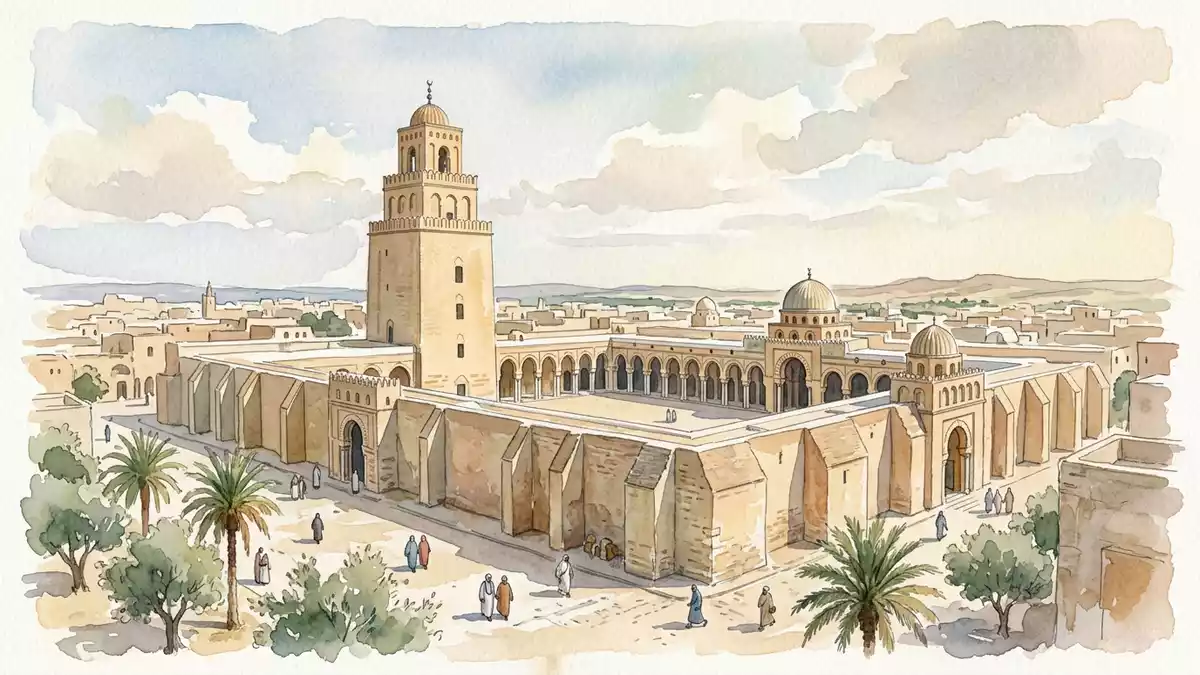
Great Mosque of Kairouan is a vast stone complex organised around an open courtyard and a deep hypostyle prayer hall. Founded by Uqba ibn Nafi in 670, it gained much of its present form under the Aghlabid dynasty in the ninth century.
Great Mosque of Kairouan: a courtyard at monumental scale
The mosque occupies an irregular walled enclosure in the historic city of Kairouan, in central Tunisia. Its pale stone surfaces, arcades and square minaret form a strongly geometric composition within the medina.
The courtyard lies on the northern side of the complex. Broad paved surfaces extend between surrounding arcades, while the prayer hall occupies the southern side. The open space and enclosed sanctuary are the two defining parts of the building.
From Uqba ibn Nafi to the Aghlabid rebuilding
Uqba ibn Nafi established the first Muslim oratory at Kairouan in 670, when the city was founded in Ifriqiya. The mosque is also known as the Mosque of Uqba, preserving the name of its founder.
The building familiar from architectural history belongs largely to the ninth century. A complete rebuilding took place under the Aghlabid emir Ziyadat Allah I in 836, and the complex became a major reference point for mosque architecture across the Maghreb. The UNESCO heritage listing includes Kairouan and its historic monuments.
Columns, arches and the square minaret
The prayer hall follows a hypostyle plan, with rows of columns carrying arcades beneath a flat roof. Many columns and carved capitals are reused antique elements, giving the interior a varied collection of materials and forms.
A central nave leads towards the qibla wall and the mihrab, the niche marking the direction of Mecca. The sanctuary also contains a richly decorated minbar, while a dome marks the area before the mihrab. The hypostyle prayer hall belongs to the architectural tradition that shaped religious buildings in North Africa.
The square minaret rises beside the northern courtyard. Built in carefully layered masonry, it has a powerful, compact appearance rather than the slender profile associated with many later minarets. Its form is among the clearest visual signatures of the Kairouan mosque.
Visiting Great Mosque of Kairouan: what travellers from Western Europe should know
- The mosque stands in the medina of Kairouan, a historic city in central Tunisia. Kairouan is reached by road from Tunis and other Tunisian cities.
- The approach leads through the compact streets of the medina. Inside, the courtyard is broad and level, while the prayer hall contains many columns, arcades and changes between open and covered spaces.
- The official language is Arabic and the currency is the Tunisian dinar.
- Entry requirements depend on your nationality; UK travellers can check the FCDO travel advice at gov.uk/foreign-travel-advice, Irish travellers the Department of Foreign Affairs at ireland.ie.
Searching for Great Mosque of Kairouan on social platforms
These links open searches for Great Mosque of Kairouan on each platform.Frequently asked questions about Great Mosque of Kairouan
Where is Great Mosque of Kairouan?
Great Mosque of Kairouan stands in the medina of Kairouan, in central Tunisia. The city is known for its historic Islamic monuments.
What does the mosque contain?
The complex contains a broad courtyard, arcades, a hypostyle prayer hall, a square minaret, a mihrab and a decorated minbar.
What makes the mosque distinctive?
Its identity comes from the contrast between the open stone courtyard and the dense interior of columns. Its foundation in 670 and Aghlabid rebuilding in 836 connect the building with major phases of Maghrebi Islamic architecture.


