
Great Mosque of Kairouan and its vast stone courtyard
Published on 08/21/2026 at 07:25 | Editorial responsibility: Rafael Müller, Editor-in-Chief AD HOC NEWS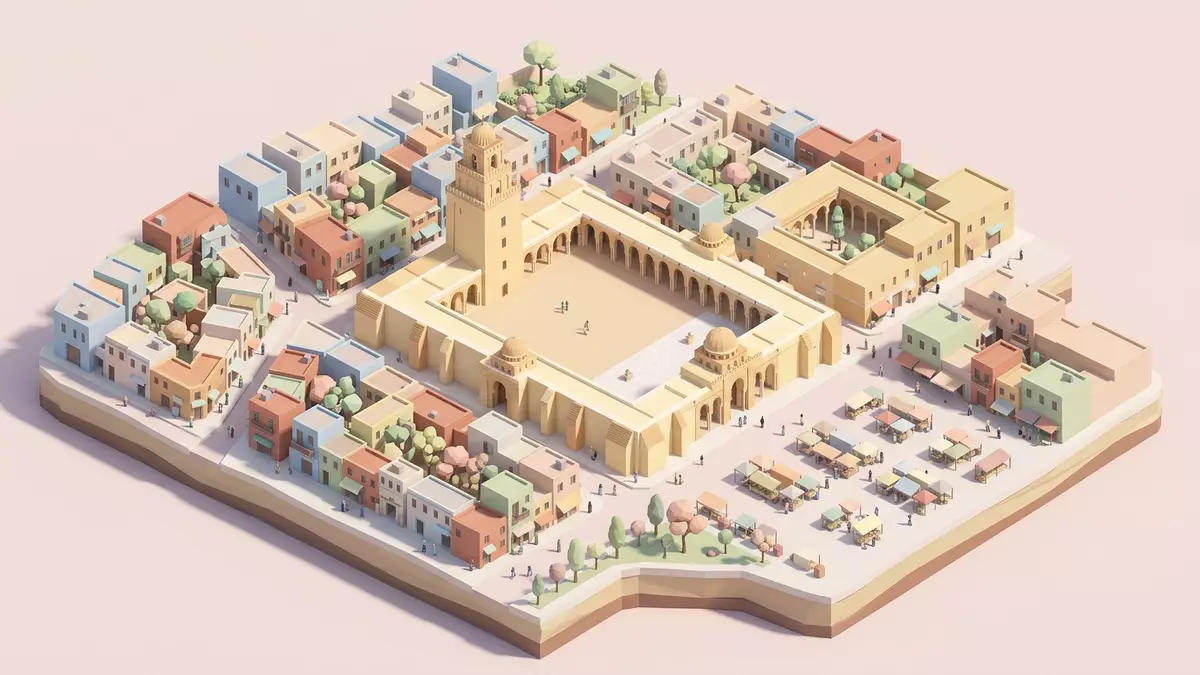
The Great Mosque of Kairouan in central Kairouan, Tunisia, is a vast stone complex where a broad courtyard and a deep hypostyle prayer hall define one of North Africa’s landmark Islamic spaces. Founded in 670 by the Arab general Uqba ibn Nafi at the birth of the city, the mosque took on much of its present monumental form in the ninth century under the Aghlabid dynasty, giving later Maghrebi architecture a durable model in stone.
A courtyard mosque born from early Islamic Kairouan
The Great Mosque of Kairouan stands in the old urban fabric of Kairouan, a city established as an early Islamic centre in Ifriqiya, roughly corresponding to modern Tunisia. The first mosque on this site was laid out around 670, when Uqba ibn Nafi founded the settlement and created an oratory that anchored religious and political life in the emerging city.Founded around 670 by Uqba ibn Nafi From the outset it functioned as a congregational, or Friday, mosque, gathering the city’s community for the main weekly prayer.
Over the following centuries, successive governors and dynasties rebuilt and enlarged the mosque, responding to Kairouan’s growth and the changing needs of the region. A major reconstruction in 703 under Hassan ibn Numan gave the complex a more substantial form in stone and brick.Rebuilding under Hassan ibn Numan in 703 The most decisive transformation, however, came in 836, when the Aghlabid emir Ziyadat Allah I ordered a comprehensive rebuilding that established the mosque’s overall plan and many of the features recognisable today.Aghlabid rebuilding by Ziyadat Allah I in 836
Stone, columns and the expanse of the courtyard
The complex occupies an irregular walled rectangle, with a footprint measuring on the order of 125 m by 75 m (410 ft by 246 ft).Overall rectangular plan around 125 by 75 m Within this enclosure, the most striking external feature is the large stone-paved courtyard, edged by arcades and opening towards the prayer hall on one side. The paving and perimeter walls use local honey-coloured ashlar and rubble stone, giving the whole ensemble a warm, sandy tone that sits comfortably within the wider cityscape.Local honey-coloured ashlar and rubble stone
Inside, the prayer hall follows a hypostyle plan, its substantial roof carried on rows of reused antique columns and carved capitals drawn from earlier Roman and Byzantine buildings in the region.Prayer hall with hypostyle layout and reused antique columns The hall itself measures roughly 135 m by 80 m (443 ft by 262 ft), divided into multiple aisles that run towards the qibla wall where the mihrab marks the direction of Mecca.Hypostyle prayer hall dimensions and aisles At ground level, the contrast between the broad open courtyard and the forest of columns inside gives a clear sense of passing from the exposure of the exterior into the dense structural rhythm of the interior.
Aghlabid design and the mosque’s wider influence
The form seen today is largely an Aghlabid work, and under that ninth-century dynasty the Great Mosque of Kairouan became a reference point for later religious architecture in the Maghreb. The building integrates Roman, Byzantine and local North African elements, with spolia columns supporting new arches and a plan that balances a spacious courtyard against a deep prayer hall.Blend of Roman, Byzantine and Maghrebi elements For later builders in Ifriqiya and neighbouring regions, this stone mosque served as an archetype for congregational architecture.
Beyond its architectural role, the mosque long functioned as a centre of religious scholarship in Kairouan and contributed to the city’s profile as a major intellectual hub in medieval North Africa.Centre for worship and learning in medieval Ifriqiya Its continuity across several rebuilding campaigns, combined with the preservation of its broad plan and key structural elements, has made it an enduring monument of early Islamic architecture in the western Islamic world.
Visiting Great Mosque of Kairouan: what travellers from Western Europe should know
- The Great Mosque of Kairouan stands within the historic core of Kairouan in central Tunisia, reached overland from coastal cities such as Tunis and Sousse.
- The complex is set on level ground inside the old city walls, with movement between the courtyard and prayer hall involving steps and passageways beneath arcades.
- The official language is Arabic and the currency is the Tunisian dinar.
- Entry requirements depend on your nationality; UK travellers can check the FCDO travel advice at gov.uk/foreign-travel-advice, Irish travellers the Department of Foreign Affairs at ireland.ie.
Searching for Great Mosque of Kairouan on social platforms
These links open searches for Great Mosque of Kairouan on each platform.
Frequently asked questions about Great Mosque of Kairouan
Where is the Great Mosque of Kairouan located?
The Great Mosque of Kairouan stands in the historic centre of Kairouan in central Tunisia, within the old urban fabric of the city.
What should visitors expect when entering the complex?
Visitors encounter a large stone-paved courtyard enclosed by walls and arcades, leading into a hypostyle prayer hall supported by numerous antique columns.
What makes the Great Mosque of Kairouan distinctive among Islamic monuments?
Its early foundation in 670, Aghlabid rebuilding in stone and expansive courtyard-prayer hall plan made it a reference for later Maghrebi mosque architecture.


