
Great Mosque of Kairouan and its vast courtyard of columns
Published on 09/07/2026 at 16:37 | Editorial responsibility: Rafael Müller, Editor-in-Chief AD HOC NEWS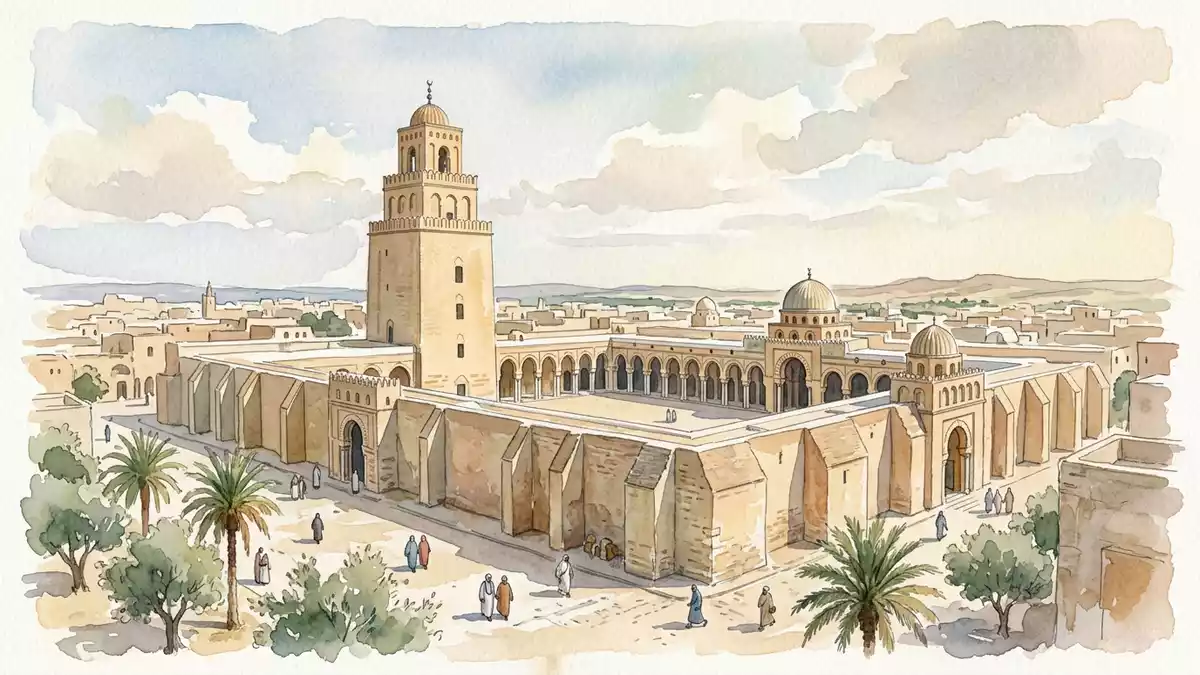
The Great Mosque of Kairouan in Tunisia is a vast stone complex where an open courtyard and a forest of columns define one of North Africa’s earliest major Islamic sanctuaries. Founded around 670 by the Arab general Uqba ibn Nafi and rebuilt on a larger scale in the ninth century, it stands at the heart of Kairouan as a congregational mosque and historical landmark of the Maghreb.
An early Islamic sanctuary shaped in the Aghlabid period
The Great Mosque of Kairouan, also known as the Mosque of Uqba, traces its origins to the foundation of Kairouan in the seventh century during the Arab expansion into Ifriqiya.Founded by Uqba ibn Nafi around 670, it was established as the main Friday mosque for the new garrison town. Early versions of the building were modest, and successive governors enlarged and rebuilt the sanctuary to accommodate a growing urban community and its religious life.A sequence of renovations in the seventh and eighth centuries gradually transformed the mosque’s footprint.
The form seen today belongs largely to the Aghlabid period in the ninth century, when Emir Ziyadat Allah I ordered a comprehensive rebuilding in durable materials such as stone and brick.Between the 820s and 830s the mosque assumed its current plan, with a monumental courtyard, hypostyle prayer hall and imposing minaret. Later Aghlabid rulers added further refinements, but the ninth-century work set the overall architecture that continues to characterise the site.
A courtyard, hypostyle hall and square minaret in stone
The mosque occupies a substantial area within Kairouan’s urban fabric, enclosed by fortified stone walls that frame an interior defined by open space and colonnaded halls.At its core lies a large central courtyard paved in stone, bordered on several sides by arcades. The arcades are carried on reused antique columns and capitals, many taken from earlier Roman and Byzantine structures, so the surfaces display a mixture of styles and carved motifs.
On the southern side of the courtyard stands the hypostyle prayer hall, where rows of columns support a timber roof punctuated by domes at key points, including above the mihrab bay.The hall’s plan, with many supports arranged in orthogonal rows, became a model for mosque design in the Maghreb and al-Andalus. The minaret, rising from the courtyard on a massive square base, is built in three stacked tiers and constructed in ashlar masonry, giving it a solid, tower-like presence that overlooks the surrounding city.
Kairouan, scholarship and the wider Maghreb
Kairouan developed into a major intellectual centre of North Africa during the early Islamic centuries, and the Great Mosque played a central role in that history.The complex functioned both as a congregational mosque and as a place of learning, associated with scholars of theology, law and Arabic language. Within the precinct, side rooms and galleries once housed teaching circles and manuscript activities linked to the city’s religious schools.
Architecturally, the mosque became an influential reference point for religious buildings across the Maghreb and in parts of Islamic Spain.Kairouan is inscribed on the UNESCO World Heritage List, with the Great Mosque highlighted as a major monument of Islamic architecture. Elements such as the horseshoe arches, the square minaret and the composition of courtyard and hypostyle hall reappear in later mosques of Tunisia and Morocco, carrying forward forms tested and refined in Kairouan.
Visiting Great Mosque of Kairouan: what travellers from Western Europe should know
- The Great Mosque of Kairouan stands inside the historic medina of Kairouan in central Tunisia, reached overland from coastal cities such as Sousse or Tunis.
- Within the complex, the large courtyard is open under the sky, while the prayer hall is entered from arcades; surfaces are stone-paved and there are steps between levels.
- The official language is Arabic and the currency is the Tunisian dinar.
- Entry requirements depend on your nationality; UK travellers can check the FCDO travel advice at gov.uk/foreign-travel-advice, Irish travellers the Department of Foreign Affairs at ireland.ie.
Searching for Great Mosque of Kairouan on social platforms
These links open searches for Great Mosque of Kairouan on each platform.
Frequently asked questions about Great Mosque of Kairouan
Where is the Great Mosque of Kairouan located?
The Great Mosque of Kairouan stands within the old city of Kairouan in central Tunisia, enclosed by the medina’s streets and traditional houses.
What can visitors expect inside the mosque complex?
Visitors encounter a large stone courtyard, surrounding arcades with reused antique columns and a hypostyle prayer hall whose interior is structured by rows of supports.
What makes the Great Mosque of Kairouan distinctive among Islamic monuments?
Its early foundation, ninth-century Aghlabid reconstruction, square minaret and influential courtyard-and-hall layout give it a central place in Maghrebi mosque architecture.


