
Great Mosque of Kairouan and its stone courtyard of prayer
Published on 09/12/2026 at 08:45 | Editorial responsibility: Rafael Müller, Editor-in-Chief AD HOC NEWS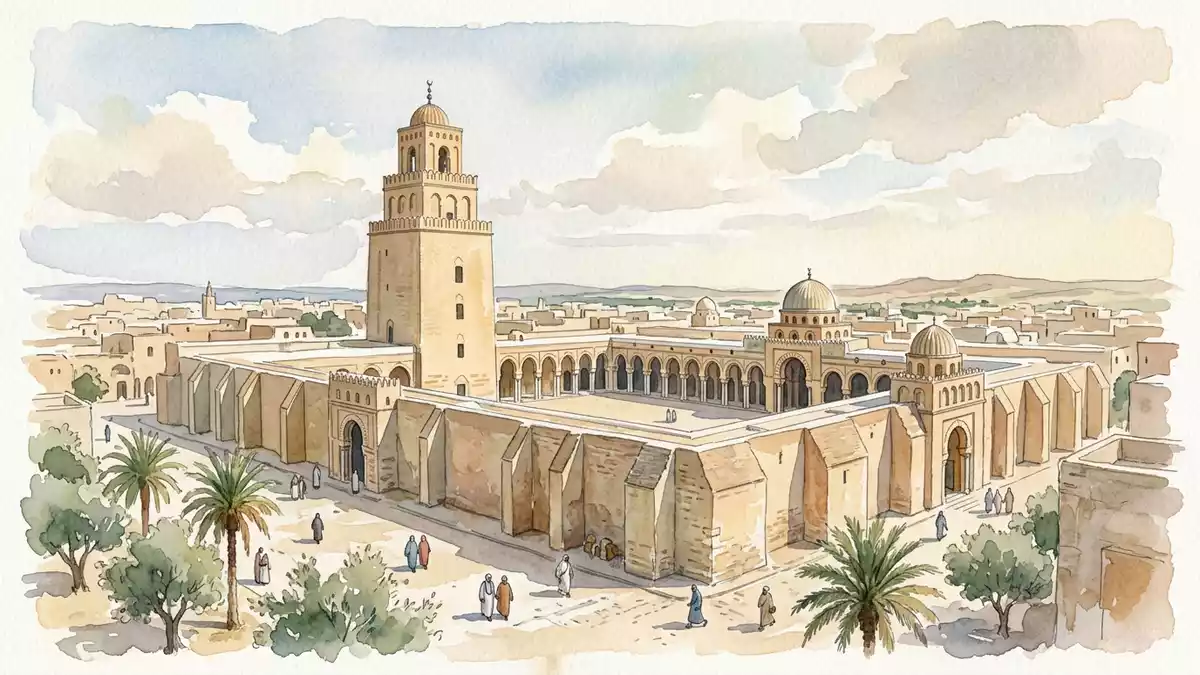
The Great Mosque of Kairouan in Kairouan in Tunisia is a sprawling stone sanctuary whose broad courtyard, hypostyle prayer hall and square minaret helped define Maghrebi mosque architecture in the ninth century.
A congregational mosque rooted in early Islamic Kairouan
The Great Mosque of Kairouan, also known as the Mosque of Uqba, stands in the historic medina of Kairouan as a major congregational mosque for the city and a landmark of Islamic North Africa.Great Mosque of Kairouan Tradition associates its foundation with the Arab general Uqba ibn Nafi, who established an early oratory on this site around 670 CE as part of the first Muslim foothold in the Maghreb.foundation around 670 CE In the ninth century the Aghlabid ruler Ziyadat Allah I ordered a complete rebuilding, giving the mosque much of the form visitors see, with substantial stone walls and carefully organised interior spaces.rebuilt by Ziyadat Allah I in 836
Kairouan itself is recognised by UNESCO as a World Heritage town, with the Great Mosque forming one of its central monuments and contributing to the city’s status as an early centre of Islamic learning in the western Islamic world.Kairouan World Heritage listing Across the centuries the mosque served both as a place for Friday prayers and as a site where jurists and scholars taught, reinforcing its role within the religious and intellectual life of Ifriqiya under the Aghlabids.
A rectangle of stone: courtyard, prayer hall and minaret
The Great Mosque of Kairouan occupies a large rectangular enclosure of roughly 125 m by 75 m, set within the fabric of the medina but visually distinct through its robust perimeter walls and projecting minaret.rectangular plan 125 by 75 m The courtyard takes up much of the interior, paved in stone and framed by arcades on several sides, while the prayer hall attaches to its southern edge as a deep hypostyle space supported by rows of columns.courtyard and hypostyle hall Within those arcades, reused marble and porphyry columns from Roman and Byzantine buildings carry an assortment of carved capitals, giving the mosque a layered material history.
The square minaret, rising above the western side of the courtyard, is built in stepped stages that recall fortified towers and is frequently described as one of the earliest surviving minarets in the Islamic world.square minaret of Kairouan Inside the prayer hall, longitudinal aisles run towards the qibla wall, where the intricately adorned mihrab niche and a carved wooden minbar form a focal ensemble that has influenced later mosques in Tunisia and across the Maghreb.Maghrebi hypostyle complex
Materials, reused elements and Maghrebi influence
The fabric of the Great Mosque of Kairouan combines local stone with a significant number of spolia elements, including columns and capitals taken from antique Roman and Byzantine sites in the region.Roman and Byzantine spolia This reuse contributes to the visual richness of the hypostyle hall, where variations in column height, shaft material and capital carving create a dense interior landscape within the otherwise regular grid of the floor plan.hypostyle hall with reused columns The mosque’s mihrab is lined with carved and glazed panels, while the timber minbar preserves early Islamic woodwork of a kind rarely found intact.
Architecturally, the Great Mosque of Kairouan stands as a model for later Maghrebi congregational mosques, particularly in its arrangement of a large courtyard before a deep hypostyle hall and its use of a prominent square minaret at one side of the enclosure.model for Maghrebi mosques In Ifriqiya, many mosques built before the Ottoman period drew on its plan and decorative repertoire, reinforcing Kairouan’s status as an architectural school whose influence reached other centres such as Tunis and Fez.influence on Maghrebi identity
Visiting Great Mosque of Kairouan: what travellers from Western Europe should know
- The Great Mosque of Kairouan stands in the north-eastern part of the medina of Kairouan, with streets leading to its enclosure from the wider historic city.
- The complex rises a little above the surrounding urban fabric, and approaches involve crossing the paved courtyard and, where permitted, moving through colonnaded spaces.
- Kairouan is reached overland from other Tunisian cities; within the medina, movement to the mosque is on foot along narrow streets and passages.
- The official language is Arabic and the currency is the Tunisian dinar.
- Entry requirements depend on your nationality; UK travellers can check the FCDO travel advice at gov.uk/foreign-travel-advice, Irish travellers the Department of Foreign Affairs at ireland.ie.
Searching for Great Mosque of Kairouan on social platforms
These links open searches for Great Mosque of Kairouan on each platform.
Frequently asked questions about Great Mosque of Kairouan
Where is the Great Mosque of Kairouan?
The Great Mosque of Kairouan stands within the medina of Kairouan in central Tunisia, in the quarter traditionally known as Houmat al-Jami.
What should visitors expect on a visit?
Visitors encounter a large stone enclosure with a broad paved courtyard, surrounding arcades, a prominent square minaret and, where accessible, a deep column-lined prayer hall.
What makes the Great Mosque of Kairouan distinctive?
Its ninth-century Aghlabid rebuilding, extensive use of reused antique columns and its influence on later Maghrebi mosque architecture make it a key monument of Islamic North Africa.


