
Great Blue Hole and the ring of Lighthouse Reef
Published on 09/08/2026 at 14:07 | Editorial responsibility: Rafael Müller, Editor-in-Chief AD HOC NEWS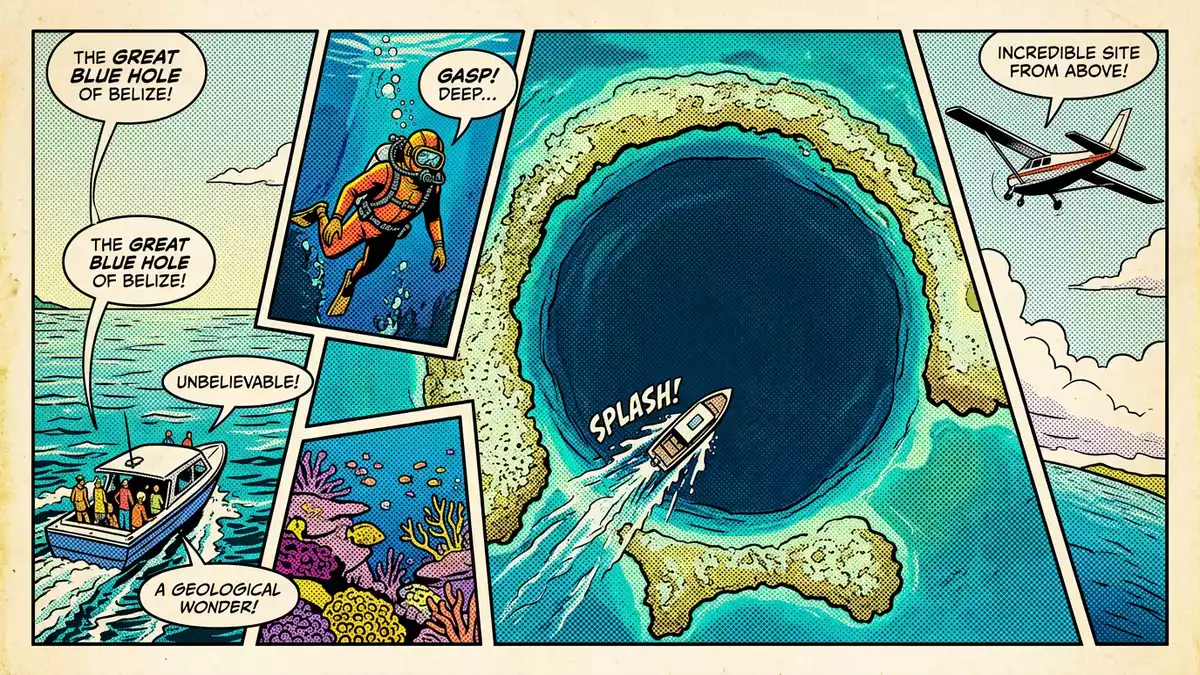
The Great Blue Hole is a flooded limestone sinkhole on Lighthouse Reef, part of Belize’s reef system. Its dark blue centre and pale reef rim make the scale visible at a glance.
Great Blue Hole beneath Lighthouse Reef
The site lies within the Belize Barrier Reef Reserve System, which was inscribed on the UNESCO World Heritage list in 1996UNESCO World Heritage list. The Great Blue Hole sits in Lighthouse Reef, one of the offshore atolls that form the wider protected reef complex.
It is roughly 318 m (1,043 ft) across and about 124 m (407 ft) deep318 m across. That combination of width and depth gives the place its striking circular profile, with steep walls descending into darker water.
Limestone, flooding and submerged walls
The sinkhole began as a limestone cave system, then filled when sea level rose and the roof collapsed. Stalactites still show that the cavity once formed above waterlimestone cave system.
This geological history places the Great Blue Hole in the karst landscapes of the Belize shelf, where soluble rock and changing sea level have left submerged voids and reef platforms. The place is part cave, part marine basin, and part reef-ringed landmark.
Belize, Cousteau and the modern name
Jacques Cousteau’s 1971 expedition helped bring the Great Blue Hole to wider attention, and the name has stayed attached to the site. The feature appears in the Belize Barrier Reef Reserve System under the Blue Hole Natural Monument designationBlue Hole Natural Monument.
That designation sits inside a larger chain of reef, lagoon and atoll environments along Belize’s coast. The Great Blue Hole remains the most recognisable single form within that system because its outline reads so clearly from the air and from the reef edgefrom the air.
Visiting Great Blue Hole: what travellers from Western Europe should know
- The Great Blue Hole lies off Belize, within Lighthouse Reef and the Belize Barrier Reef Reserve System. Reaching the area involves sea travel from the mainland or a flight and boat combination to the atolls.
- The site is a marine sinkhole, not a beach. Expect open water, reef surroundings and a steep underwater wall rather than a shallow lagoon.
- The water around the rim rests above limestone reef and coral, while the centre drops far below the surface. That contrast is the defining feature of the place.
- The official language is English and the currency is the Belize dollar.
- Entry requirements depend on your nationality; UK travellers can check the FCDO travel advice at gov.uk/foreign-travel-advice, Irish travellers the Department of Foreign Affairs at ireland.ie.
Searching for Great Blue Hole on social platforms
These links open searches for Great Blue Hole on each platform.
Frequently asked questions about Great Blue Hole
Where is Great Blue Hole?
It lies on Lighthouse Reef off Belize, within the Belize Barrier Reef Reserve System. The site is part of an offshore atoll environment.
What does a visit involve?
The place is viewed from boat or aircraft, and divers encounter open water above a deep limestone sinkhole. The reef edge and dark centre create the strongest visual contrast.
What makes Great Blue Hole distinctive?
The site combines a near-circular form, a limestone origin and UNESCO-recognised reef surroundings. Jacques Cousteau’s 1971 expedition is part of its modern identity.


