
Great Blue Hole and the deep circle of Lighthouse Reef
Published on 09/09/2026 at 19:11 | Editorial responsibility: Rafael Müller, Editor-in-Chief AD HOC NEWS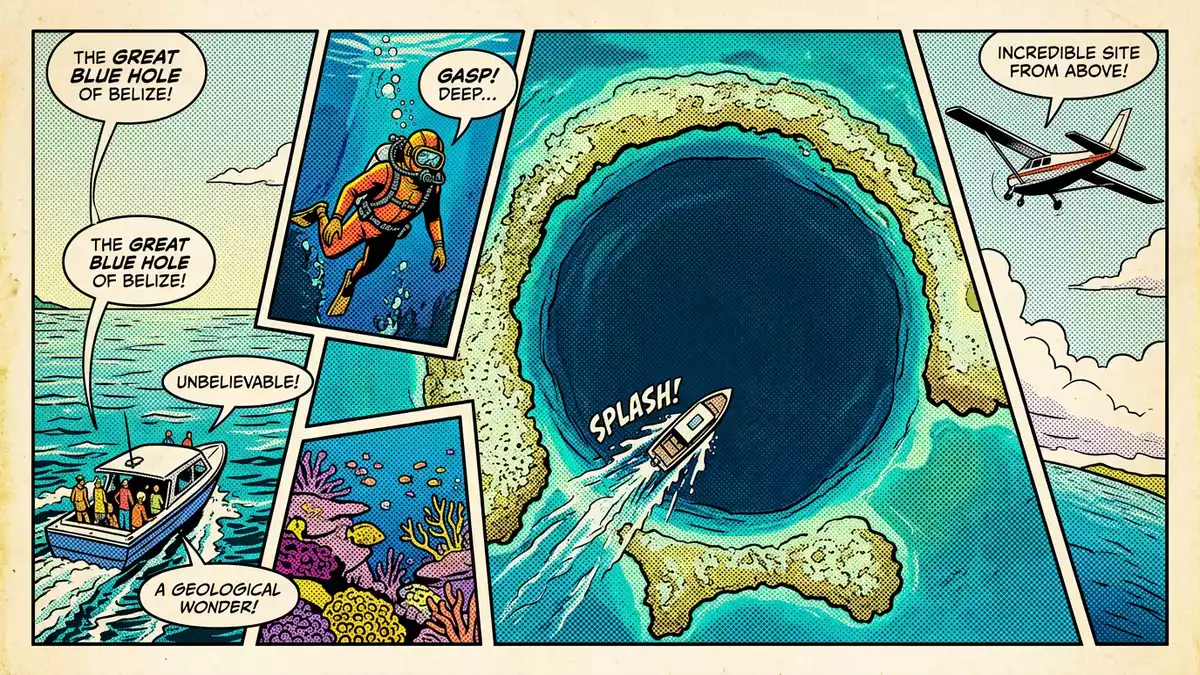
Great Blue Hole in Lighthouse Reef, Belize, is a vast marine sinkhole that interrupts the pale shallows of the atoll with a single, dark circular shaft of deeper water. Set within the wider Belize Barrier Reef Reserve System in the Caribbean Sea, it combines extreme depth with visible traces of an earlier limestone cave that collapsed and flooded during a period of lower sea level.
A circular sinkhole in the middle of an atoll
Great Blue Hole lies near the centre of Lighthouse Reef Atoll, an offshore coral ring east of mainland Belize in the western Caribbean Sea. From the air and from surrounding boats, it appears as a sharply defined circle of deep blue water framed by lighter turquoise reef flats and sandy shoals.Lighthouse Reef and the Great Blue Hole The surrounding waters of the atoll are shallow, while the sinkhole descends far below the lagoon floor, creating a strong visual contrast between its centre and its rim.
The formation is broadly circular and widely documented at over 300 m (around 1,000 ft) across, making it large enough to dominate the central part of the reef.over 300 metres across Depth measurements from geological surveys and dive expeditions converge on values a little above 120 m (about 400 ft), placing the base of the sinkhole far below the shallow coral gardens that surround it.depth of more than 120 m From above, the almost uniform dark tone of the centre reflects this abrupt change in depth.
Limestone origins and submerged cave features
Geologically, Great Blue Hole is a karst sinkhole formed in limestone, part of a longer history in which caves developed during times when sea level was significantly lower than at present. Analyses of stalactites and other speleothems recovered from inside the hole indicate that the cave system began forming during Quaternary glaciations, with episodes of growth at several points over the last 150,000 years.formation during Quaternary glaciation As climate conditions shifted and sea levels rose again, the roofs of parts of this cave system collapsed, and the resulting vertical shaft flooded with seawater.
The rock walls of Great Blue Hole preserve many of these earlier cave features. Divers report large limestone stalactites and overhangs at depth, hanging from former cave ceilings now submerged well below the surface.limestone stalactites and stalagmites The sinkhole can therefore be read as a cross?section through a collapsed cave, its circular outline marking the boundary where the roof once met the open lagoon. Above, shallow coral growth rims parts of the edge; below, the vertical walls drop sharply into darker water with more limited circulation.
Part of Belize’s World Heritage reef system
Although Great Blue Hole is visually distinct, it forms only one element within a wider protected marine landscape. It sits inside the Blue Hole Natural Monument, a designated area within Lighthouse Reef Atoll. Lighthouse Reef, in turn, belongs to the Belize Barrier Reef Reserve System, which was inscribed on UNESCO’s World Heritage List in 1996 as a large, diverse coral reef complex along the coast of Belize.Belize Barrier Reef Reserve System This system brings together several protected sites, including atolls, barrier reefs and coastal lagoons.
Within this context, Great Blue Hole provides a dramatic depth contrast amid otherwise shallow coral formations. The crest of reef around the sinkhole forms part of Lighthouse Reef’s coral structure, while the deeper interior lies below the levels at which most reef?building corals thrive.Blue Hole Natural Monument within Lighthouse Reef The wider reserve system includes brain and tube corals, seagrass beds and patch reefs, all of which frame the sinkhole and contribute to the ecological character of this part of the Caribbean Sea.
Visiting Great Blue Hole: what travellers from Western Europe should know
- Great Blue Hole lies near the centre of Lighthouse Reef Atoll in the Caribbean Sea, reached from Belize’s mainland by boat or aircraft crossing open water from the coast.
- The site is surrounded by shallow coral reef and sandy shoals, with approaches typically involving boarding vessels and moving across decks rather than walking long distances on foot.
- The official language is English and the currency is the Belize dollar.
- Entry requirements depend on your nationality; UK travellers can check the FCDO travel advice at gov.uk/foreign-travel-advice, Irish travellers the Department of Foreign Affairs at ireland.ie.
Searching for Great Blue Hole on social platforms
These links open searches for Great Blue Hole on each platform.
Frequently asked questions about Great Blue Hole
Where is Great Blue Hole located?
Great Blue Hole lies near the centre of Lighthouse Reef Atoll in the Caribbean Sea, off the coast of Belize in Central America.
What do visitors encounter at Great Blue Hole?
Visitors encounter a large circular marine sinkhole surrounded by shallow coral reef and sandy shoals, reached across open water from the Belize coast.
What makes Great Blue Hole distinctive?
Its combination of a broad circular outline, a depth of more than 120 m beneath a shallow atoll and preserved submerged cave features makes Great Blue Hole distinctive.


