
Great Barrier Reef, the vast coral world off Cairns
Published on 09/07/2026 at 07:42 | Editorial responsibility: Rafael Müller, Editor-in-Chief AD HOC NEWS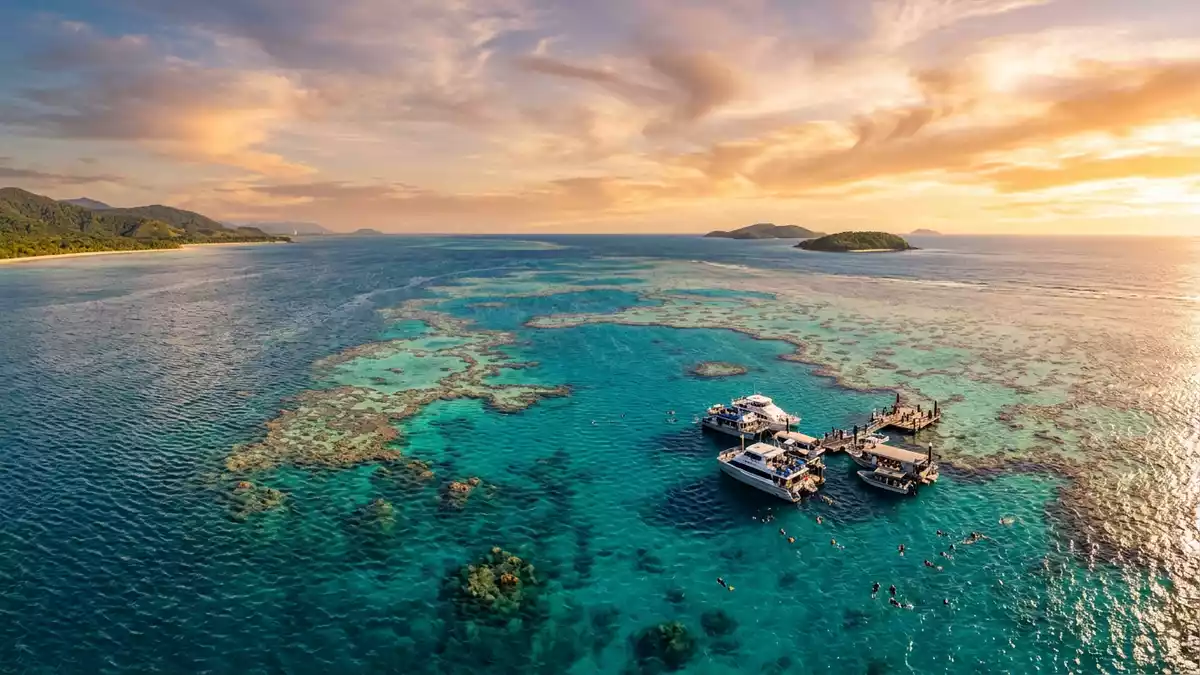
Off the coast of Queensland near Cairns lies Great Barrier Reef, a sprawling coral ecosystem that forms one of Earth’s largest continuous marine landscapes. It is recognised as a UNESCO World Heritage Site, inscribed in 1981 for its outstanding natural value and ecological richness.
A reef system on a continental scale
Great Barrier Reef occupies a broad swathe of the Coral Sea off north-eastern Australia, running roughly parallel to the Queensland mainland for more than 2,000 km (about 1,250 miles). This coral reef system covers in the region of 344,000 to 350,000 square kilometres, a marine area comparable in size to countries such as Germany or Japan.The reef’s overall area is set out in long-standing reference works.
The reef extends in a broad band that is typically between 60 and 250 km wide, separated from the Queensland coast by lagoons and channels of varying depth.Measurements of its width and length underline the way Great Barrier Reef reads as a marine province rather than a single site. Within this band lie thousands of individual reef formations and hundreds of islands, many of them accessible from coastal hubs such as Cairns and Port Douglas.
World Heritage status and ecological richness
In 1981 Great Barrier Reef was inscribed on the UNESCO World Heritage List as a natural site, meeting all four natural criteria recognised under the World Heritage Convention.The World Heritage listing describes the reef as the most extensive coral reef ecosystem on the planet. The inscribed World Heritage Area covers a contiguous latitudinal range from around 10°S to 24°S and includes most of the reef system and its associated habitats.
Biologically, Great Barrier Reef supports a wide variety of marine life. Surveys highlight several hundred types of coral, large numbers of fish species and thousands of mollusc species distributed across its reefs and islands.Descriptions of its biodiversity also emphasise that it provides habitat for species such as dugong and green turtle, which are threatened elsewhere. The reef’s scale and diversity make it a key reference point for marine science and conservation.
Experiencing the reef from Cairns
Cairns stands on the Queensland coast as one of the main urban gateways to Great Barrier Reef. From here, vessels travel eastwards into the Coral Sea to reach outer reef platforms, cays and coral-fringed islands. Approaching the reef by boat, travellers see the colour of the water shift across bands of blue and green as shallow coral structures alternate with deeper channels.
On the reef itself, activity tends to focus on simple, direct encounters with the marine environment. Common experiences include swimming above coral gardens with a mask and snorkel, viewing the underwater landscape through glass-bottomed boats, or descending to fixed underwater viewing areas built into some offshore structures. The physical character of the reef varies from flat-topped coral platforms to steeper slopes falling away into clearer, deeper water, with sandy patches and seagrass beds forming part of the wider seascape.
Visiting Great Barrier Reef: what travellers from Western Europe should know
- Great Barrier Reef lies off the coast of Queensland, with Cairns serving as a major departure point; boats and other marine transport link the city to offshore reef locations.
- Movement on reef sites frequently involves boarding and disembarking from vessels, walking on jetties or pontoons, and using ladders or steps between platforms and the sea.
- The reef environment is strongly maritime, with exposure to sun and salt water on open decks and swimming areas; conditions reflect a tropical coastal climate.
- The official language is English and the currency is the Australian dollar.
- Entry requirements depend on your nationality; UK travellers can check the FCDO travel advice at gov.uk/foreign-travel-advice, Irish travellers the Department of Foreign Affairs at ireland.ie.
Searching for Great Barrier Reef on social platforms
These links open searches for Great Barrier Reef on each platform.Frequently asked questions about Great Barrier Reef
Where is Great Barrier Reef in relation to Cairns?
Great Barrier Reef lies offshore in the Coral Sea, east of the Queensland coast, and is reached from coastal cities such as Cairns by marine transport.
What can travellers expect when visiting Great Barrier Reef?
Visits commonly involve boat travel to reef sites, time on floating platforms or islands, and opportunities to view coral and marine life in shallow, clear waters.
What makes Great Barrier Reef distinctive among marine destinations?
Its exceptional scale as a continuous coral reef system, its World Heritage designation since 1981 and its high biodiversity give Great Barrier Reef a distinctive position among marine environments.


