
Great Barrier Reef, a vast coral seascape off Cairns
Published on 09/16/2026 at 19:50 | Editorial responsibility: Rafael Müller, Editor-in-Chief AD HOC NEWS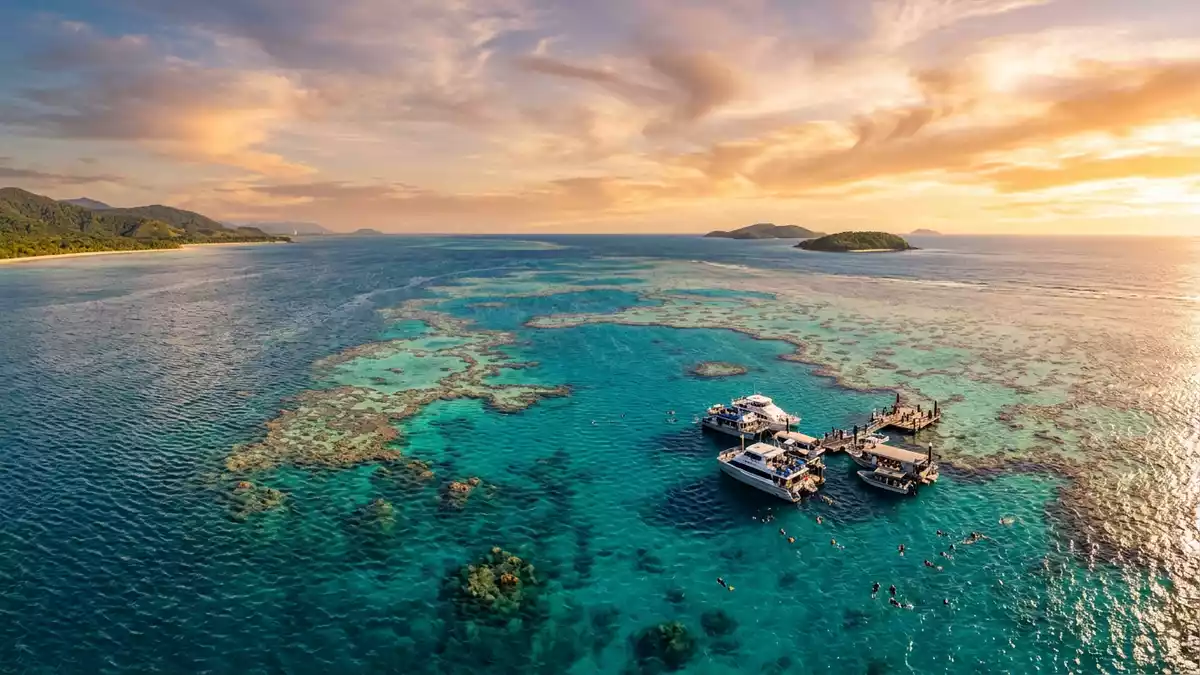
Off the coast of Queensland near Cairns, the Great Barrier Reef unfolds not as one site but as an immense coral seascape stretching for about 2,300 km (1,400 mi) along Australia’s north?east shore.extends across a distance of 2,300 km Inscribed as a UNESCO World Heritage Site in 1981, it is recognised as the world’s largest coral reef ecosystem.inscribed as World Heritage in 1981
An ecosystem of continental scale
The Great Barrier Reef occupies an area of around 344,400 km² (133,000 sq mi), a marine region larger than the United Kingdom and comparable in size to Japan.about 348,000 km² in extent Instead of a single continuous wall of coral, it comprises thousands of individual reef structures and a wide scatter of islands rising from the Coral Sea.composed of over 2,900 reefs From a boat or aircraft, this mosaic appears as pale turquoise shallows and darker channels, tracing parallel bands off the Queensland coast.
Within this expanse, reefs of different sizes sit on submerged platforms, separated by deeper passages used by shipping. Some reefs carry sandy cays with beaches and low vegetation, while others remain entirely submerged, visited only by marine life and divers. The World Heritage Area is divided into broad management zones, including the Cairns–Cooktown section that borders the mainland north and south of Cairns.Cairns–Cooktown management area
Life on the reef: corals, seagrass and marine species
The ecological richness of the Great Barrier Reef lies in the diversity of habitats layered across its area. Hard coral structures form the framework of the reefs, with hundreds of coral species growing as branching thickets, domes and layered plates that create surfaces for fish and invertebrates.world’s largest collection of coral reefs Between these reef formations, broad meadows of seagrass spread across sandy or muddy seabeds, providing feeding grounds for dugong and habitat for juvenile fish.seagrass meadows and dugong habitat
Mangrove forests line parts of the mainland and island shorelines within the World Heritage Area, their roots forming dense, sheltered margins that support crustaceans and birds. The reef system hosts thousands of mollusc species, hundreds of fish species and several species of marine turtles, including large green turtles that use reefs and surrounding islands for feeding and nesting.habitat of dugong and green turtle Seasonal migrations bring whales into the corridor along the reef, where some species use sheltered waters as breeding grounds.breeding grounds for humpback whales
Reef, coast and Cairns
Cairns sits on the Queensland mainland near the central portion of the Great Barrier Reef, serving as a convenient coastal base for visiting nearby reef systems and islands.located off the northeastern coast of Australia Offshore, coral structures and sand cays lie scattered across the Coral Sea, separated from the urban shoreline by stretches of blue water. Approaches to the outer reefs from Cairns cross shipping routes and pass low islands, before reaching zones of shallow coral platforms where vessels moor at fixed points.
Near Cairns, designated marine park areas are managed to balance conservation with recreation, including snorkelling, diving and guided trips on semi?submersible vessels. Platforms and pontoons anchored over selected reefs provide access to coral gardens without landing on delicate shorelines, while nearby islands offer beaches and walking tracks through coastal vegetation. The setting combines the infrastructure of a regional Australian city with views across mangrove?lined estuaries and offshore reef silhouettes.
Visiting Great Barrier Reef: what travellers from Western Europe should know
- The Great Barrier Reef lies off the north?east coast of Australia in the Coral Sea, with Cairns in Queensland providing a major gateway for reef tours by boat and aircraft.
- Trips from Cairns to reef sites involve travel over open water; visitors move between vessels, snorkel platforms and island jetties, with some access routes using ladders and steps.
- Many reef excursions include time on exposed decks and beaches, where shade may be limited and surfaces can be uneven underfoot because of sand, coral rubble and tidal pools.
- English is the official language and the currency is the Australian dollar.
- Entry requirements depend on your nationality; UK travellers can check the FCDO travel advice at gov.uk/foreign-travel-advice, Irish travellers the Department of Foreign Affairs at ireland.ie.
Searching for Great Barrier Reef on social platforms
These links open searches for Great Barrier Reef on each platform.Frequently asked questions about Great Barrier Reef
Where is the Great Barrier Reef in relation to Cairns?
The Great Barrier Reef lies offshore in the Coral Sea along Queensland’s coast, with Cairns on the mainland near its central section and acting as a major access point.
What can visitors expect on a trip from Cairns?
Visitors travel over open water to reach selected reefs or islands, spending time on boats, snorkel platforms and beaches with coral structures visible beneath clear shallows.
What makes the Great Barrier Reef distinctive among marine destinations?
Its continental scale, thousands of individual reefs, extensive seagrass and mangrove habitats, and World Heritage recognition combine into an unusually varied coral ecosystem.


