
Great Barrier Reef, a living seascape off Cairns
Published on 09/07/2026 at 10:05 | Editorial responsibility: Rafael Müller, Editor-in-Chief AD HOC NEWS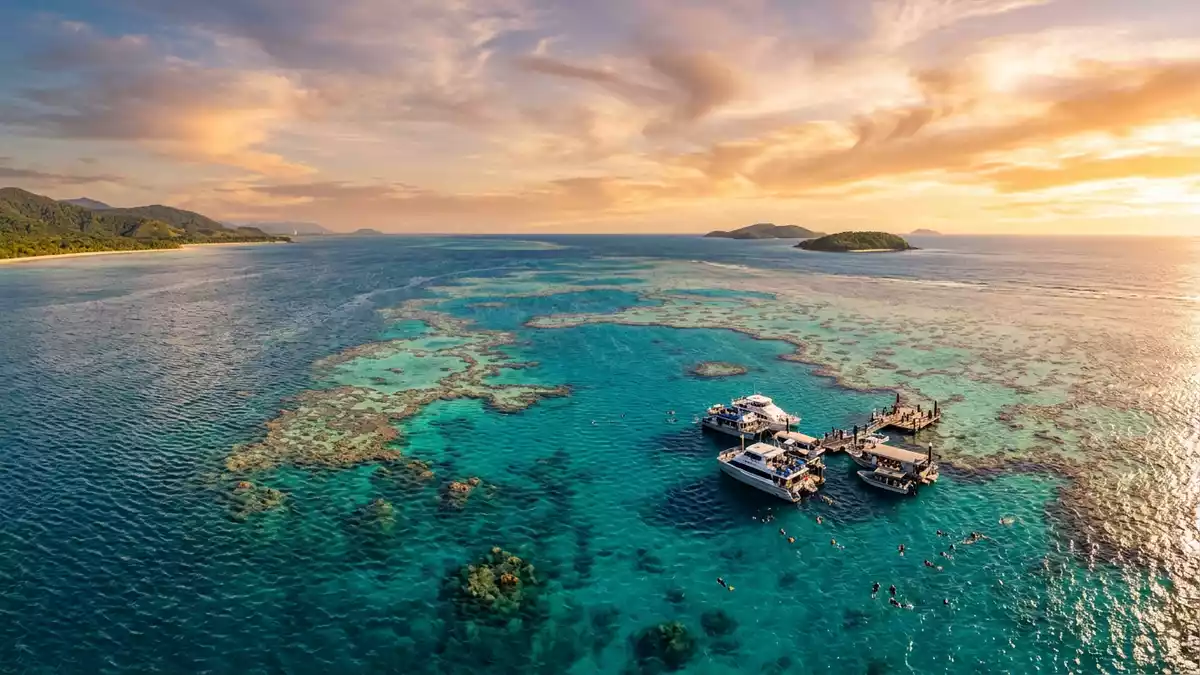
Great Barrier Reef lies off the coast of Queensland in north?eastern Australia, forming a vast coral and island system along the Coral Sea. It is recognised as a World Heritage property, inscribed in 1981 for its outstanding natural value and ecological scale.
A reef the size of a country
Great Barrier Reef extends for more than 2,000 km (around 1,250 miles) along the coast, running roughly northwest to southeast from the Torres Strait off Cape York Peninsula to waters near Lady Elliot Island north of Bundaberg.extends over a vast area Within this length, the World Heritage Area covers about 348,000 km², a marine landscape larger than many European countries.covering an area of 348,000 square kilometres
The reef lies offshore from the Queensland mainland, separated from the coast by lagoon waters and channels that vary from tens to more than a hundred kilometres wide.off the northeastern coast of Australia The city of Cairns sits opposite one of its central sections, and serves as a gateway to nearby reefs and sandy cays reached by boat and aircraft. From above, the system appears as bands and clusters of reefs, shoals and low islands set against deep blue ocean and pale lagoon water.
Coral architecture and island chains
Geologically, Great Barrier Reef occupies part of the continental shelf of Australia and is composed of thousands of individual coral structures growing on older foundations. The World Heritage datasheets describe more than 2,500 individual reefs and hundreds of associated islands within the protected area, ranging from small coral cays to larger continental islands.thousands of reefs and hundreds of islands Many of these rise only a few metres above sea level, formed from accumulated coral fragments and sand.
The reef environment includes shallow platforms, steep outer slopes and enclosed lagoons, with coral colonies branching, encrusting and forming massive rounded heads. Between them lie channels where boats navigate, and sandbanks that emerge at low tide. Some islands carry fringing reefs that wrap close to the shore, while others stand as isolated cays with sparse vegetation and surrounding shallow water that reveals intricate coral patterns when seen from the air.
An ecosystem of extraordinary diversity
Beyond its physical scale, Great Barrier Reef is defined by biological richness. The Australian government’s descriptions of the area emphasise that the ecosystem includes far more than coral alone, extending to seagrass meadows, mangrove forests, estuaries, wetlands, deep?water habitats and vegetated islands within the same marine region.ecosystem comprises much more than just coral These diverse environments support thousands of animal and plant species.
Coral reefs host a wide variety of bony fish, sharks and rays, along with invertebrates such as molluscs, crustaceans and sea stars. Seagrass areas provide feeding grounds for dugongs and green turtles, while islands offer nesting sites for seabirds. The World Heritage listing cites the reef under all four natural criteria, recognising its beauty, geological history, ecological processes and biodiversity.listed against all four natural criteria Traditional Owner groups along the Queensland coast have longstanding cultural connections to the reef seascape, reflected in knowledge systems and custodial practices linked to specific reefs, islands and sea country.
Visiting Great Barrier Reef: what travellers from Western Europe should know
- Great Barrier Reef lies off the coast of Queensland, with Cairns acting as a major access point; boat and aircraft tours reach nearby reefs and sandy cays from the city.
- Many reef sites are approached across open water, and landings may be on vessels, pontoons or low coral cays, so visitors encounter uneven surfaces, wet decks and, in places, basic jetty structures.
- The wider reef region stretches from Cape York Peninsula to waters near Bundaberg, with different zones administered as sections of the Great Barrier Reef Marine Park under Australian federal and state arrangements.
- The official language is English and the currency is the Australian dollar (AUD).
- Entry requirements depend on your nationality; UK travellers can check the FCDO travel advice at gov.uk/foreign-travel-advice, Irish travellers the Department of Foreign Affairs at ireland.ie.
Searching for Great Barrier Reef on social platforms
These links open searches for Great Barrier Reef on each platform.Frequently asked questions about Great Barrier Reef
Where is Great Barrier Reef in relation to Cairns?
Great Barrier Reef lies offshore in the Coral Sea along the Queensland coast, with Cairns positioned opposite one of its central sections used as a departure point.
What can visitors expect on a trip from Cairns?
Trips from Cairns reach selected reef sites or coral cays, where visitors encounter marine environments with coral formations, lagoon water, boat platforms and, in some cases, small low?lying islands.
What makes Great Barrier Reef distinctive among reef systems?
Great Barrier Reef stands out for its exceptional length, vast protected area and recognition as a World Heritage property meeting all four natural criteria for beauty, geology, ecological processes and biodiversity.


