
Great Aletsch Glacier sees record melt on 1 October
Published on 10/04/2026 at 01:53 | Editorial responsibility: Rafael Müller, Editor-in-Chief AD HOC NEWS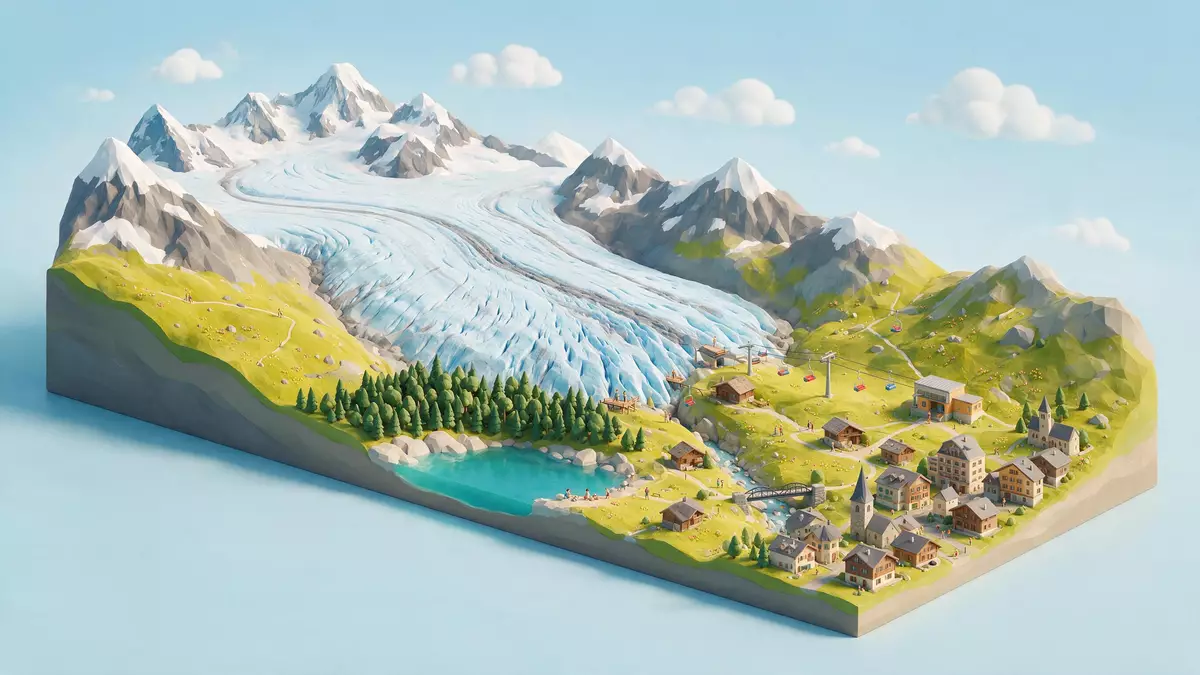
The Great Aletsch Glacier saw its greatest melt on record in 2026, according to findings published on 1 October 2026. The glacier above Fiesch is part of a wider Swiss monitoring programme that recorded exceptional ice loss after a winter with little snow and a hot, dry summer.
Record melt findings published on 1 October 2026
The Swiss Federal Institute for Forest, Snow and Landscape Research published the findings with the Swiss Commission for Cryosphere Observation. The report draws on measurements made on 23 Swiss glaciers during September 2026.
It says the Aletsch, Allalin, Clariden and Rhône glaciers experienced their greatest melt on record in 2026. At the lowest monitoring point on the Great Aletsch Glacier, at 1,980 metres above sea level, about 13 metres of ice disappeared during the measurement year.
The wider assessment found that Swiss glaciers lost 5.5 per cent of their ice volume in 2026. Individual glaciers lost between 2.5 and 4 metres of average thickness, while some glacier tongues lost up to 10 metres over the summer. The WSL findings published on 1 October link the losses to low winter precipitation and heatwaves between May and September.
What the record means for the Alpine glacier
The annual assessment covers the hydrological year from 1 October 2025 to 30 September 2026. Researchers found that the freezing level rose above 4,000 metres on 76 days between May and September, more than twice the average.
The Great Aletsch Glacier extends for about 20 kilometres and covers 79 square kilometres, according to the Aletsch Arena. Its ice begins near the Jungfrau region and flows towards the Massa Gorge, forming the dominant glacial feature of the surrounding protected landscape.
The glacier is within the Swiss Alps Jungfrau-Aletsch World Heritage Site, inscribed by UNESCO in 2001. The UNESCO description of the World Heritage site identifies the region as the most glaciated part of the European Alps and highlights its value for understanding Alpine formation.
The 2026 result gives the current visitor landscape a measurable context: the viewpoints around Fiesch show the glacier within a protected high-mountain area, while the monitoring report records how quickly its ice balance is changing.
Research puts Fiesch glacier views in context
The report also says Swiss glaciers lost about 2,200 billion litres of water between July and September 2026. That volume temporarily helps ease summer water shortages, although the report says this effect is diminishing as ice-covered areas shrink.
The findings do not announce a new closure or a changed entrance at the glacier. They instead provide a scientific update for visitors using the Aletsch Arena's established viewpoints and routes to observe the ice from above.
Visiting Great Aletsch Glacier: what travellers from Western Europe should know
- The relevant news date is 1 October 2026, when the monitoring findings were published. The measurements describe the 2026 season and include the Great Aletsch Glacier.
- The report announces no closure or access restriction. Visitors should therefore distinguish the scientific findings from any separate local trail or lift notice.
- Fiesch is a reference point for the glacier area in Valais, Switzerland. The Aletsch Arena provides access to viewpoints including Eggishorn, while the wider World Heritage landscape includes Riederalp and Bettmeralp.
- The glacier lies in high mountain terrain. Routes and viewpoints can involve steep ground, changing surfaces and exposure, so conditions must be assessed locally before setting out.
Searching for Great Aletsch Glacier on social platforms
These links open searches for Great Aletsch Glacier on each platform.
Frequently asked questions about Great Aletsch Glacier
When was the record melt reported at Great Aletsch Glacier?
The findings were published on 1 October 2026 and identified 2026 as the glacier's greatest melt year on record.
Where is Great Aletsch Glacier and how do you get there?
The glacier is in Valais, Switzerland, with Fiesch serving as a reference point for the Aletsch Arena and its mountain viewpoints.
What is Great Aletsch Glacier?
It is an approximately 20-kilometre-long glacier covering about 79 square kilometres within the Swiss Alps Jungfrau-Aletsch World Heritage Site.


