
Gravensteen and the stone stronghold of medieval Gent
Published on 09/24/2026 at 09:46 | Editorial responsibility: Rafael Müller, Editor-in-Chief AD HOC NEWS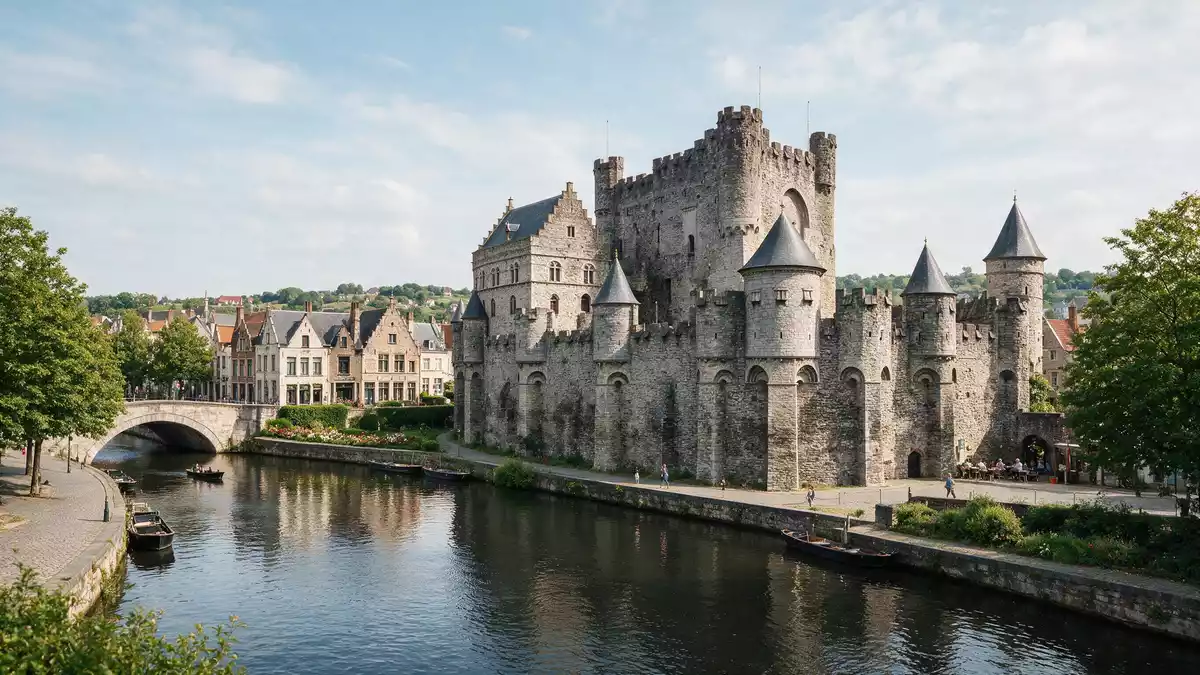
Gravensteen rises beside the Leie in central Gent as a compact stone fortress with walls, towers, battlements and a substantial central keep. The castle’s principal form dates from 1180, when Philip of Alsace was Count of Flanders, giving the city a surviving medieval stronghold at close quarters.
Its character comes from the contrast between a hard defensive exterior and the civic life of Gent around it. Stone masonry, narrow openings, enclosed passages and the open courtyard belong to a castle; the surrounding streets connect it with the city’s canals, squares and former trading districts.
Gravensteen’s fortress form in Gent
The castle is a fortified water castle, with a moat enclosing a walled complex. Its outer defences include projecting towers, a gate and a continuous wall with a battlement walk. The central keep forms the dominant mass within the enclosure.
Philip of Alsace rebuilt Gravensteen in the twelfth century. The completed stronghold became the residence of the Counts of Flanders until 1353, linking the building directly with the political history of medieval Flanders. The date 1180 remains part of the castle’s identity, recorded in the history of its present form through the 1180 foundation date.
From comital residence to civic institution
Gravensteen did not retain a single function throughout its history. After the Counts of Flanders moved their residence elsewhere, the building served as a court, a prison and a mint. Its rooms therefore belong to both aristocratic government and the administrative life of the city.
A later industrial use connected the complex with textile production. This change of function places the castle within Gent’s broader history, where medieval power, municipal institutions and cloth manufacturing occupied the same urban landscape. The sequence of uses is recorded in descriptions of the castle’s changing functions.
Stone, water and the Counts of Flanders
Gravensteen’s materials and layout communicate its military character without requiring reconstruction of medieval life. The moat places water directly beside the walls, while the gate controls access to the courtyard and the keep concentrates the castle’s vertical mass.
The design belongs to the fortified architecture of the late twelfth century. Its stern stone appearance has connections with castle forms associated with the Crusader states, a feature linked to Philip of Alsace and his journey to the eastern Mediterranean. The central keep and projecting towers remain the clearest elements of the complex’s silhouette.
Inside, the visit moves through spaces with different scales and functions: the courtyard, defensive routes, chambers and the keep. Exhibits present the castle’s political history and its association with medieval justice, including displays connected with punishment and imprisonment. The stone fabric remains the constant feature across these changing stories.
Visiting Gravensteen: what travellers from Western Europe should know
- Gravensteen stands at Sint-Veerleplein beside the Leie in central Gent. The city’s tram and railway network connect the castle area with Gent-Sint-Pieters station.
- The complex contains uneven stone surfaces, staircases and narrow defensive passages. The keep includes elevated viewpoints reached through internal stairs.
- The moat surrounds the castle walls, while the courtyard provides the main open space within the fortified enclosure.
- The official language is Dutch and the currency is the euro.
Searching for Gravensteen on social platforms
These links open searches for Gravensteen on each platform.
Frequently asked questions about Gravensteen
Where is Gravensteen?
Gravensteen is in central Gent, beside the Leie at Sint-Veerleplein. Its position places the castle within the city’s medieval street network.
What can visitors expect inside?
Visitors encounter a courtyard, defensive walls, staircases, chambers and the central keep. Displays explore the Counts of Flanders, medieval justice and the castle’s later civic uses.
What makes Gravensteen distinctive?
Its moat, stone walls, projecting towers and central keep form a complete fortified composition within an active city. The castle also preserves a visible link between a 1180 comital residence and Gent’s later institutional history.


