
Grande Mosquee de Djenne, Mali’s monumental earthen mosque
Published on 09/18/2026 at 14:51 | Editorial responsibility: Rafael Müller, Editor-in-Chief AD HOC NEWS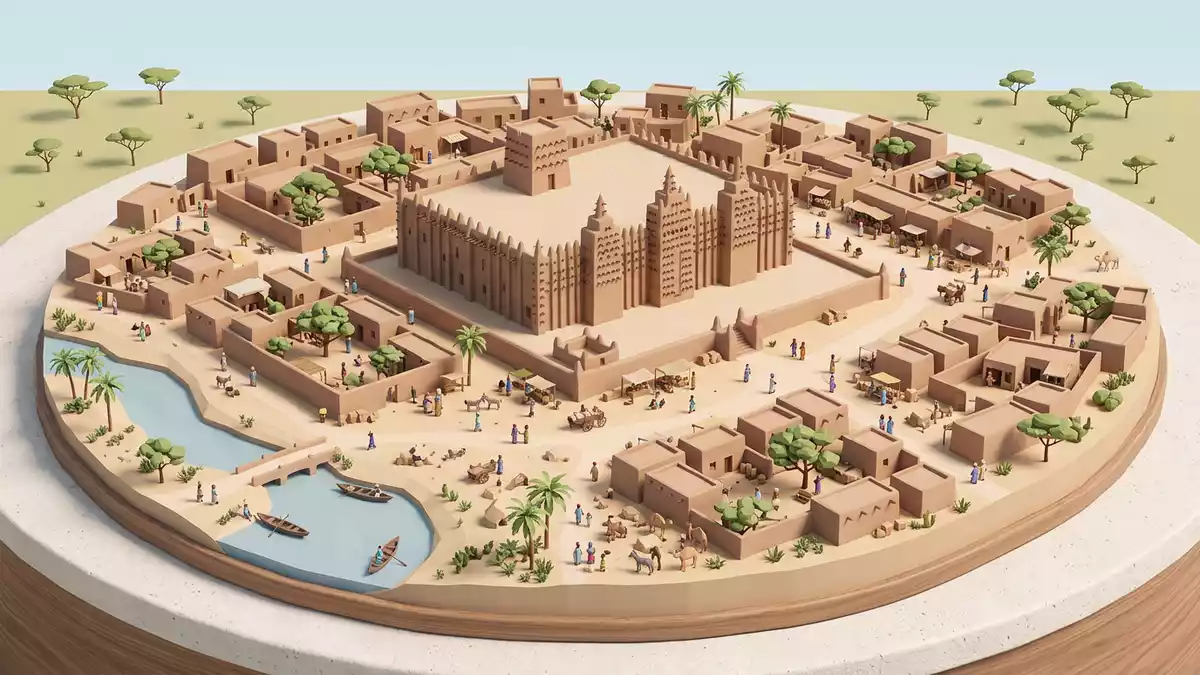
Grande Mosquee de Djenne, known in English as the Great Mosque of Djenné, is a vast earthen Friday mosque that dominates the old trading town of Djenne in central Mali. Its current form dates from 1907 and stands on a flood plain of the Bani River, continuing a tradition of Islamic worship and scholarship that reaches back to the thirteenth century.
An earthen giant in the heart of Djenne
Grande Mosquee de Djenne stands on a raised platform beside the market square of Djenne, in the Mopti Region of Mali, close to a branch of the Bani River that joins the Niger in the country’s inland delta.The mosque is located in Djenné, Mali This position places the building at the centre of a town that grew as a node in Saharan and Sahelian trade routes between the Niger valley and the wider Western Sudan.
The mosque is built almost entirely from earth, in a regional technique known as banco or adobe, with sun-dried mud bricks bonded by mud mortar and coated in a smooth earthen render.The building is a banco or adobe structure Bundles of palm timber project from the outer walls, forming a regular pattern of wooden elements that act as permanent supports for scaffolding whenever repairs are carried out.Palm timber projects from the mud walls The combination of earthen mass and projecting wood gives Grande Mosquee de Djenne a textured appearance that changes with the light and the season.
Sudano-Sahelian architecture and a twentieth-century reconstruction
Grande Mosquee de Djenne is a leading example of Sudano-Sahelian architecture, a style that blends Islamic religious forms with building traditions of the Sahel and savannah regions of West Africa.The mosque is a major Sudano-Sahelian monument Its overall mass is articulated by towers that rise above the main prayer hall and by buttresses that step out from the walls at regular intervals. Earthen pinnacles and small decorative elements give the upper silhouette a distinctive rhythm against the sky.
The present mosque was completed in 1907, replacing earlier structures on the same site that had fallen into disrepair during political changes in the nineteenth century.The current structure dates from 1907 Historical accounts link the earliest mosque here to the thirteenth century, when the ruler Koi Kunboro embraced Islam and supported the building of a congregational mosque for the town.An original mosque was built in the thirteenth century The 1907 reconstruction followed the general layout of its predecessors while using local guilds of masons and traditional materials, tying Grande Mosquee de Djenne into a long architectural lineage.
World Heritage status and a living place of worship
In 1988 Grande Mosquee de Djenne and the surrounding historic quarters were inscribed together on the UNESCO World Heritage List as the “Old Towns of Djenné”.Old Towns of Djenné were inscribed in 1988 This designation recognises both the mosque itself and the wider ensemble of earthen houses, tombs and archaeological sites that preserve the town’s role in the history of trans-Saharan trade and Islamic learning.UNESCO status covers the town and mosque The mosque has long served as Djenne’s principal Friday congregational mosque, linked to Qur’anic schools that operate in its vicinity and reinforcing its status as a religious centre.
Grande Mosquee de Djenne is also widely recognised as the largest mud-brick or adobe building in the world, a record that reflects both its footprint and the height of its earthen walls.The mosque is the largest adobe brick building Standing on its elevated platform above the surrounding square, the building forms a continuous backdrop to daily life in Djenne, from trading activity in the marketplace to religious observance inside the prayer hall.
Grande Mosquee de Djenne in the landscape of Mali
Djenne stands in central Mali, in a region shaped by waterways of the Bani and Niger that create an inland delta and seasonal floodplains. Grande Mosquee de Djenne rises from this landscape on a deliberately raised platform of compacted earth, lifting the base of the mosque above the surrounding ground.The mosque stands on a raised platform The platform forms a clear edge between the building and the square, and its sides act as broad steps, giving access from several directions.
The town’s historic core, with its earthen houses and narrow streets, extends away from the mosque in all directions, while the floodplain and channels of the Bani lie beyond.The mosque stands above a floodplain of the Bani River Seen from the marketplace, Grande Mosquee de Djenne presents long earthen walls punctuated by regular buttresses and towers, their surfaces marked by the projecting ends of palm beams. In the dry season the bare earth of the square and the pale tones of the mud walls sit under strong Sahelian light, emphasising the texture of the banco render.
Visiting Grande Mosquee de Djenne: what travellers from Western Europe should know
- Grande Mosquee de Djenne stands in the town of Djenne in central Mali, in the Mopti Region, reached by road connections from other settlements in the Bani and Niger river area.
- The mosque is built on a raised earthen platform above the market square, and accessing the base involves walking up broad packed-earth slopes and steps from the surrounding open space.
- Djenne lies near the Bani River within Mali’s inland delta, so approaching the town by road involves crossing low-lying terrain that can include causeways and bridges over seasonal channels.
- The official language is French and the currency is the West African CFA franc.
- Entry requirements depend on your nationality; UK travellers can check the FCDO travel advice at gov.uk/foreign-travel-advice, Irish travellers the Department of Foreign Affairs at ireland.ie.
Searching for Grande Mosquee de Djenne on social platforms
These links open searches for Grande Mosquee de Djenne on each platform.
Frequently asked questions about Grande Mosquee de Djenne
Where is Grande Mosquee de Djenne?
Grande Mosquee de Djenne stands in the town of Djenne in the Mopti Region of central Mali, on the flood plain of the Bani River near the Niger inland delta.
What should travellers expect when visiting the area around the mosque?
The mosque rises above a large market square on a raised earthen platform, surrounded by dense quarters of earthen houses and streets that reflect the town’s historic trading character.
What makes Grande Mosquee de Djenne distinctive among mosques?
Grande Mosquee de Djenne is an immense banco-built Friday mosque, completed in 1907 on thirteenth-century foundations and recognised as the largest adobe brick building in the world within a UNESCO-listed town.


