
Grande Mosquee de Djenne and its monumental earthen architecture
Published on 09/12/2026 at 21:58 | Editorial responsibility: Rafael Müller, Editor-in-Chief AD HOC NEWS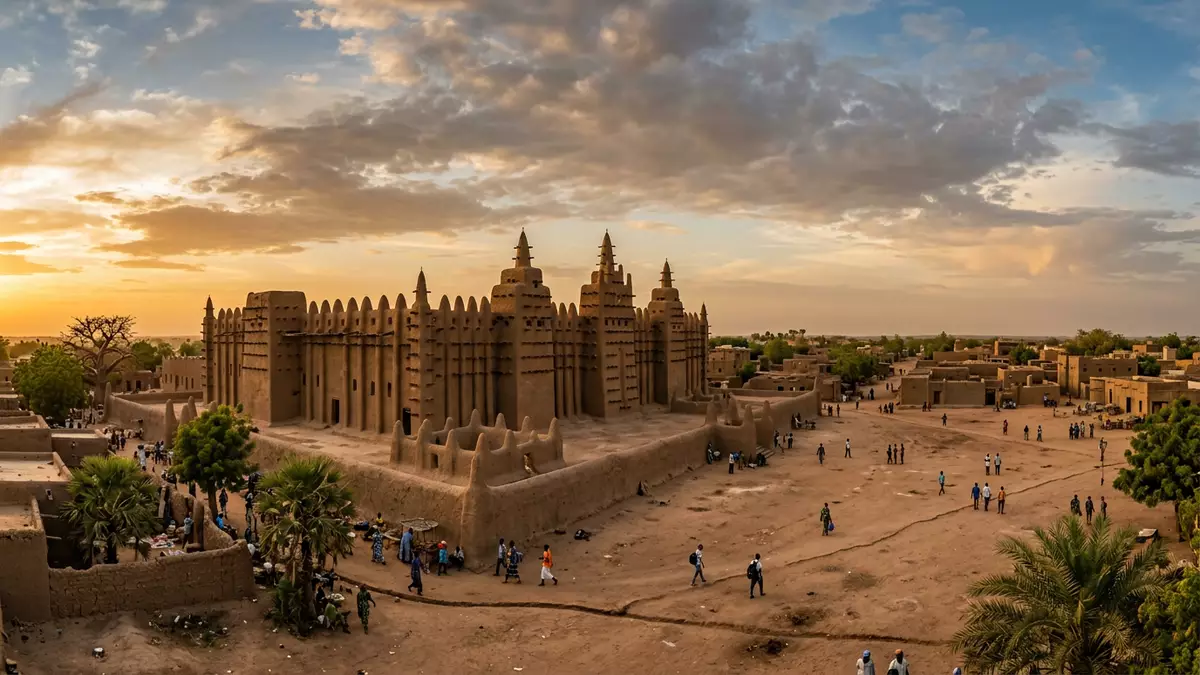
Grande Mosquee de Djenne, known in English as the Great Mosque of Djenné, dominates the old town of Djenne in central Mali with a vast mass of sculpted earth. Standing on a raised platform beside the floodplain of the Bani River, it is regarded as the largest mud-brick mosque in the world and a landmark of Sudano-Sahelian architecture. Completed in 1907 on the site of earlier mosques dating to the thirteenth century, it anchors a historic town whose core fabric and archaeological sites are recognised together on the UNESCO World Heritage List.
An earthen monument on the Bani floodplain
Grande Mosquee de Djenne stands within the inland Niger delta, in the Mopti Region of Mali, on a floodplain of the Bani River at the edge of Djenne’s historic centre. The present mosque occupies a rectangular platform raised above the surrounding market square, helping to keep its earthen walls clear of seasonal water from the river and nearby channels.raised platform Around it, dense streets of traditional houses, tombs and archaeological mounds form the ensemble protected as the “Old Towns of Djenné” on the World Heritage List.Old Towns of Djenné
The mosque itself is an adobe or banco structure built from sun-dried earth bricks bound with earth-based mortar and coated in a thick mud plaster. Its external walls rise to a substantial height and are punctuated by projecting buttresses, each capped with wooden elements that visually articulate the facade and provide fixing points for future repairs.mud-brick building The exposed timber beams that protrude from the earthen surfaces are part of the construction system and are a visible marker of the mosque’s earthen character.
Sudano-Sahelian design and community craftsmanship
Grande Mosquee de Djenne is a canonical work of Sudano-Sahelian architecture, the regional tradition that uses earth, timber and rectilinear forms to create large religious and civic buildings across the Sahel. The mosque’s tall corner towers and central facade elements, topped with finial-like details, frame a broad front wall that faces the town’s market square and shapes the urban space used for trading and social gathering.Sudano-Sahelian architecture Behind the facade, the prayer hall is supported by rows of thick earthen pillars and timber, forming a forest of heavy columns and shadowed aisles inside the mosque.
The building visible today was constructed between 1906 and 1907 under French colonial administration, drawing on local knowledge and supervised by Ismaila Traoré, head of Djenne’s guild of masons known as the barey ton.Ismaila Traoré and the barey ton Earlier mosques on the same site date back to around the thirteenth century, when Djenne’s first Muslim ruler commissioned an initial congregational mosque, but that medieval structure was later abandoned and fell into ruin.mosque founded in the thirteenth century The present Grande Mosquee de Djenne therefore combines colonial-era patronage with a much older lineage of local earthen construction and Islamic scholarship.
World Heritage status and living earthen architecture
Grande Mosquee de Djenne and the surrounding Old Towns of Djenné were inscribed together on the UNESCO World Heritage List in 1988, recognising both the mosque and the wider urban landscape of earthen houses, tombs and archaeological sites.UNESCO inscription in 1988 The property covers a series of archaeological sites, including Djenné-Djeno, Hambarkétolo, Kaniana and Tonomba, along with the historic fabric of Djenne itself, which is divided into multiple districts and retains a distinctive network of narrow streets and mud-walled compounds.serial World Heritage property
Within this protected townscape, Grande Mosquee de Djenne continues to function as the main Friday congregational mosque of Djenne, serving worshippers and religious schools clustered around its walls.main congregational mosque The mosque is constructed almost entirely from sun-dried brick and banco plaster, and its maintenance relies on periodic re-plastering carried out by local communities using traditional techniques.largest mud-brick structure In international architectural discourse it is frequently described as the largest mud-brick building in the world, and it has become a reference point for earthen construction, climate-adapted materials and the preservation of living architectural heritage in the Sahel.
Visiting Grande Mosquee de Djenne: what travellers from Western Europe should know
- Grande Mosquee de Djenne stands in Djenne in the Mopti Region of Mali, on the floodplain of the Bani River, reached from regional centres by road.
- The mosque rises on a raised earthen platform above the surrounding square, with steps leading up from the market area to its main entrances.
- The town of Djenne lies within the inland Niger delta, where access routes cross low-lying terrain influenced by seasonal water and river channels.
- The official language is French and the currency is the West African CFA franc.
- Entry requirements depend on your nationality; UK travellers can check the FCDO travel advice at gov.uk/foreign-travel-advice, Irish travellers the Department of Foreign Affairs at ireland.ie.
Searching for Grande Mosquee de Djenne on social platforms
These links open searches for Grande Mosquee de Djenne on each platform.
Frequently asked questions about Grande Mosquee de Djenne
Where is Grande Mosquee de Djenne located?
Grande Mosquee de Djenne is in the town of Djenne in the Mopti Region of Mali, on the floodplain of the Bani River within the inland Niger delta.
What can visitors expect when they come to Grande Mosquee de Djenne?
Visitors encounter a monumental earthen mosque on a raised platform beside a busy market square, with mud-brick walls, projecting timber beams and surrounding streets of traditional houses.
What makes Grande Mosquee de Djenne distinctive among mosques?
Grande Mosquee de Djenne is distinctive for its Sudano-Sahelian earthen construction, its status as one of the largest mud-brick mosques, and its integration into the UNESCO-listed Old Towns of Djenné.


