
Grande Mosquee de Djenne and its earthen towers
Published on 09/23/2026 at 17:14 | Editorial responsibility: Rafael Müller, Editor-in-Chief AD HOC NEWS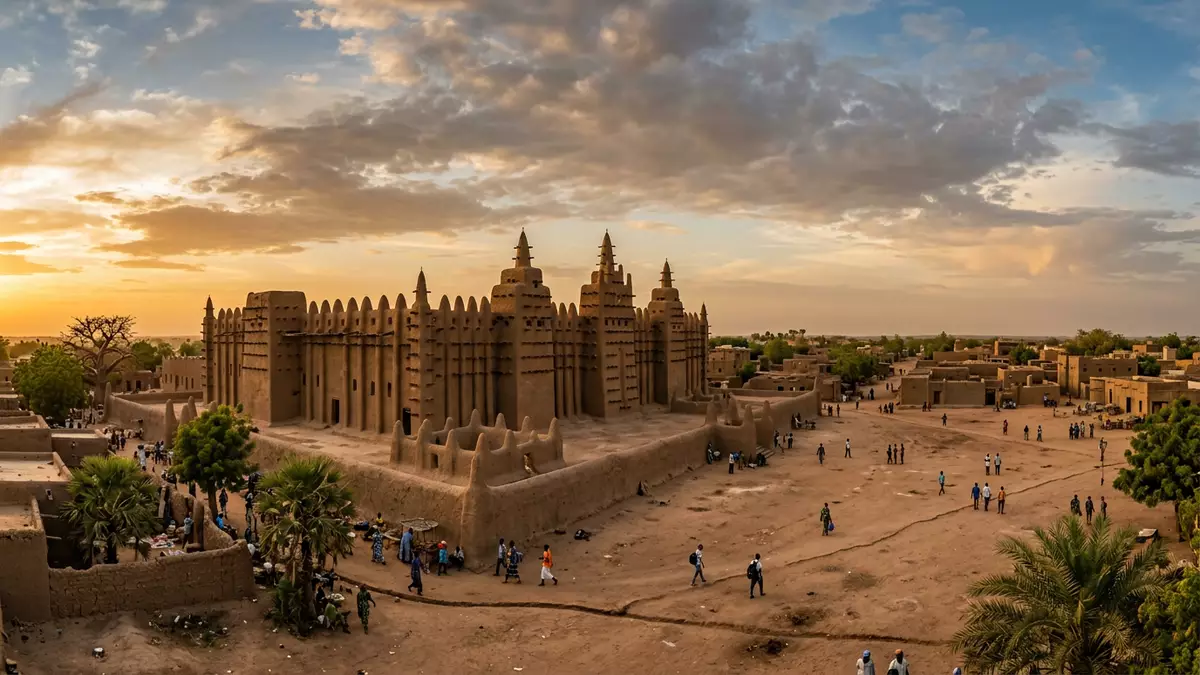
Grande Mosquee de Djenne rises from a raised platform in the centre of Djenne, Mali, as a broad mass of sun-dried earth and timber. Its walls, towers and projecting wooden beams form a distinctly sculptural silhouette, while the present building dates from 1907 and carries the architectural language of the Sudano-Sahelian tradition.
Grande Mosquee de Djenne: a monument shaped from earth
The mosque is built from mud brick covered with banco, a plaster made from earth. Its square plan measures about 75 metres on each side, and its walls gather into a stepped, pyramidal profile. The material is practical and visual at once: the building has the colour and texture of the surrounding Sahel, while its carefully formed surfaces create a powerful civic landmark.
Rows of toron, or wooden beams, project from the exterior walls. These elements are part of the mosque’s visible construction language and remain embedded in the façade as dark horizontal accents. Tall engaged pillars, crenellations and pointed upper forms complete the exterior, giving the earthen mass a strong vertical rhythm. the present building dates from 1907.
From thirteenth-century Djenné to the 1907 mosque
A mosque stood at Djenné from the thirteenth century, when the town was connected to trans-Saharan trade and Islamic scholarship. The first structure is associated with Koi Konboro, Djenné’s first Muslim ruler, whose conversion is placed in the thirteenth century. The medieval mosque disappeared as a physical building, but its place in the city’s religious history remains central.
Djenné flourished under the Mali Empire between 1300 and 1500, developing as a centre of commerce, Islamic faith and learning. The present mosque belongs to a different historical period: it was raised in 1907 during French colonial rule, using local earthen building traditions. The distinction between the medieval foundation and the visible twentieth-century structure is essential to understanding the monument. Djenné under the Mali Empire.
A living centre within the Old Towns of Djenné
Grande Mosquee de Djenne is a mosque before it is a museum object. Its prayer hall and courtyard belong to the religious life of the town, while the surrounding urban fabric preserves Djenné’s earthen architectural character. The building’s cultural meaning therefore rests on both its appearance and its continuing place within the city.
The mosque forms part of the Old Towns of Djenné, inscribed on the UNESCO World Heritage List in 1988. The designation covers a historic urban environment rather than an isolated monument, placing the mosque among streets, houses and public spaces formed through the same Sudano-Sahelian building culture. the Old Towns of Djenné.
The annual replastering of the mosque is associated with Djenné’s communal traditions of earthen maintenance. Mud surfaces require renewal, and the wooden toron provide visible points within the façade during this work. The ceremony connects architecture, religious practice and collective labour without separating the building from the town that sustains it.
Visiting Grande Mosquee de Djenne: what travellers from Western Europe should know
- Grande Mosquee de Djenne stands in central Djenne, on the flood plain of the Bani River. Road journeys from Mopti approach the town from the east, and shared taxis and buses connect the two towns.
- The mosque rises on a raised platform, with open public spaces and earthen streets around it. Walking surfaces in Djenne are formed from packed earth, and seasonal flooding belongs to the geography of the Bani plain.
- The official language is French and the currency is the West African CFA franc.
- Entry requirements depend on your nationality; UK travellers can check the FCDO travel advice at gov.uk/foreign-travel-advice, Irish travellers the Department of Foreign Affairs at ireland.ie.
Searching for Grande Mosquee de Djenne on social platforms
These links open searches for Grande Mosquee de Djenne on each platform.
Frequently asked questions about Grande Mosquee de Djenne
Where is Grande Mosquee de Djenne?
Grande Mosquee de Djenne is in central Djenne, Mali, on the flood plain of the Bani River. The town lies within the historic Old Towns of Djenné.
What can travellers expect at the mosque?
The exterior presents sun-dried mud brick, banco plaster, projecting toron, engaged pillars and crenellated details. The mosque remains a religious building within the town.
What makes Grande Mosquee de Djenne distinctive?
Its broad 75-metre square plan and earthen construction create a monumental form from local materials. The present structure dates from 1907, while mosque building at Djenné reaches back to the thirteenth century.


