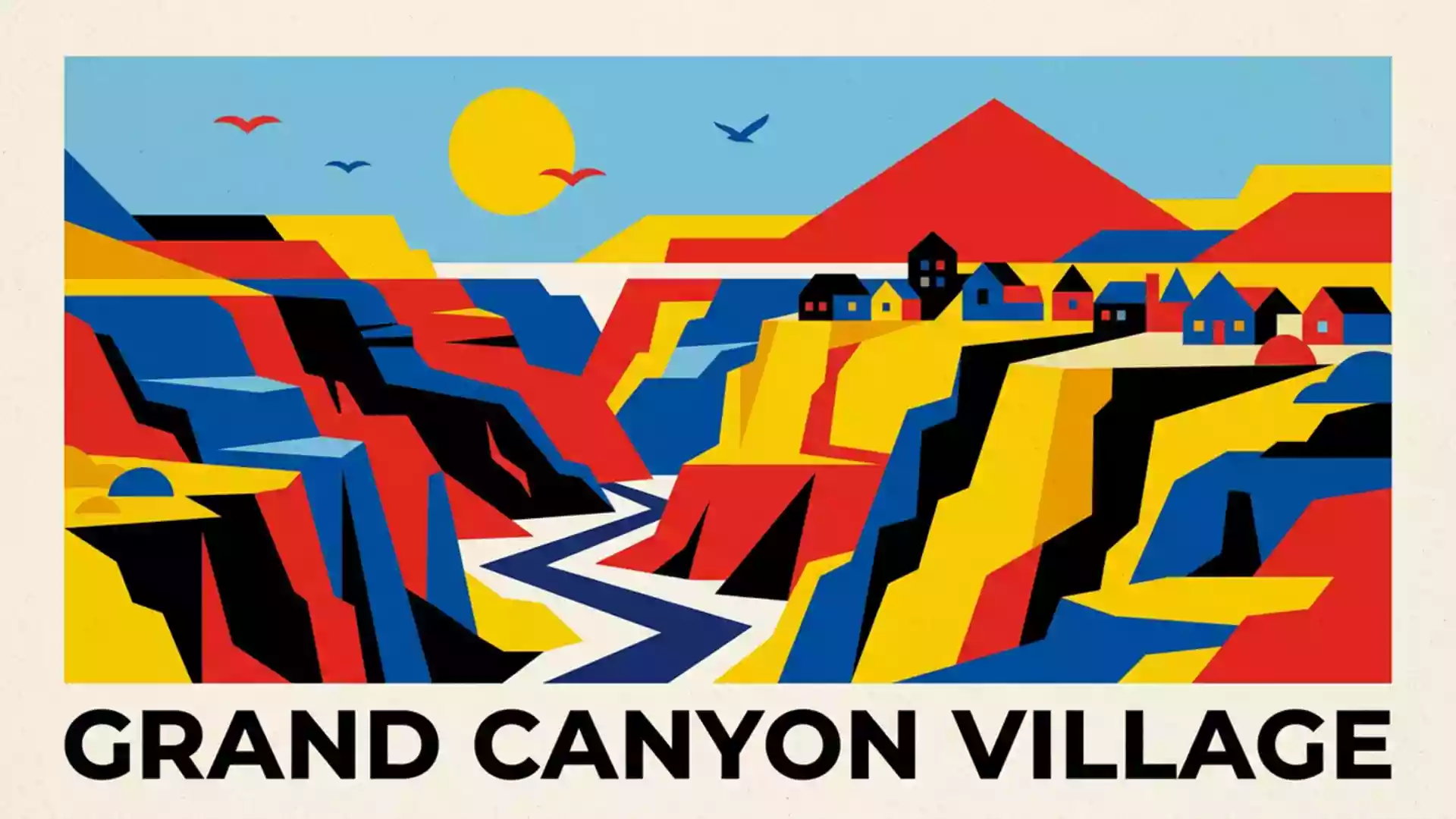
Grand Canyon’s vast chasm and layered cliffs from Grand Canyon Village
Published on 09/11/2026 at 18:25 | Editorial responsibility: Rafael Müller, Editor-in-Chief AD HOC NEWS
Grand Canyon stretches across northern Arizona as an immense river-cut gorge, with Grand Canyon Village sitting on the South Rim above walls of layered rock and the Colorado River far below. The landscape brings together a deep canyon, a high desert plateau and visible rock strata that record a long span of Earth’s history.
A canyon carved into the Colorado Plateau
Grand Canyon lies within Grand Canyon National Park in northern Arizona, where the Colorado River has cut down through the uplifted Colorado Plateau to form a twisting gorge. The park was established by the United States Congress in 1919 as a protected area for this canyon landscape and its surrounding ecosystems.Grand Canyon National Park in 1919 The canyon itself occupies a broad belt across the plateau, dividing it into the North Rim on the Kaibab Plateau and the slightly lower South Rim on the Coconino Plateau.North and South Rim plateaux
The gorge extends for roughly 277 miles (about 446 km) between Lees Ferry in the east and Grand Wash Cliffs in the west, with sections where the canyon is around 1.6 km (about 1 mile) deep and many kilometres wide.Length and depth of the gorge Near Grand Canyon Village the drop from rim to river is close to a vertical mile, giving views down into side canyons, cliffs and terraces that step towards the inner gorge.Vertical mile from rim to river From the South Rim, the Colorado River appears as a distant line at the base of the canyon, winding between buttes and mesas.
Rock layers and geological time on the South Rim
One of the most striking features visible from Grand Canyon Village is the succession of horizontal rock layers that form the canyon walls, recording around two billion years of geological history in cross-section. Dark, highly altered basement rocks such as Vishnu Schist form the base of the inner gorge, overlain by sedimentary packages that include Tapeats Sandstone, Bright Angel Shale and Muav Limestone of Cambrian age.Basement rocks and Tonto Group Above these lie thicker sequences including Redwall Limestone, Supai Formation, Coconino Sandstone, Toroweap Formation and Kaibab Limestone, which together build many of the pale cliffs and broader ledges seen from the South Rim.Paleozoic strata forming cliffs
The rock record in Grand Canyon spans all four major geological eras, from Precambrian to Cenozoic, with especially clear exposures of Proterozoic and Paleozoic formations that are significant for understanding Earth history.Strata representing four geologic eras At the South Rim near Grand Canyon Village, the land surface lies around 2,100 m (about 6,900 ft) above sea level on the Coconino Plateau, giving visitors views out across terraces and cliffs stacked in bands of buff, red and grey rock.South Rim elevation on the Coconino Plateau The canyon walls in this area drop almost 1,524 m (about 5,000 ft) from rim to river, emphasising the contrast between the high plateau surface and the deep, narrow inner gorge.Rim-to-river depth near the village
Grand Canyon Village and the South Rim setting
Grand Canyon Village forms the main visitor area on the South Rim, a developed community that includes lodges, shops and transport links along the canyon edge.Services at Grand Canyon Village It sits close to the rim on the Coconino Plateau, where roads, paths and viewpoints bring the plateau surface right to the canyon’s edge. From this balcony-like position, the land falls away towards terraces, cliffs and isolated rock formations rising from the canyon floor.
The surrounding South Rim environment is largely high desert, with sparse surface water and plants adapted to dry, sunny conditions on the plateau.High desert setting on the South Rim Within the park, museums such as the Yavapai Museum of Geology sit close to the rim and offer indoor vantage points onto this canyon landscape and its layered rock walls.Yavapai Museum of Geology at the rim Paths along the South Rim near Grand Canyon Village pass viewpoints where the Colorado River can be seen far below, and where the complex pattern of tributary canyons and mesas becomes apparent.
Visiting Grand Canyon: what travellers from Western Europe should know
- Grand Canyon lies in northern Arizona in the United States, with Grand Canyon Village on the South Rim reached by road from the surrounding region and connected to regional highways and nearby towns.
- The South Rim around Grand Canyon Village stands at roughly 2,100 m (about 6,900 ft) above sea level, and paths near the rim pass close to steep drop-offs into the canyon, with viewpoints along the edge.
- Trails that descend from the South Rim into Grand Canyon involve substantial changes in elevation, and the approach from rim to river covers several kilometres on foot with sections of sustained gradient.
- Nearby features include the Colorado River in the canyon below and points such as Yavapai Point along the South Rim, which offer further views into the gorge and towards rock formations.
- The official language is English and the currency is the United States dollar.
Searching for Grand Canyon on social platforms
These links open searches for Grand Canyon on each platform.Frequently asked questions about Grand Canyon
Where is Grand Canyon in relation to Grand Canyon Village?
Grand Canyon is a long gorge in northern Arizona, and Grand Canyon Village sits on its South Rim, close to the canyon’s edge on the Coconino Plateau.
What should visitors expect when viewing Grand Canyon from the South Rim?
From the South Rim near Grand Canyon Village, visitors see deep cliffs and terraces dropping towards the Colorado River, with broad views along the gorge and across layered rock walls.
What makes Grand Canyon distinctive as a landscape?
Grand Canyon combines a high desert plateau with a deep river-cut chasm, exposing rock layers that span around two billion years of geological history and forming a prominent canyon system carved by the Colorado River.