
Gobekli Tepe, the Neolithic hill of stone circles
Published on 09/17/2026 at 16:48 | Editorial responsibility: Rafael Müller, Editor-in-Chief AD HOC NEWS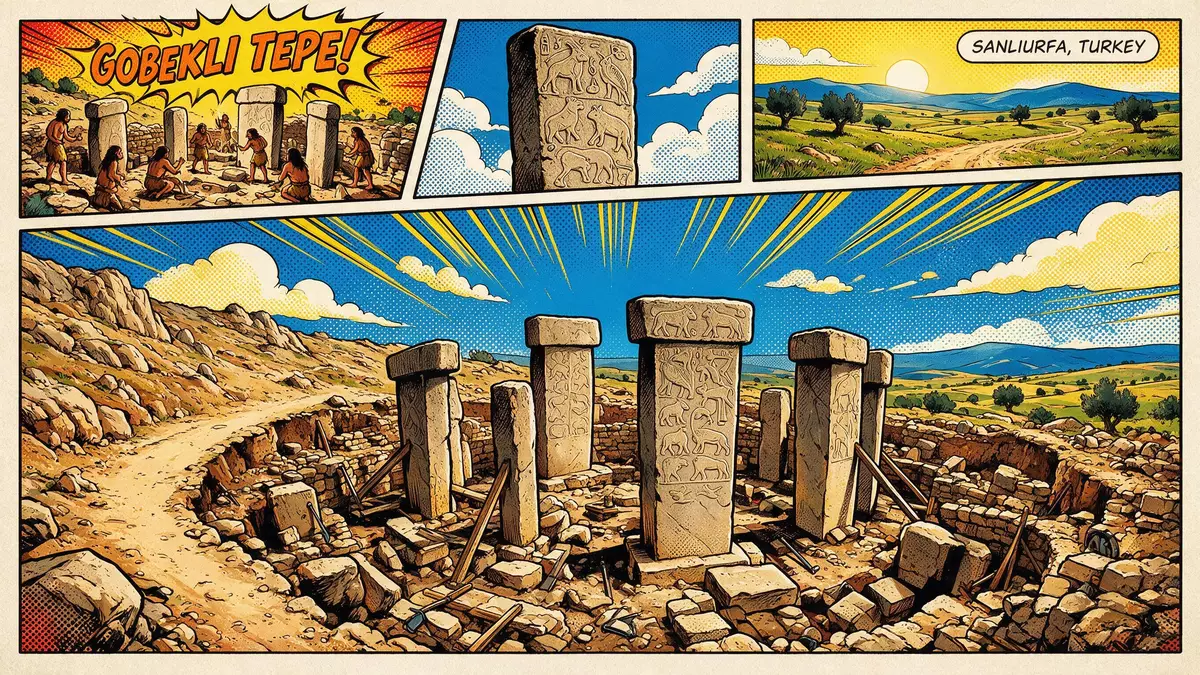
Gobekli Tepe, on a low ridge north-east of Sanliurfa in south-eastern Turkey, is a Neolithic sanctuary where rings of carved stone pillars rise from an artificial mound shaped by millennia of building and backfill. The site belongs to the Pre-Pottery Neolithic between roughly 9,600 and 8,200 BCE, making it one of the earliest monumental landscapes associated with hunter-gatherer communities in Upper Mesopotamia.
Stone circles carved at the dawn of settled life
At first sight Gobekli Tepe appears as a rounded hill broken into a series of excavated hollows, each revealing parts of broad stone enclosures cut into the ridge. Archaeological work has uncovered round and oval megalithic structures defined by a low stone wall containing a ring of monolithic pillars around a central pair, a layout that recurs across several levels of the mound.round-oval and rectangular megalithic structures The pillars are carved from local limestone, their upper ends taking a T-shape that gives the circles a distinctive profile against the cut bedrock and fill.massive T-shaped stone pillars
Most of these monoliths stand well over human height and some reach several metres, forming vertical accents in spaces otherwise defined by rock-cut floors and low walls. Many carry reliefs of wild animals, abstract symbols and stylised human forms, including belts and hands, carved directly into the stone surface. The enclosures belong to Pre-Pottery Neolithic A and B phases, broadly between 9,600 and 8,200 BCE, when agriculture and permanent settlement were only beginning to appear in the wider region.Pre-Pottery Neolithic A and B Together, the circles and carved pillars form an early example of large-scale stone architecture shaped by communities that did not yet rely fully on domesticated plants or animals.Neolithic site near ?anl?urfa
A Neolithic mound above Upper Mesopotamia
Gobekli Tepe stands on the highest part of an elongated ridge in the Germus mountains north-east of Sanliurfa, overlooking the plains that form part of ancient Upper Mesopotamia.Germu? mountains of south-eastern Anatolia The mound lies close to the village of Orencik in the Haliliye district, in a cluster of Neolithic sites sometimes referred to as Tas Tepeler, or “Stone Hills”, where low rises interrupt the otherwise open plateau.near the village of Örencik From the ridge the view stretches across agricultural land and further low hills, giving clear context for how the sanctuary sits in relation to the surrounding landscape.
The hill itself is largely artificial, built up by successive phases of construction, use and deliberate backfilling that turned the ridge into a rounded mound. Archaeological evidence indicates that the earliest monumental phase dates to around the tenth millennium BCE, with occupation and activity continuing into the ninth millennium before the site was abandoned.inhabited from about 9500 BCE to at least 8000 BCE The mound covers several hectares, with geophysical surveys indicating many more buried enclosures than the ones currently open, suggesting a long sequence of building episodes layered one above another.more than 200 pillars in about 20 circles
Discovery, excavation and World Heritage status
Although the ridge had long been visible, the significance of Gobekli Tepe as an early monumental sanctuary was recognised only in the late twentieth century. A detailed survey in the 1960s noted worked stones at the site, and systematic excavations began in 1994 under German archaeologist Klaus Schmidt, revealing the now well-known stone circles with their carved pillars.excavations began in 1994 Work since then has focused on selected enclosures, leaving other parts of the mound untouched for future study.
In July 2018 Gobekli Tepe was inscribed on the UNESCO World Heritage List as a property that demonstrates “one of the first manifestations of human-made monumental architecture”, underlining its importance for understanding early building and social organisation.Decision 42 COM 8B.34 Göbekli Tepe The designation emphasises the concentration of megalithic enclosures on the ridge and their dating to the 10th–9th millennia BC, a period when most communities in the region were still partly mobile.inscribed on the World Heritage List As a result, Gobekli Tepe now stands alongside other major archaeological sites recognised for their contribution to global heritage, while remaining part of a wider local landscape of Neolithic mounds around Sanliurfa.
Visiting Gobekli Tepe: what travellers from Western Europe should know
- Gobekli Tepe lies north-east of central Sanliurfa in south-eastern Turkey, close to the village of Orencik in the Haliliye district. It is reached on surfaced roads used by local traffic and excursion vehicles.
- The sanctuary sits on a ridge above surrounding fields, with approaches on foot that include slopes and paths across compacted soil and stone. Within the visitor zone, walkways and platforms stand above the excavated enclosures.
- The official language is Turkish and the currency is the Turkish lira.
- Entry requirements depend on your nationality; UK travellers can check the FCDO travel advice at gov.uk/foreign-travel-advice, Irish travellers the Department of Foreign Affairs at ireland.ie.
Searching for Gobekli Tepe on social platforms
These links open searches for Gobekli Tepe on each platform.
Frequently asked questions about Gobekli Tepe
Where is Gobekli Tepe?
Gobekli Tepe is on a ridge north-east of Sanliurfa in south-eastern Turkey, near the village of Orencik in the Haliliye district.
What should visitors expect on a visit?
Visitors encounter excavated Neolithic stone enclosures with T-shaped pillars, seen from raised walkways and platforms on a mound above the surrounding plains.
What makes Gobekli Tepe distinctive among archaeological sites?
Gobekli Tepe is distinctive for its concentration of carved megalithic circles dating to the 10th–9th millennia BCE, recognised as an early example of monumental stone architecture.


