
Gobekli Tepe’s carved circles above the Mesopotamian plain
Published on 09/16/2026 at 11:23 | Editorial responsibility: Rafael Müller, Editor-in-Chief AD HOC NEWS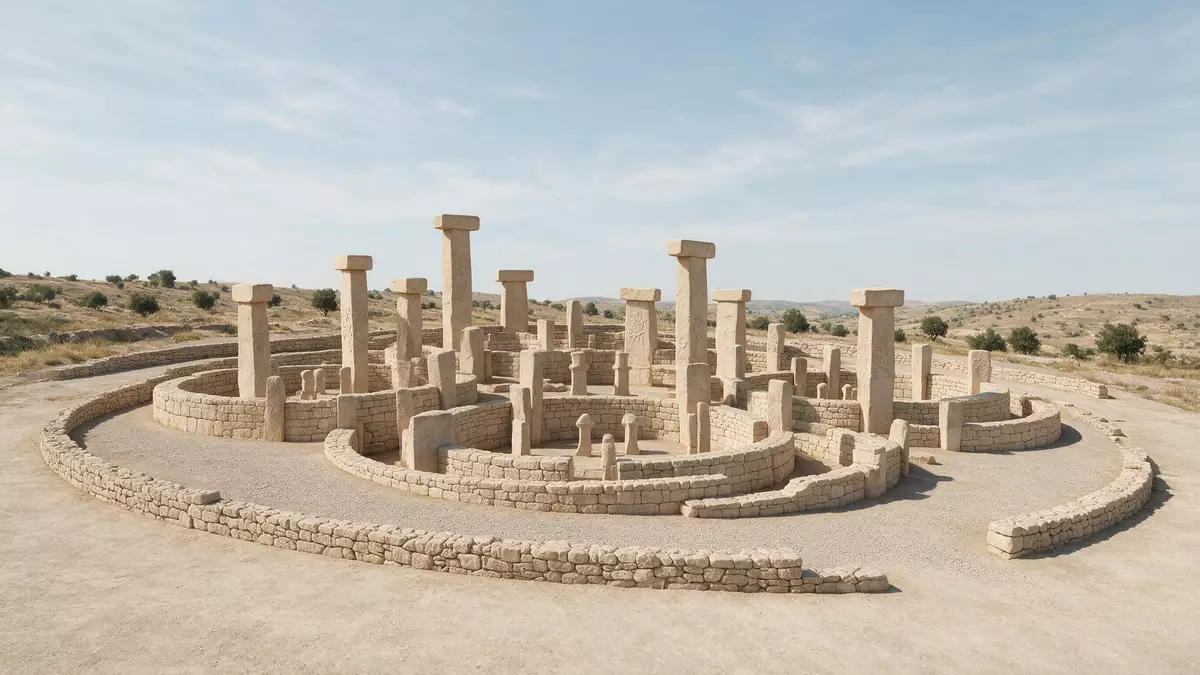
Gobekli Tepe on the outskirts of Sanliurfa is a low hill carrying a Neolithic sanctuary of carved stone circles that rise above the plains of south-eastern Turkey. Set in Upper Mesopotamia and dated to the Pre-Pottery Neolithic between the tenth and ninth millennia BC, it has become a key site for understanding how monumental architecture emerged long before settled farming communities.Pre-Pottery Neolithic
A stone hill of Neolithic enclosures
Gobekli Tepe occupies an artificial mound on a limestone ridge north-east of Sanliurfa, with the archaeological structures exposed near the summit of the hill.artificial mound northeast of Sanliurfa From the approach road the ridge rises gently from the surrounding plain, and the protective shelter covering the main excavated area marks the centre of the site against the wide Anatolian landscape.
Beneath the surface, excavations have revealed a series of stone-built enclosures laid out in circular and rectangular plans, each defined by massive T-shaped limestone pillars set in perimeter walls and around central pairs of uprights.large circular structures or enclosures These megaliths were carved and set in place by hunter-gatherer groups in the ninth and tenth millennia BCE, making them among the earliest known examples of monumental stone architecture anywhere in the world.among the earliest megaliths
Carved pillars and animal reliefs
The pillars at Gobekli Tepe are cut from the local limestone and shaped into T-forms, with the cross-piece resting on a vertical shaft to suggest stylised human figures. Many carry low-relief carvings of wild animals, abstract symbols and elements interpreted as belts and hands, creating an intricate sculptural programme across the enclosures.carved megaliths and animals Some pillars reach heights of around 5 m (16 ft), and the largest blocks weigh several tonnes, emphasising the scale of labour involved in shaping and erecting them.T-shaped limestone megaliths
The arrangement of pillars in circles and rectangles gives each enclosure a distinct spatial character, with central uprights facing one another across the space and ring walls punctuated by standing stones. Visitors walking along the raised paths today look down into these excavated structures, seeing the carved surfaces from above rather than standing among them, but the relationship between the central pair and the surrounding ring remains legible even at a distance.set of stone enclosures on a limestone ridge
From early discovery to World Heritage recognition
Gobekli Tepe entered wider archaeological awareness in the 1990s, when systematic excavation began on the hilltop and the extent of the buried stone architecture came to light.discovered near Sanliurfa Stratigraphic studies have since shown that the site was used over centuries between about 9,600 and 8,200 BCE, with successive phases of building and backfilling that created the mound visible today.inhabited from about 9500 to 8000 BCE
In July 2018 Gobekli Tepe was inscribed on the UNESCO World Heritage List, recognised as one of the earliest manifestations of human-made monumental architecture and as evidence that complex social organisation emerged among hunter-gatherer communities in Upper Mesopotamia.inscription on the World Heritage List in 2018 The World Heritage listing places the hilltop within a broader context of Neolithic sites across south-eastern Anatolia and reinforces its status as a key reference point for the study of the transition from mobile foraging groups to settled farming villages.oldest known megalithic structure in Upper Mesopotamia
Visiting Gobekli Tepe: what travellers from Western Europe should know
- Gobekli Tepe lies in Sanliurfa Province in south-eastern Turkey, on a limestone ridge north-east of Sanliurfa city, and is reached by road from the urban area.
- The archaeological zone sits on a hill at several hundred metres altitude, with walkways and terraces laid out above excavated pits, and surfaces varying between paved paths and exposed rock.
- The site is within Turkey; the official language is Turkish and the currency is the Turkish lira.
- Entry requirements depend on your nationality; UK travellers can check the FCDO travel advice at gov.uk/foreign-travel-advice, Irish travellers the Department of Foreign Affairs at ireland.ie.
Searching for Gobekli Tepe on social platforms
These links open searches for Gobekli Tepe on each platform.
Frequently asked questions about Gobekli Tepe
Where is Gobekli Tepe?
Gobekli Tepe is on a limestone ridge north-east of Sanliurfa in south-eastern Turkey, within Sanliurfa Province and Upper Mesopotamia.
What can visitors expect at the site?
Visitors encounter excavated Neolithic stone enclosures with T-shaped carved pillars, viewed from raised walkways under a protective shelter above the hilltop.
What makes Gobekli Tepe distinctive?
Gobekli Tepe is distinctive as a Pre-Pottery Neolithic sanctuary of monumental stone architecture dating to the tenth and ninth millennia BC and recognised as a UNESCO World Heritage Site.


