
Gobekli Tepe and the stone circles of early belief
Published on 09/12/2026 at 09:07 | Editorial responsibility: Rafael Müller, Editor-in-Chief AD HOC NEWS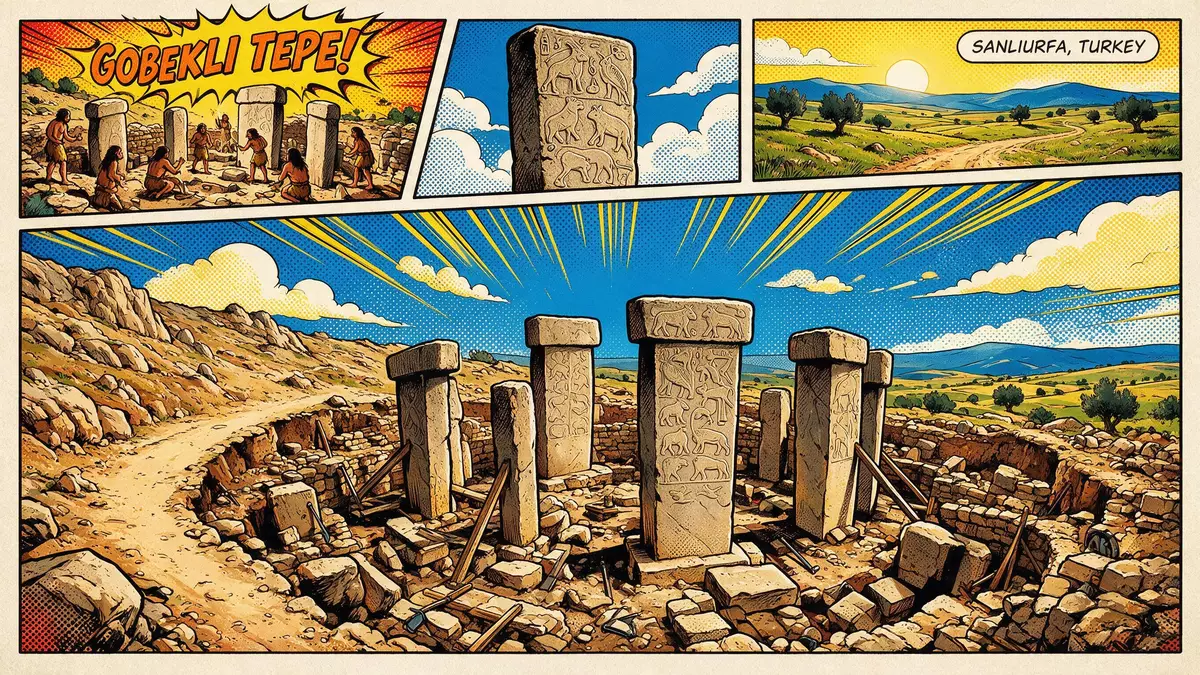
Gobekli Tepe in south-eastern Turkey is an early Neolithic hilltop site where circles of massive stone pillars rise from an artificial mound above the Mesopotamian plains. Dating to the Pre-Pottery Neolithic between roughly the tenth and ninth millennia BCE, it brings organised monumental architecture into view thousands of years before metal tools or ceramics.
A Neolithic sanctuary above the Mesopotamian plains
Gobekli Tepe lies on a limestone plateau in the Germus mountains of south-eastern Anatolia, north-east of the modern town of Sanliurfa and close to the village of Orencik.Gobekli Tepe lies some 15 km north-east of the modern-day town of ?anl?urfa The mound rises above the surrounding Harran plain, forming a conspicuous knoll in a landscape that once sat within the western arc of the Fertile Crescent.western part of what was considered the Fertile Crescent
The site belongs to Upper Mesopotamia, a region between the upper and middle reaches of the rivers Tigris and Euphrates where some of the oldest known farming communities later emerged.Upper Mesopotamia At Gobekli Tepe, however, the builders were still hunter-gatherers, and the monumental stonework represents activity by mobile groups rather than a settled village.
Monumental stone circles and T-shaped pillars
Archaeological work at Gobekli Tepe has revealed round-oval and rectangular megalithic structures, interpreted as enclosures, built in the Pre-Pottery Neolithic between about 9,600 and 8,200 BCE.megalithic structures erected by hunter-gatherers in the Pre-Pottery Neolithic age between 9,600 and 8,200 BCE The core of these enclosures is a pair of tall limestone monoliths with a distinctive T-shaped profile, encircled by smaller pillars linked by low stone walls.
Some of the standing stones reach heights of around 5 m (16 ft) and masses measured in tens of tonnes, placing them among the earliest known large megaliths in human construction.T-shaped limestone megaliths, some of which surpass 16 feet (5 metres) in height and weigh as much as 50 tons The pillars carry low-relief carvings of wild animals and abstract symbols, and geophysical surveys indicate that far more enclosures remain buried within the mound than the handful currently uncovered.More than 200 pillars in about 20 circles are currently known through geophysical surveys
From archaeological discovery to World Heritage status
Gobekli Tepe was recognised in the late twentieth century as a major early Neolithic site and has since become central to discussions of prehistoric ritual architecture. Excavations associated with the German Archaeological Institute and the Sanliurfa Museum began in the 1990s, building on earlier surveys that had noted worked stone on the hill.excavations conducted by Klaus Schmidt of the Istanbul branch of the German Archaeological Institute Work on site has exposed several enclosures while leaving the majority of the tell undisturbed.
In 2018 Gobekli Tepe was inscribed on the UNESCO World Heritage List as a property of outstanding universal value, with the formal entry recording it as a site of monumental megalithic structures erected by hunter-gatherers in the Pre-Pottery Neolithic.inscribed on the UNESCO World Heritage List The listing emphasises the carved T-shaped pillars and the evidence they provide for the world view and beliefs of communities living in Upper Mesopotamia more than eleven millennia ago.Distinctive T-shaped pillars with rich carved imagery provide an insight into the world view and belief
Visiting Gobekli Tepe: what travellers from Western Europe should know
- Gobekli Tepe stands on a hill in the Germus mountains north-east of Sanliurfa, and is reached on paved roads from the city and the nearby village of Orencik.
- The archaeological area lies on a limestone plateau with uneven ground, and access within the visitor zone involves walking on paths and platforms over an exposed mound.
- Sanliurfa in south-eastern Turkey is the main urban base, with an airport serving domestic routes and onward travel options into the surrounding region.
- The official language is Turkish and the currency is the Turkish lira.
- Entry requirements depend on your nationality; UK travellers can check the FCDO travel advice at gov.uk/foreign-travel-advice, Irish travellers the Department of Foreign Affairs at ireland.ie.
Searching for Gobekli Tepe on social platforms
These links open searches for Gobekli Tepe on each platform.
Frequently asked questions about Gobekli Tepe
Where is Gobekli Tepe located?
Gobekli Tepe is on a limestone hill in the Germus mountains of south-eastern Turkey, north-east of Sanliurfa and close to the village of Orencik.
What can visitors expect to see at Gobekli Tepe?
Visitors encounter excavated stone enclosures with T-shaped pillars, protective structures over parts of the mound, and views over the surrounding plains of Upper Mesopotamia.
What makes Gobekli Tepe distinctive among archaeological sites?
Gobekli Tepe is distinctive for its early Pre-Pottery Neolithic date, its monumental T-shaped pillars arranged in stone circles, and its recognition as a UNESCO World Heritage Site.


