
Glaciar Perito Moreno and the ice wall over Lago Argentino
Published on 09/14/2026 at 08:13 | Editorial responsibility: Rafael Müller, Editor-in-Chief AD HOC NEWS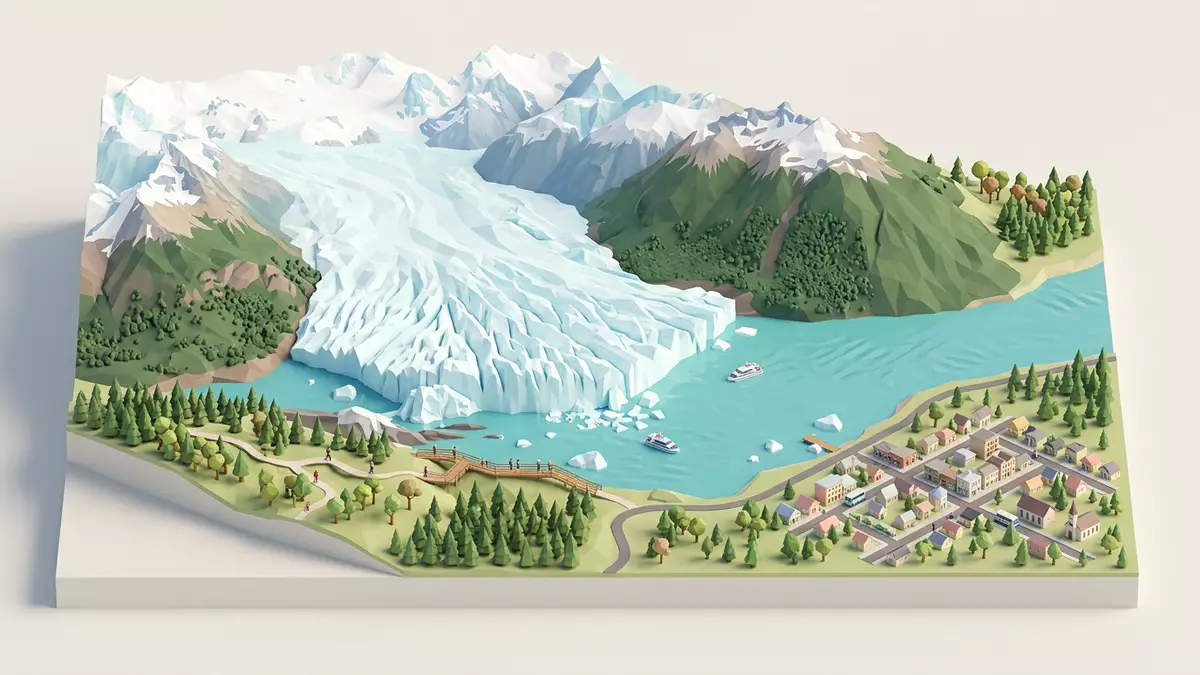
Glaciar Perito Moreno is the southern Patagonian glacier most closely associated with El Calafate, in Santa Cruz Province, Argentina. Its long ice front meets Lago Argentino inside Los Glaciares National Park, a UNESCO World Heritage site inscribed in 1981Los Glaciares National Park.
The glacier as a wall of ice
The glacier stretches for about 30 km and reaches roughly 5 km across at its front, making the ice mass easy to read in profile30 km. Its face rises above the water in broken blue and white layers, while the lower ice continues beneath the lake surface.
That contrast between a visible cliff and the hidden mass below it gives Glaciar Perito Moreno much of its impact. The glacier belongs to the Southern Patagonian Ice Field, one of the great ice bodies of the Andes, and it has long been linked with the name of Francisco Moreno, the explorer for whom it is namedFrancisco Moreno.
Los Glaciares and the Patagonian setting
Los Glaciares National Park frames the glacier with lake water, distant peaks and the open Patagonian steppe. The park lies in the south-west of Santa Cruz Province, and Glaciar Perito Moreno is one of its best-known ice formationssouth-west of Santa Cruz Province.
The setting matters because the glacier reaches a lake shore rather than sitting high and remote on a mountain crest. That low approach lets the ice front appear abruptly against the dark water, with the Andean source area far behind itAndean source area.
A named glacier in a protected landscape
Glaciar Perito Moreno is part of a formally protected landscape that links geology, ice and lake scenery in a single protected unit. The park’s 1981 World Heritage inscription places the glacier within a larger Patagonia landscape recognised for its glacial terrain1981 World Heritage.
The glacier’s Spanish name is the one most travellers encounter, and it is the name used in English as well. The same ice mass also appears in older English references as Perito Moreno Glacier, while the scientific and travel literature keeps the focus on the glacier itself rather than on the town that serves itPerito Moreno Glacier.
Visiting Glaciar Perito Moreno: what travellers from Western Europe should know
- The glacier lies in Los Glaciares National Park, west of El Calafate in Santa Cruz Province. Road access from the town reaches the lake shore and the glacier viewpoints.
- The terrain is dominated by lake water, ice cliffs and Patagonian steppe. Distances around the site are best understood as a landscape of broad views rather than a compact urban visit.
- The official language is Spanish and the currency is the Argentine peso.
- Entry requirements depend on your nationality; UK travellers can check the FCDO travel advice at gov.uk/foreign-travel-advice, Irish travellers the Department of Foreign Affairs at ireland.ie.
Searching for Glaciar Perito Moreno on social platforms
These links open searches for Glaciar Perito Moreno on each platform.
Frequently asked questions about Glaciar Perito Moreno
Where is Glaciar Perito Moreno?
It lies in Los Glaciares National Park in Santa Cruz Province, west of El Calafate. The glacier faces Lago Argentino in Argentine Patagonia.
What does a visit involve?
The usual setting is a road approach from El Calafate to the park and then viewpoints over the lake and ice front. The site is a glacier landscape rather than an urban monument.
What makes it distinctive?
The most striking feature is the long ice wall meeting the lake, with a large body of ice visible above and below the waterline. Its link to the Southern Patagonian Ice Field gives the place its scale.


