
Ghadames and its layered oasis town in the Libyan Sahara
Published on 09/17/2026 at 13:50 | Editorial responsibility: Rafael Müller, Editor-in-Chief AD HOC NEWS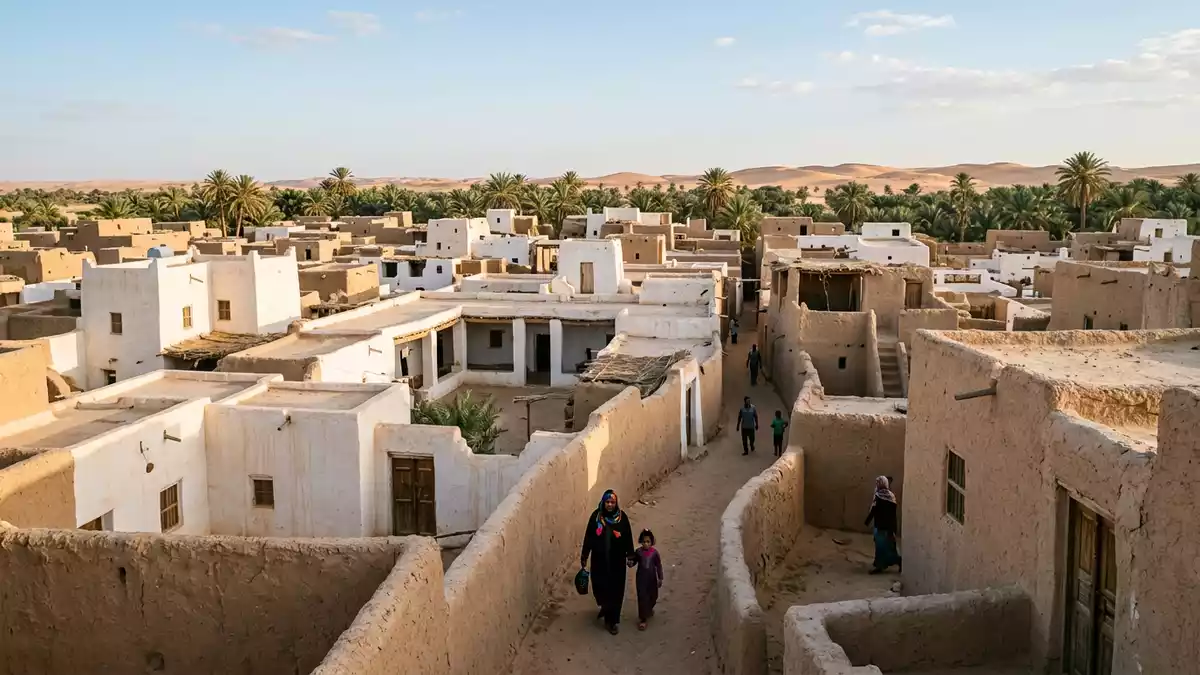
Ghadames in north?western Libya is an oasis town where the historic core forms a compact desert settlement of mud?brick houses, shaded passages and layered roof terraces. At the edge of the Sahara near the borders with Algeria and Tunisia, its old town is inscribed as a cultural UNESCO World Heritage site, anchoring the settlement in both the pre?Saharan landscape and the history of trans?Saharan trade.
An oasis town shaped as a compact mud?brick labyrinth
Ghadames lies within an oasis at the foot of the stony Al Hamada al?Hamra plateau, in a depression bordered by desert slopes and palm groves that have sustained settlement for centuries.oasis near Libya’s borders The old town occupies this oasis in a roughly circular plan, its outer ring formed by the thickened outer walls of adjoining houses that combine domestic architecture with defensive perimeter.roughly circular layout Inside, a dense network of narrow lanes and covered passageways runs between whitewashed mud?brick facades, making the town feel like a built labyrinth adapted to desert heat.
The settlement is one of the oldest pre?Saharan towns documented in the region, with evidence of habitation stretching back to prehistoric periods and later to the era when the oasis stood on key caravan routes across the Sahara.oldest habitable medina Roman power reached the oasis in 19 BC, when the fortified town of Cydamus was made an ally of Rome, leaving ruins that underpin the later Arab and Berber settlement.Antique Cydamae allied to Rome What visitors see in the old town today, however, belongs largely to the centuries when Ghadames flourished as a hub of caravan trade linking central Africa with the Mediterranean coast.
World Heritage status and the desert architecture of the old town
The old part of Ghadames, enclosed by its city wall, was inscribed on the UNESCO World Heritage List in 1986 as a cultural site that demonstrates interaction between a traditional settlement and the harsh environment of the pre?Sahara.Old Town of Ghadamès inscription UNESCO registers the property as Old Town of Ghadamès with identification number C 362 and places it within the group of fortified towns linked to trans?Saharan trading routes.fortified town on trade route The recognition focuses not on monumental structures but on the way ordinary houses and alleys form a coherent urban fabric tuned to life in extreme desert conditions.
Architecture in the old town follows a characteristic pattern. Houses are built from mud?brick and rendered surfaces, their outer walls forming continuous fronts to the alleys while interiors are organised vertically. Ground floors are used for storage, warehousing and business activities, first floors contain family living rooms, and interconnected roof terraces create a separate circulation level above the streets, traditionally reserved for women.standard plan of flat?roofed houses Many first?floor rooms extend out above the alleys, producing a continuous cover that turns much of the ground?level network into sheltered passageways punctuated by small openings for ventilation and light.
Layers of history: from Roman Cydamus to caravan crossroads
Long before its present mud?brick townscape, the site of Ghadames was a frontier stronghold for Rome at the junction of caravan routes crossing the Sahara. The Roman settlement of Cydamus served as an allied fortified city whose remains survive in and around the oasis.Roman stronghold Cydamus Later, during the Byzantine period, Ghadames became an episcopal see, and columns from the Christian church are still incorporated into the fabric of the Sidi Badr? Mosque, illustrating how successive layers of worship and architecture coexist in a single complex.
As trans?Saharan trade intensified between the thirteenth and sixteenth centuries, the oasis emerged as one of the busiest caravan centres in the Libyan Sahara, with routes linking it southwards to Fezzan and Sub?Saharan Africa and northwards towards the Mediterranean coast.busy caravan trade centre This period shaped much of the built environment visible today, from the organisation of houses around internal courtyards to the alignment of alleys and covered streets that connected traders’ warehouses with residential quarters and with the palm gardens at the edge of the town.
Landscape, oasis gardens and the surrounding plateau
The wider landscape around Ghadames combines sand, stone plateau and cultivated palm groves. The town lies in a wadi at the foot of the al?Hamra Plateau, where steep slopes rise above the oasis and emphasise the contrast between the green canopy of date palms and the bare stone of the pre?Sahara.wadi bordered by plateau slopes A perennial spring known locally as ghasil or ghasuf feeds the settlement and its gardens, with traditional enclosed farms arranged around irrigation channels that support cultivation under the shade of palm trees.settlement around Ain al?Faras spring
Beyond the oasis, dunes and desert plains stretch towards Algeria and Tunisia, underlining the town’s role as a stopping point along caravan and modern transport routes that cross the Sahara. The old town itself is separated from newer quarters and infrastructure by its encircling wall and by the visual threshold of the gardens and cemetery, which mark the transition from compact mud?brick fabric to open desert. A modern hotel, road links towards Dirj and air connections support travel to and from the oasis while leaving the historic core largely defined by its traditional materials and layout.caravan depot linked by sand track
Visiting Ghadames: what travellers from Western Europe should know
- Ghadames lies in north?western Libya close to the borders with Algeria and Tunisia, reached overland from northern Libya via the desert town of Dirj.
- The old town consists of narrow, covered passageways and staircases connecting multi?storey mud?brick houses and roof terraces, so movement involves gradients and enclosed spaces rather than broad streets.
- The oasis gardens and palm groves sit immediately beside the historic core, with paths that lead from the compact townscape to cultivated plots under the shade of date palms.
- The official language is Arabic and the currency is the Libyan dinar.
- Entry requirements depend on your nationality; UK travellers can check the FCDO travel advice at gov.uk/foreign-travel-advice, Irish travellers the Department of Foreign Affairs at ireland.ie.
Searching for Ghadames on social platforms
These links open searches for Ghadames on each platform.
Frequently asked questions about Ghadames
Where is Ghadames and what kind of place is it?
Ghadames is an oasis town in north?western Libya near the borders with Algeria and Tunisia, with a historic mud?brick old quarter surrounded by a city wall.
What should visitors expect when exploring the old town?
Visitors encounter narrow covered passageways, multi?storey mud?brick houses, interconnected roof terraces and enclosed courtyards that together form a compact pre?Saharan urban fabric.
What makes Ghadames distinctive among desert towns?
Its distinction lies in the layered history from Roman Cydamus to caravan crossroads and in the organised mud?brick architecture that earned the Old Town of Ghadamès UNESCO World Heritage status.


