
Ghadames and its layered oasis town in the Libyan Sahara
Published on 09/16/2026 at 10:15 | Editorial responsibility: Rafael Müller, Editor-in-Chief AD HOC NEWS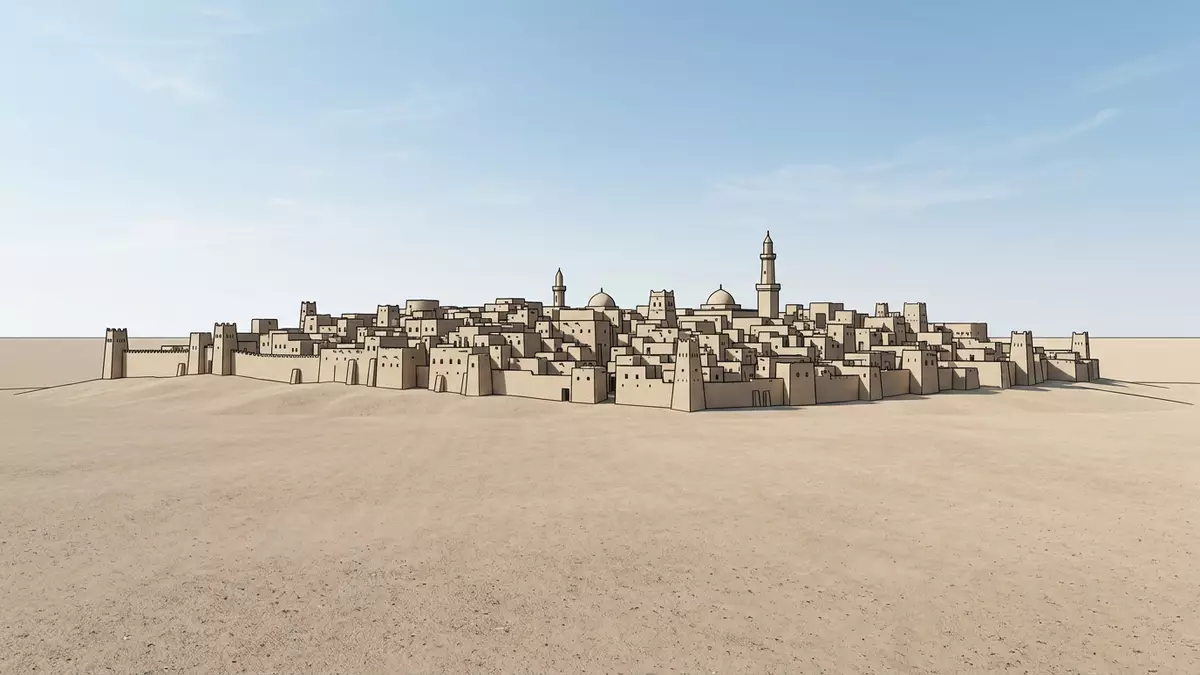
On the edge of the Libyan Sahara, Ghadames is an oasis town where a compact walled quarter rises like a mud-brick labyrinth above a palm grove and seasonal watercourses. Its historic core is recognised as the Old Town of Ghadamès, a cultural World Heritage site, and shows how generations in the Tripolitania region organised earthen architecture around scarce desert water and intense heat.
The walled oasis town and its setting
Ghadames lies in north-western Libya near the borders with Algeria and Tunisia, at the bottom of a dry wadi framed by the stony slopes of the al-Hamr?? Plateau. The oasis forms part of the Nalut District in the wider Tripolitania region, giving the town a position between the high plateau and the open desert further south.oasis in northwestern Libya The core of the settlement clusters around springs and cultivated palms, with built structures gathering on slightly raised ground while groves and garden plots surround the walls.
For centuries, Ghadames has stood on caravan routes that linked central Saharan regions with Mediterranean ports, and its location near a tri-border zone made it a stopping point for traders moving between present-day Libya, Algeria and Tunisia.traditional settlement on trade route Historical sources trace the town back to ancient Cydamae, and later Arabic accounts describe Ghadames as “the pearl of the desert”, underlining both its age and its status as a notable pre-Saharan city.the pearl of the desert
Inside the Old Town of Ghadamès
The historic quarter of Ghadames is enclosed by walls and organised as a dense mass of houses constructed in mud brick on stone foundations, reinforced with palm trunks and finished with lime-based whitewash.compact desert settlement of mud-brick houses Floors inside many houses are carried on palm timber and fibres spanning between thick earthen walls, creating layered interiors aligned with the structural rhythm of the oasis materials. The townscape appears as a continuous fabric of earthen volumes and light-coloured surfaces, cut through by narrow passageways and punctuated by occasional open courts.
Movement within the Old Town largely follows covered passageways that run between and sometimes beneath houses, producing a network of shaded routes distinct from the more open streets beyond the walls.network of covered passageways Domestic architecture in Ghadames often uses a vertical sequence of spaces: storage and service rooms at ground level, family living rooms on upper floors and open roof terraces at the top, some linked by bridges above the alleys. Interiors can incorporate painted and carved surfaces, with rooms and staircases arranged around circulation routes rather than around large exterior squares.
World Heritage recognition and continuity
The Old Town of Ghadamès was inscribed on the UNESCO World Heritage List as a cultural property in 1986, recognised as an outstanding example of a traditional human settlement in a pre-Saharan environment.inscribed on the World Heritage List in 1986 UNESCO documentation records the site under identification number C 362, with a property area measured in hundreds of hectares and an emphasis on the way its architecture responds to harsh desert conditions.World Heritage property C 362 The inscription places Ghadames among notable historic towns in the Arab States region whose urban form and building techniques carry collective memory.
In the late twentieth century, housing built outside the walls drew many inhabitants away from the old quarter, leaving its earthen architecture vulnerable without regular domestic maintenance.historic core and city wall Conservation programmes and documentation have since focused on preserving the labyrinthine layout, the vertical organisation of homes and the relationship between the walled town and its palm grove. Berber communities associated with Ghadames maintained distinct districts within the old town, each with meeting places that underlined social ties alongside the architectural fabric.traditional settlement of houses and enclosed farms
Visiting Ghadames: what travellers from Western Europe should know
- Ghadames stands in western Libya in the Nalut District, near the borders with Algeria and Tunisia, and is reached by road from other Libyan cities across desert terrain.
- Within the Old Town, movement takes place along narrow, shaded passageways and staircases, with many routes covered and some access to upper levels via steep internal steps.
- The oasis palm grove lies beyond the historic walls, and approaches can involve walking on uneven ground near cultivated plots and dry watercourses before reaching denser built areas.
- The official language is Arabic and the currency is the Libyan dinar.
- Entry requirements depend on your nationality; UK travellers can check the FCDO travel advice at gov.uk/foreign-travel-advice, Irish travellers the Department of Foreign Affairs at ireland.ie.
Searching for Ghadames on social platforms
These links open searches for Ghadames on each platform.
Frequently asked questions about Ghadames
Where is Ghadames and what kind of place is it?
Ghadames is an oasis town in western Libya, near the borders with Algeria and Tunisia, whose historic core forms a walled desert settlement gathered around springs and palms.
What should visitors expect inside the historic quarter?
The Old Town is a compact maze of mud-brick houses, covered alleys and internal staircases, with domestic rooms stacked above storage spaces and roof terraces connected over some lanes.
What makes Ghadames distinctive among desert towns?
Ghadames combines pre-Saharan earthen architecture, a vertically organised domestic layout and a long history as a caravan centre, recognised through its inscription as a cultural World Heritage site.


