
Getty Center: travertine terraces above Los Angeles
Published on 09/16/2026 at 19:08 | Editorial responsibility: Rafael Müller, Editor-in-Chief AD HOC NEWS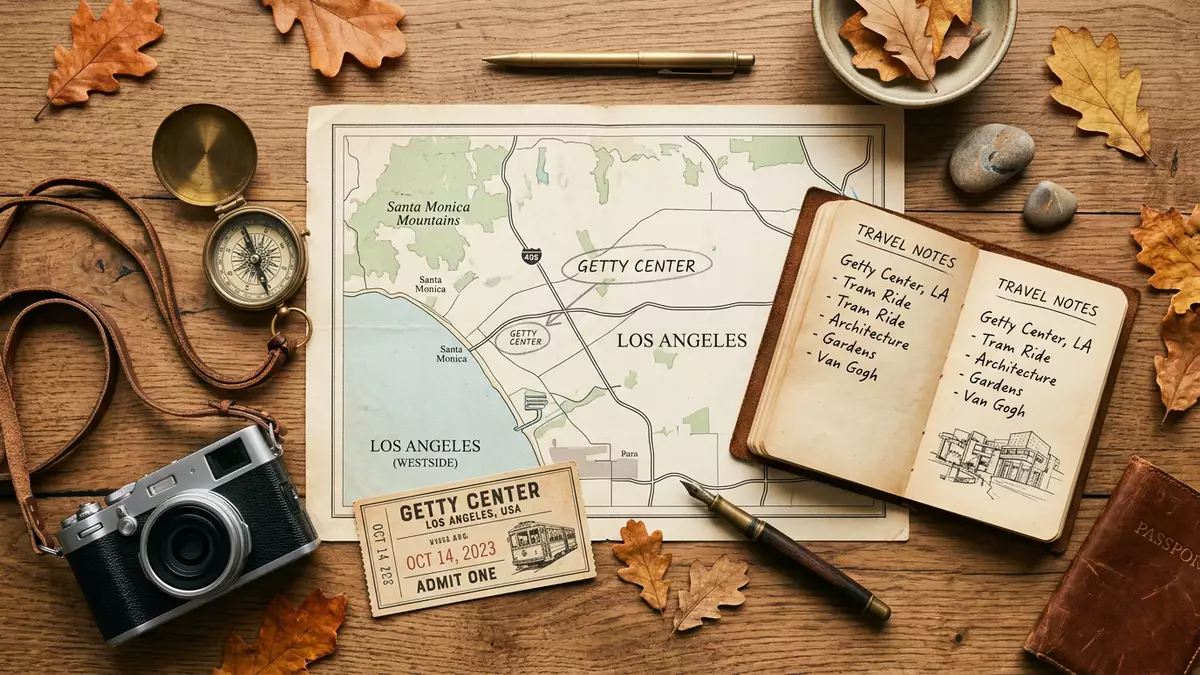
High on a ridge above the traffic of west Los Angeles, Getty Center brings together Richard Meier’s pale travertine architecture, landscaped terraces and a major art collection in a single hilltop campus. Opened in 1997 as a new home for the J. Paul Getty Museum and related institutions, it has become a defining cultural landmark for the Brentwood area, with galleries, research buildings and gardens arranged around a central courtyard.
A hilltop campus of art and stone
Getty Center occupies a hill above the Brentwood neighbourhood on the western side of Los Angeles, with its buildings and terraces aligned along the slope. The site was acquired by the J. Paul Getty Trust in the 1980s to create a larger base for its museum and programmes than the original Getty Villa in Pacific Palisades.A roughly 750-acre property in Brentwood became the setting for what would become a multi-building complex housing both public and specialist functions.
The campus is best known for the combination of its art museum, the landscaped Central Garden and the wide views across Los Angeles from the upper terraces.The Center sits atop a hill connected to a visitors' parking garage by a funicular-style tram that climbs from street level to the museum entrance. From the terraces, visitors see the Santa Monica Mountains inland and, on clear days, the Pacific horizon.
Richard Meier’s travertine architecture
The architecture of Getty Center was designed by Richard Meier, the New York-based architect known for geometric compositions in pale materials.From 1985 to 1997 Meier focused much of his attention on the Getty Center, developing a six-building complex that arranges the museum, research facilities and trust offices around courts and walkways. The buildings combine creamy Italian travertine stone with white metal cladding, giving the campus a distinct light-coloured palette against the darker slopes around it.
Planning for the project began in the mid-1980s, and the centre opened to the public in December 1997 after more than a decade of design and construction.The center opened to the public on December 16, 1997, marking a shift in the Getty Museum’s presence from its earlier single site at the Villa to a larger complex with broader scope. The buildings were laid out with seismic and fire considerations in mind, reflecting Los Angeles’s geography and climate, and their façades are broken into smaller planes and terraces that catch the changing light across the day.
Collections, institutions and the Central Garden
Within Getty Center, the J. Paul Getty Museum presents European paintings, drawings, manuscripts, sculpture and decorative arts from before the twentieth century, alongside photography from the nineteenth and twentieth centuries.The Center branch of the Museum features pre-20th-century European works and 19th- and 20th-century photographs, displayed in a sequence of galleries linked to outdoor sculpture terraces. Among the works on view is Vincent van Gogh’s “Irises”, an 1889 painting that has become one of the museum’s most recognised canvases.
The campus also houses several other arms of the Getty organisation, including the Getty Research Institute, the Getty Conservation Institute, the Getty Foundation and the headquarters of the J. Paul Getty Trust.Designed by architect Richard Meier, the campus also houses the Getty Research Institute and other programmes that support scholarship and conservation. Outside the buildings, artist Robert Irwin’s Central Garden forms a planted bowl and stream below the main courtyard, with paths that wind through sculpted beds, clipped shrubs and seasonal planting set against the stone terraces.
Visiting Getty Center: what travellers from Western Europe should know
- Getty Center stands above the Brentwood area of Los Angeles, reached from North Sepulveda Boulevard and Getty Center Drive, with a dedicated tram carrying visitors from the parking structure up to the hilltop campus.
- The site is laid out across a slope, and moving between the museum buildings and garden involves walking on outdoor terraces and using stairs, lifts and ramps.
- Metro bus services serve the entrance on Sepulveda Boulevard, providing a public transport link between the hilltop complex and the wider Los Angeles area.
- The official language is English and the currency is the United States dollar.
Searching for Getty Center on social platforms
These links open searches for Getty Center on each platform.
Frequently asked questions about Getty Center
Where is Getty Center located?
Getty Center is on a hill above the Brentwood neighbourhood of Los Angeles, California, accessed from North Sepulveda Boulevard and Getty Center Drive.
What can visitors expect on a visit?
Visitors encounter a hilltop complex with galleries, landscaped terraces, Robert Irwin’s Central Garden and wide views over Los Angeles, linked by a short tram ride from the entrance.
What makes Getty Center distinctive among art museums?
The combination of Richard Meier’s travertine architecture, a major European and photographic collection, several Getty institutions and a sculpted garden on a single elevated site gives the centre its particular character.


