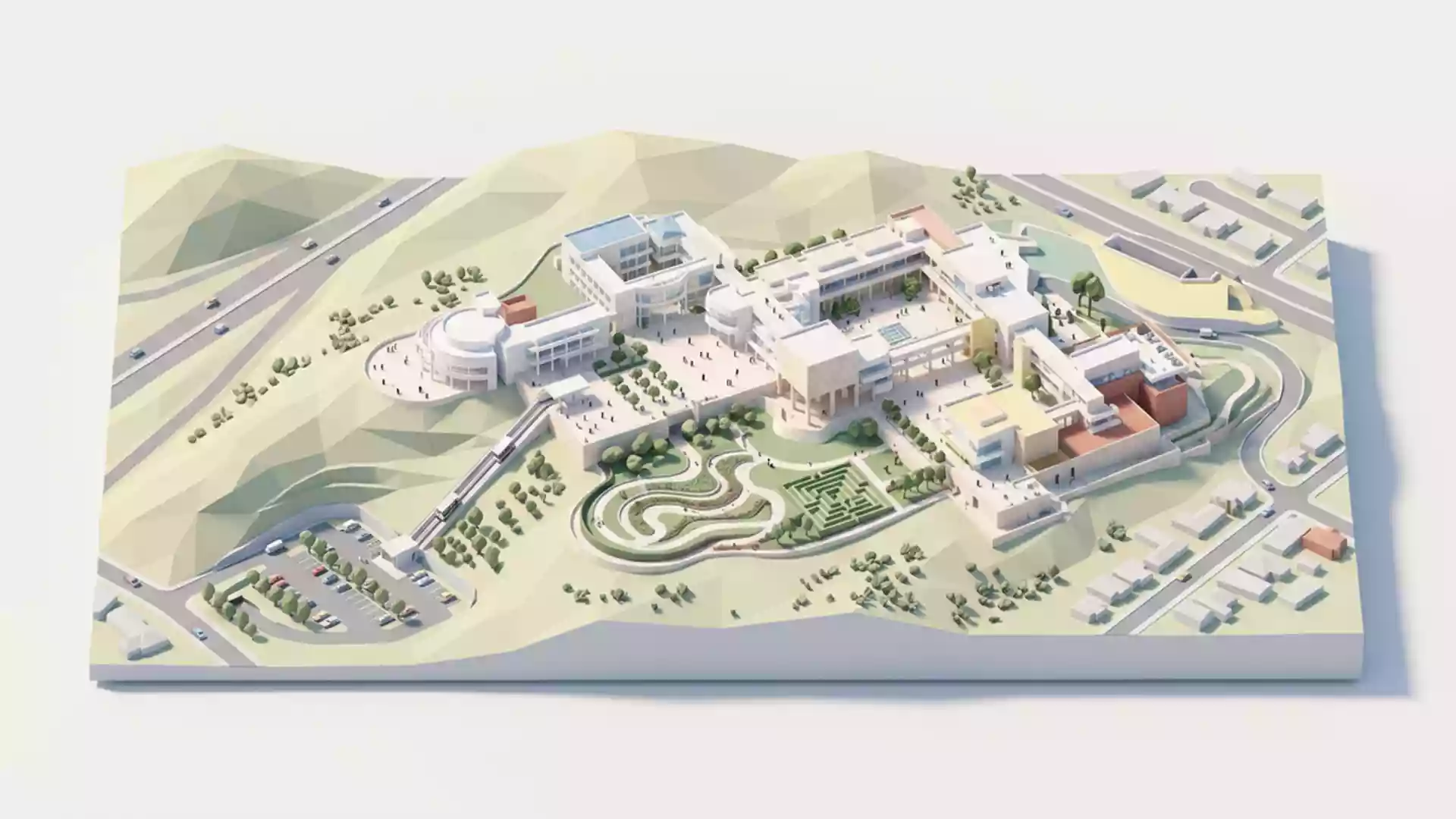
Getty Center as a stone and light landscape above Los Angeles
Published on 09/03/2026 at 16:06 | Editorial responsibility: Rafael Müller, Editor-in-Chief AD HOC NEWS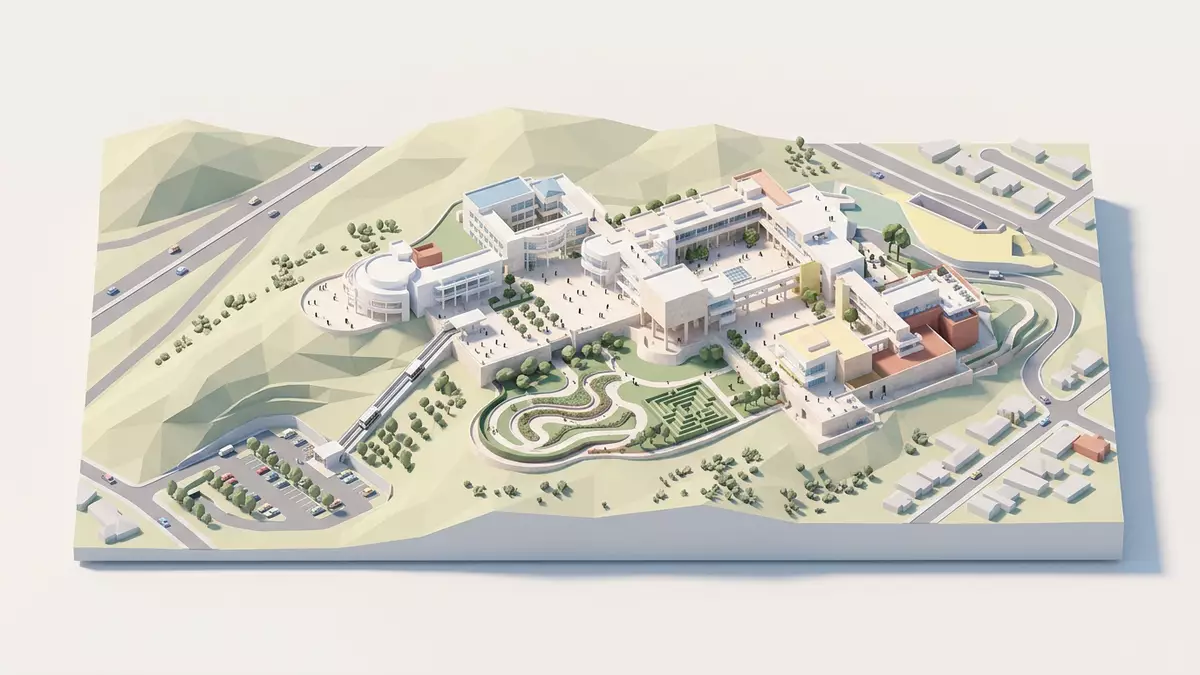
High above Los Angeles, Getty Center forms a hilltop ensemble of travertine terraces, glass pavilions and gardens that turns architecture itself into a landscape. Designed by Richard Meier and opened in 1997, this campus of the J. Paul Getty Museum and associated institutions uses stone, light and topography as its defining elements.
Stone, grids and a hilltop campus
Getty Center occupies a narrow hilly site on the slopes of the Santa Monica Mountains, overlooking the west side of Los Angeles and the broad grid of the city below.The Getty Center occupies a narrow, hilly stretch high above the San Diego Freeway Visitors arrive at a lower car park and board a small cable-pulled train that climbs to the hilltop, underscoring the sense of entering a separate architectural world.a three-car, cable-pulled hovertrain funicular
The complex was designed by architect Richard Meier for the J. Paul Getty Trust and brought together the Getty Museum, the Getty Research Institute, the Getty Conservation Institute and the Getty Foundation on one campus.Designed by architect Richard Meier, the campus also houses the Getty Research Institute, the Getty Conservation Institute, the Getty Foundation, and the J. Paul Getty Trust Planning and construction ran through the 1980s and 1990s, with the centre opening to the public in December 1997.opened with great publicity in 1997 Meier organised the buildings along two natural ridges, using a pair of offset grids to structure the site and aligning courtyards, paths and pavilions to these underlying lines.The Getty Center sits on a hilltop in the Santa Monica Mountains
Travertine, glass and measured light
The most immediately recognisable material of Getty Center is travertine limestone, used extensively on exterior walls, paving and balustrades.The stone—1.2 million square feet of it—is one of the most remarkable elements of the complex Around sixteen thousand tons of travertine were quarried near Bagni di Tivoli outside Rome, the same region whose stone was used for major classical monuments.travertine limestone mined from the same quarry used for the Roman Colosseum Fossil traces and natural variations remain visible in the stone, giving the otherwise rigorous geometry a textured, geological surface.
Beneath the cladding, the buildings use concrete and steel frames, with many façades finished in polymer-coated aluminium panels that contrast with the warmer limestone.concrete and steel covered in aluminium and travertine limestone Meier’s design makes extensive use of a modular grid of square units, with floor tiles, cladding panels and other elements laid out in repeated dimensions based on a regular measure.The two grids that Meier imposed upon the Getty Center are composed of smaller blocks of space measuring 30-inches square Large areas of glass admit daylight deep into galleries and public spaces, creating views across terraces, planted areas and the city beyond.Natural light is one of the Getty Center's most important architectural elements
Gardens, collections and Los Angeles views
Getty Center is one of two sites of the J. Paul Getty Museum, focusing on European paintings, decorative arts and antiquities, with outdoor sculpture placed on terraces and in landscaped areas.the Museum’s collection at the Center includes outdoor sculpture displayed on terraces and in gardens A major feature of the campus is the Central Garden, an evolving artwork by artist Robert Irwin that shapes a descending sequence of paths, water features and planting between the upper buildings and a lower bowl-like garden space.the large Central Garden designed by Robert Irwin
From many points on the site there are broad views westward towards the Pacific Ocean and eastwards towards the San Gabriel Mountains, with the linear traffic of Interstate 405 far below.Set on 110 acres overlooking the Pacific The combination of art museum, research institutes and gardens is spread across several buildings, linked by plazas and open walkways that encourage movement between interior galleries and the outdoor spaces of the hilltop.program brings the seven components of the Getty Trust into a coherent unity The setting within the Santa Monica Mountains and the consistent palette of white metal, limestone and glass give the complex a strong identity within the wider Los Angeles landscape.six-building complex designed by Richard Meier in the Brentwood neighbourhood
Visiting Getty Center: what travellers from Western Europe should know
- Getty Center stands in the Brentwood area of Los Angeles, on Getty Center Drive off Interstate 405, with access from a lower car park via a hill-climbing train.
- The hilltop site involves open terraces, multi-level plazas and outdoor paths, with changes in elevation and a series of stairways and ramps between buildings and gardens.
- The official language is English and the currency is the US dollar.
- Entry requirements depend on your nationality; UK travellers can check the FCDO travel advice at gov.uk/foreign-travel-advice, Irish travellers the Department of Foreign Affairs at ireland.ie.
Searching for Getty Center on social platforms
These links open searches for Getty Center on each platform.
Frequently asked questions about Getty Center
Where is Getty Center located in Los Angeles?
Getty Center is situated on a hilltop above the Brentwood neighbourhood, reached from Getty Center Drive near Interstate 405 on the western side of Los Angeles.
What can visitors expect when exploring Getty Center?
Visitors encounter art galleries, research buildings, open plazas, the Central Garden and extensive views over Los Angeles, all connected by terraces clad in travertine and glass.
What makes Getty Center distinctive among museum campuses?
The combination of a unified hilltop plan by Richard Meier, extensive travertine limestone, a modular grid system and a major contemporary garden gives Getty Center a distinctive architectural character.