
Getty Center and its travertine hilltop campus
Published on 08/29/2026 at 12:08 | Editorial responsibility: Rafael Müller, Editor-in-Chief AD HOC NEWS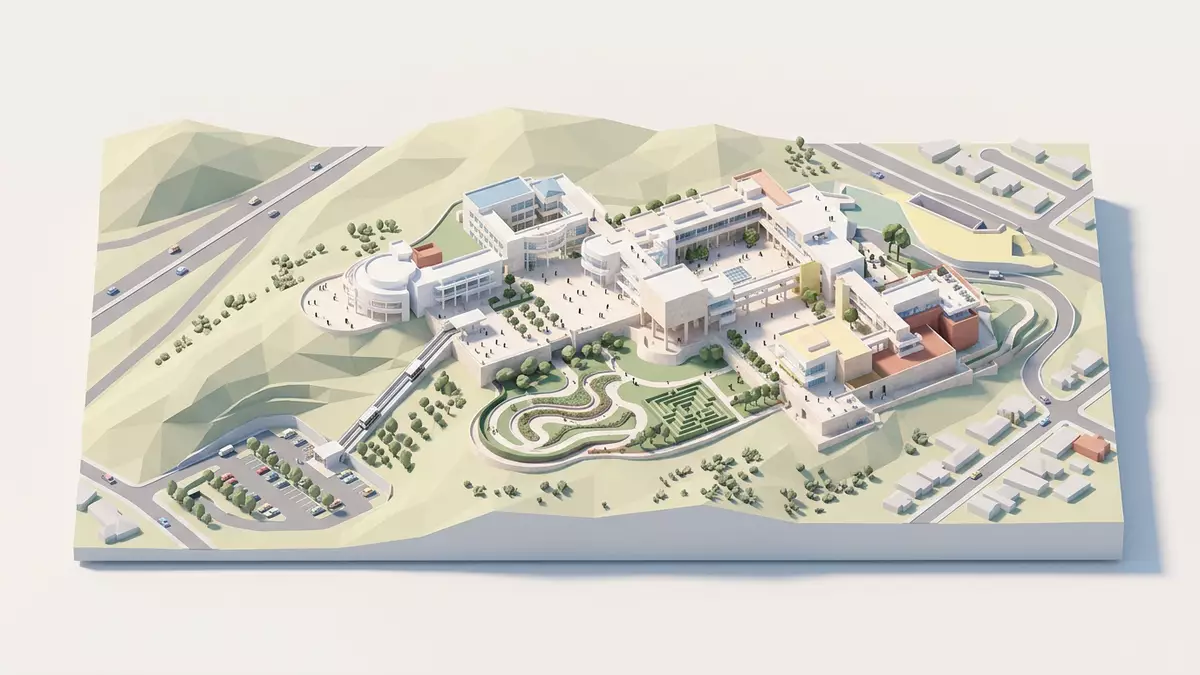
Getty Center rises above Los Angeles as a hilltop complex in travertine, aluminium and white metal panels. Designed by Richard Meier and opened in 1997, it brings galleries, gardens and research buildings into a single campus.
Richard Meier’s hilltop ensemble
The centre is a multi-building work by Richard Meier, whose name is closely tied to the project. Britannica describes it as a six-building complex, while Getty material presents the campus as a broad arrangement of museum, garden and institutional spaces.
The campus opened on 16 December 1997. The date matters because it places the ensemble in the late twentieth century, when museum architecture often aimed for strong visual identity without losing functional variety.
Travertine, aluminium and open space
The most immediate feature is the material palette. The Getty Centre uses cream-coloured travertine blocks, aluminium and light-toned panels, set in a composition of broad terraces, pavilions and circulation spaces.
That surface treatment gives the place a clear visual order. It also keeps the architecture legible from a distance, with the buildings reading as parts of one coordinated campus rather than a single enclosed block.
The collection of forms includes the Central Garden, designed by Robert Irwin, and the galleries that hold the museum’s pre-twentieth-century holdings. Those elements sit beside one another without dissolving into each other, which gives the place its distinctive balance of art, landscape and institutional use.
Los Angeles seen from the hill
The setting is part of the experience of the place itself. Getty Center stands in the Brentwood area of Los Angeles, high enough to open broad views across the city and towards the coast.
Its position in the hills makes the approach feel deliberate and elevated, but the article’s real interest lies in the visible contrast between the hard geometry of the buildings and the planted spaces around them. The campus reads as a sequence of terraces, paths and viewing points rather than a sealed museum interior.
The site also connects to the wider Getty institutions housed there, including the Getty Research Institute, the Getty Conservation Institute and the Getty Foundation. That mix of public galleries and scholarly work gives the campus a rare density of purpose without changing its overall calm, ordered appearance.
Visiting Getty Center: what travellers from Western Europe should know
- The centre is in Brentwood, west of central Los Angeles. It is reached by road and by tram from the arrival area.
- The site sits on a hill, with terraces, steps and long outdoor walks between the buildings. The ground plane is not flat.
- Travellers will find museum galleries, landscaped gardens and wide city views in one place. The museum and the garden are separate parts of the same campus.
- The official language is English and the currency is the US dollar.
- Entry requirements depend on your nationality; UK travellers can check the FCDO travel advice at gov.uk/foreign-travel-advice, Irish travellers the Department of Foreign Affairs at ireland.ie.
Searching for Getty Center on social platforms
These links open searches for Getty Center on each platform.
Frequently asked questions about Getty Center
Where is Getty Center?
Getty Center is in Brentwood, on the western side of Los Angeles. The complex sits on a hill above the city.
What does a visit involve?
It combines museum galleries, the Central Garden and a campus of connected buildings. The layout includes terraces, outdoor circulation and framed views over Los Angeles.
What makes Getty Center distinctive?
Its identity lies in the combination of Richard Meier’s architecture, the travertine surfaces and the mix of art, landscape and research buildings. The result is a coherent campus rather than a single museum block.


