
Getty Center, a travertine hilltop world above Los Angeles
Published on 08/16/2026 at 13:50 | Editorial responsibility: Rafael Müller, Editor-in-Chief AD HOC NEWS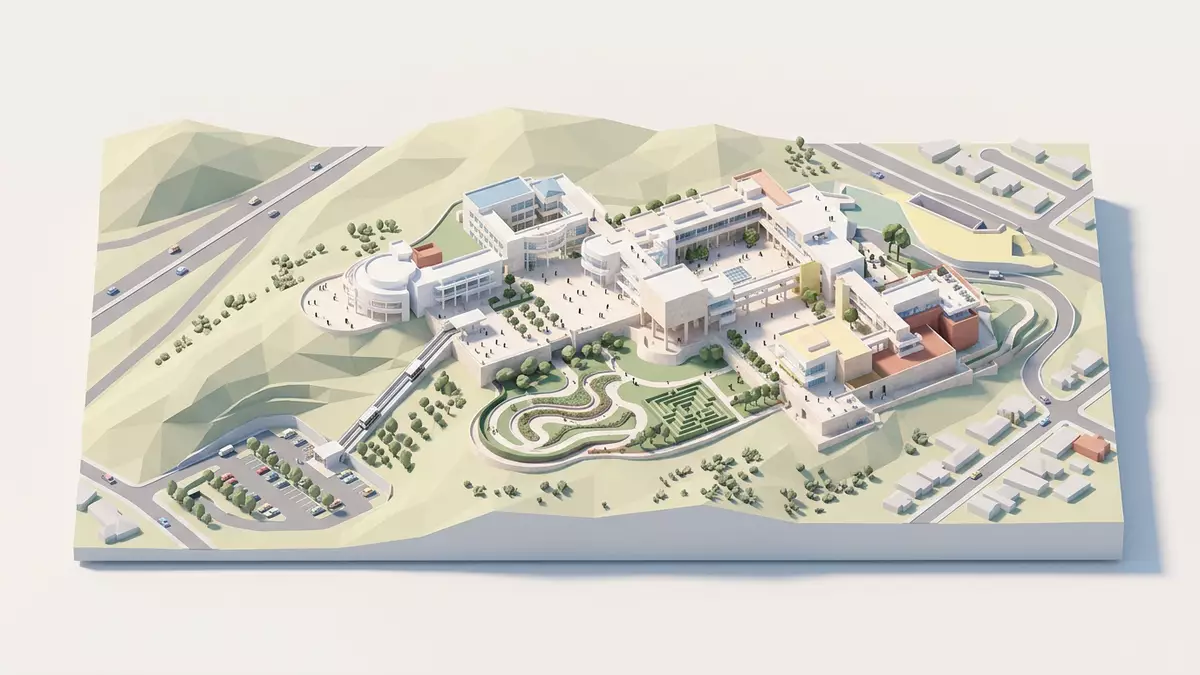
On a ridge high above Los Angeles, Getty Center unfolds as a self-contained campus of pale travertine and metal that turns a hilltop into an arts landscape. Conceived in the 1980s for the J. Paul Getty Trust and opened in 1997, it brings collections, research institutes and gardens together in a single architectural ensemble by Richard Meier.
A hilltop campus shaped by light and stone
Getty Center occupies a large site in the hills above the Brentwood area of Los Angeles, with long views towards the Pacific Ocean, the city grid and the Santa Monica Mountains. The complex is arranged as a series of low buildings and terraces aligned to the natural ridges of the hill, so that the architecture steps and turns with the topography rather than forming one continuous block.a hilltop in west Los Angeles
The architect Richard Meier was selected for the project in 1984 after an extended competition for the new home of the Getty programmes.selected to design the Getty Center in 1984 Construction took more than a decade, and the centre opened to visitors on 16 December 1997, marking the completion of one of the major cultural building projects in late twentieth-century Los Angeles.opened to the public on December 16, 1997
Travertine, metal and Meier’s geometric language
Seen from the approach, Getty Center reads as a composition of rectilinear volumes, open courts and curved façades, a three-dimensional play of right angles and arcs characteristic of Richard Meier’s work.curvilinear forms derived from the contours of the site The buildings are clad in cream-coloured travertine stone combined with light metal panels, so that solid, textured walls alternate with smoother, more reflective surfaces.travertine complemented by aluminium panels
The travertine itself comes from a quarry near Rome and is cut into blocks that give the façades a distinct grain and rhythm.travertine blocks imported from a quarry near Rome Meier’s layout overlays two geometric grids that follow naturally occurring ridges on the site, which diverge at a set angle, so that courtyards, paths and façades line up either with the city below or with the line of the mountains.two grids along naturally occurring ridges
Galleries, institutes and gardens on a single site
Beyond the arrival plaza, Getty Center houses the Getty Museum alongside several scholarly and conservation bodies under the umbrella of the J. Paul Getty Trust.operating entities of the J. Paul Getty Trust The campus includes the Getty Research Institute, the Getty Conservation Institute, the Getty Foundation and administrative offices, grouped into separate buildings yet connected by paths and shared outdoor spaces.houses the Getty Research Institute and other entities
Between the buildings, landscaped areas form an essential part of the experience of the site. The Central Garden descends from the upper terraces into a bowl-shaped space framed by planting and pathways, while other gardens and courtyards punctuate the route between galleries. These outdoor rooms pick up the materials of the architecture, combining stone paving with water features and structured planting to extend the campus into the landscape.
Visiting Getty Center: what travellers from Western Europe should know
- Getty Center stands in the hills above the Brentwood neighbourhood on the western side of Los Angeles, reached from the city by road and a dedicated tram from the lower parking area.address on Getty Center Drive in Los Angeles
- The approach from the parking area involves an electric tram climbing to the hilltop arrival plaza, followed by walking across open terraces and through outdoor spaces with changes in level and flights of steps.access via an electric tram and propylaeum
- The complex lies at an elevation noted in architectural sources, and visitors spend time both indoors in climate-controlled galleries and outdoors on exposed terraces, where conditions reflect the typical weather of coastal Southern California.facilities at a level of 876 feet
- Getty Center is in the United States; the official language is English and the currency is the US dollar.
- Entry requirements depend on your nationality; UK travellers can check the FCDO travel advice at gov.uk/foreign-travel-advice, Irish travellers the Department of Foreign Affairs at ireland.ie.
Searching for Getty Center on social platforms
These links open searches for Getty Center on each platform.
Frequently asked questions about Getty Center
Where is Getty Center located?
Getty Center stands on Getty Center Drive in the hills above the Brentwood neighbourhood of Los Angeles, in the state of California in the United States.
What can visitors expect on a visit?
A visit combines art galleries, research and conservation facilities, landscaped gardens and terraces, all set within Richard Meier’s travertine and metal architecture on a hilltop site.
What makes Getty Center distinctive among museums?
The combination of a multi-building campus, a strong geometric architectural language, extensive travertine cladding and far-reaching views over Los Angeles gives Getty Center a character tied to its site.


