
George Town’s layered streetscape on the Straits of Malacca
Published on 09/03/2026 at 13:38 | Editorial responsibility: Rafael Müller, Editor-in-Chief AD HOC NEWS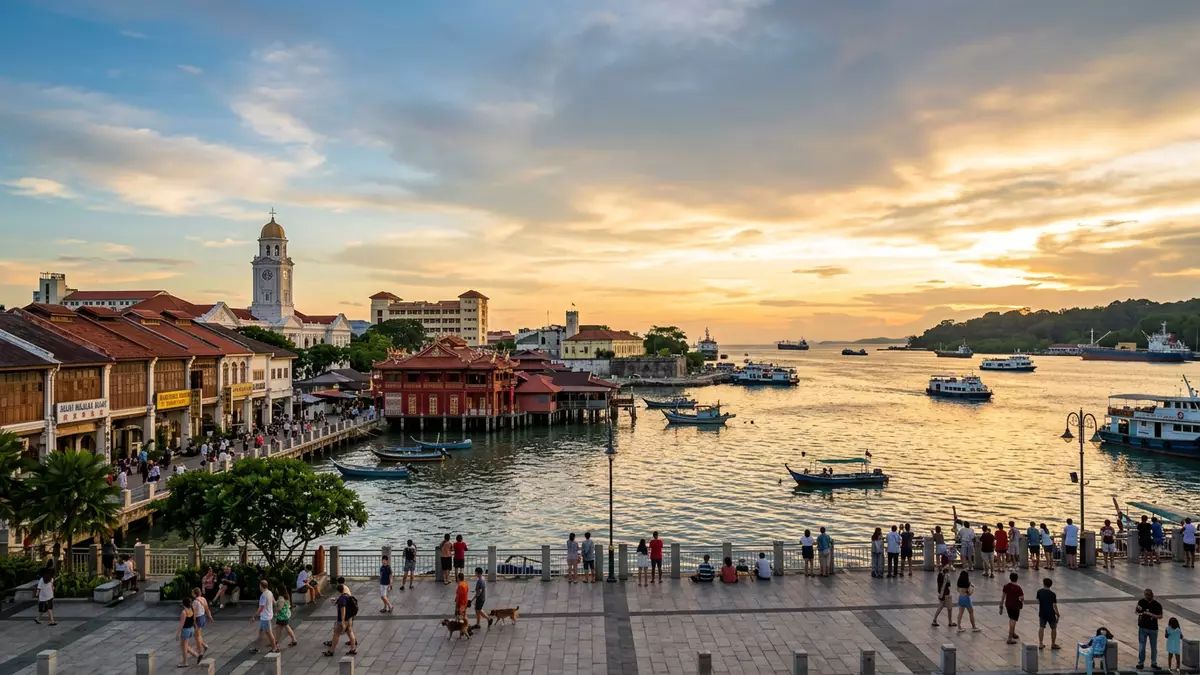
George Town, on the north?eastern shore of Penang Island in Malaysia, is a historic port city where a compact grid of shophouses, religious buildings and clan jetties forms a continuous streetscape along the Straits of Malacca. In the late eighteenth century it was established as a British trading settlement named for King George III, and its historic centre is now recognised as part of the serial UNESCO World Heritage property “Melaka and George Town, Historic Cities of the Straits of Malacca”. The core idea of George Town as a place is not a single monument but the way thousands of individual buildings, streets and waterfront structures fit together into one urban fabric.
The UNESCO core: a townscape protected as a whole
The historic centre of George Town is formally inscribed on the UNESCO World Heritage List under the joint title “Melaka and George Town, Historic Cities of the Straits of Malacca”, acknowledging the city’s layered architectural and cultural townscape shaped since the late eighteenth century.Melaka and George Town, Historic Cities of the Straits of Malacca UNESCO recognises the historic streets of George Town as a serial property whose Outstanding Universal Value rests on three key elements: a multicultural trading town, multicultural heritage and traditions, and distinctive architecture and townscape.three criteria of George Town’s Outstanding Universal Value The protected area covers a defined core zone surrounded by a buffer zone and includes a large number of pre?war buildings, religious complexes and waterfront settlements that together reflect centuries of mercantile and community life.
The UNESCO core zone in George Town encompasses a compact area of the north?east of Penang Island, bounded by streets such as Weld Quay, Lebuh Light and Jalan Transfer, and is surrounded by a buffer zone that stretches further inland.UNESCO World Heritage Site in 2008 Within this zone, a grid of streets lined with shophouses, civic buildings, houses of worship, markets and clan jetties is preserved not as isolated relics but as an ensemble. The same listing covers Melaka on the mainland, with the two cities recognised together as historic ports of the Straits of Malacca that share a British colonial imprint while retaining distinct local character.historic city of George Town in the State of Penang
Shophouses, five?foot ways and the multicultural street
The defining building type of George Town’s historic centre is the shophouse: a narrow, deep terrace structure, generally two or three storeys high, with commercial activity at street level and living space above or behind.The shophouse is the defining building type of George Town Rows of these shophouses run along streets laid out during the British colonial period, and their facades show a succession of architectural styles, from early utilitarian forms to later decorative fronts that incorporate Chinese, Malay, Indian and European motifs. Street?level verandahs form linked covered walkways known as five?foot ways, a planning device introduced in the region in the early nineteenth century and widely adopted in Penang.five-foot-way system was introduced
Along many of George Town’s streets, English colonial names sit alongside official Malay versions on signboards, sometimes accompanied by Chinese or Tamil scripts, reflecting the multicultural history of the city and the language policy shifts since the mid?twentieth century.street names of George Town reflect the multicultural heritage At junctions and in side streets, shophouses are interspersed with mosques, Chinese temples, churches and clan houses, so that commerce, religion and residential life share the same blocks. This close mixture of uses is a visible expression of the city’s long?standing role as a trading hub attracting Malay, Chinese, Indian, Peranakan and European communities, each leaving traces in building forms, street layout and everyday practices.multicultural architectural landscape
Waterfront jetties and colonial origins
George Town’s historic relationship with the sea is legible along Weld Quay, where wooden clan jetties extend from the shoreline, forming linear settlements on stilts that housed generations of Chinese clan communities associated with maritime trades.clan jetties, street art, religious buildings These jetties, together with nearby godowns, warehouses and the fort area, show how the city grew as a port where goods, people and ideas arrived by sea. Inland from the waterfront stand colonial?era civic structures and defensive works that date back to the period when the British East India Company administered Penang as a trading base in the Straits of Malacca.the capital of the Malaysian state of Penang
The history of George Town as a city began in 1786, when Captain Francis Light, acting on behalf of the British East India Company, established a settlement on Penang Island and laid out a street grid near the coast.history of George Town began in 1786 The town was named after King George III, aligning it symbolically with the British crown while serving practical trading functions between the Malay world, China, India and, later, Europe.founded in 1786 and named after King George III Over time, mercantile and residential districts expanded inland from the harbour, but the original grid and many of its buildings remained, so that the colonial townscape can still be read in the alignment of streets, blocks and waterfront structures.
Visiting George Town: what travellers from Western Europe should know
- George Town lies on the north?eastern tip of Penang Island, off the north?west coast of Peninsular Malaysia, and is linked to the mainland by bridges and ferry services serving Penang.
- The UNESCO core of George Town is largely level and laid out on a street grid, but many heritage buildings have narrow pavements, stepped thresholds and covered walkways that require attention when moving on foot.
- In the tropical climate of Penang, strong sun and heavy rain are common across the year, and the five?foot ways along shophouse fronts provide sheltered paths that visitors can follow between blocks.
- English has a long presence in George Town, but the official language of Malaysia is Malay and the national currency is the Malaysian ringgit.
- Entry requirements depend on your nationality; UK travellers can check the FCDO travel advice at gov.uk/foreign-travel-advice, Irish travellers the Department of Foreign Affairs at ireland.ie.
Searching for George Town on social platforms
These links open searches for George Town on each platform.
Frequently asked questions about George Town
Where is George Town and what kind of place is it?
George Town is the capital city of the Malaysian state of Penang, on the north?eastern shore of Penang Island, facing the Straits of Malacca.
What should visitors expect in George Town’s historic centre?
Visitors encounter rows of shophouses with five?foot ways, a mixture of temples, mosques and churches, clan jetties along the waterfront and streets whose names reflect the city’s multicultural past.
What makes George Town distinctive among historic Asian port cities?
George Town is distinctive for the way its late eighteenth?century British street grid, multicultural communities and pre?war architecture are preserved together under a UNESCO World Heritage listing as a single townscape.


