
Gaztelugatxe, a stone stairway to a sea?bound hermitage
Published on 09/15/2026 at 07:25 | Editorial responsibility: Rafael Müller, Editor-in-Chief AD HOC NEWS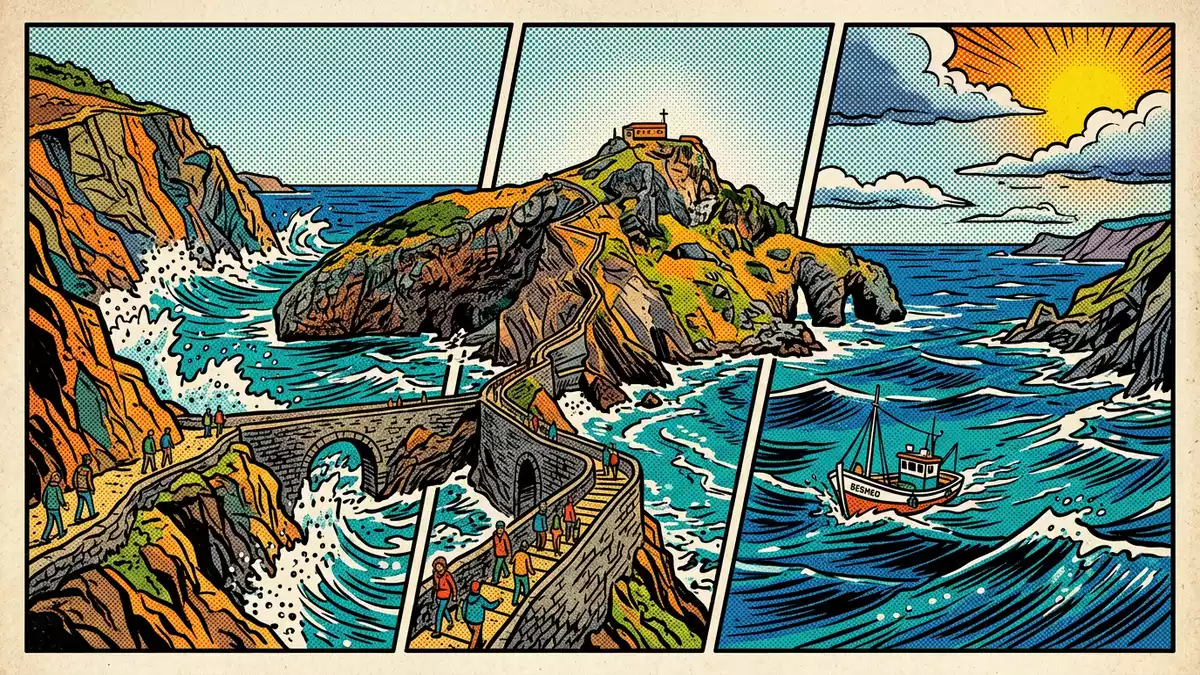
Off the Biscay coast near Bermeo in northern Spain, Gaztelugatxe is a rocky islet linked to the mainland by a long stone stairway that climbs to a small hermitage dedicated to Saint John the Baptist. Rising from the Cantabrian Sea within the Basque Autonomous Community, it forms part of a protected coastal landscape where stone, surf and a solitary chapel meet at the top of the rock.
Rock, sea and a medieval hermitage
Gaztelugatxe stands a short distance off the shore of Bermeo, on the Bay of Biscay, within Spain’s Basque Country, and belongs administratively to the municipality of Bermeo.an islet on the coast of the Bay of Biscay The rock rises steeply from the water and is connected to the mainland by a narrow stone bridge that turns the islet into a kind of peninsula, continuing as a stairway cut into the slope.a rocky peninsula rising from the Cantabrian Sea
At the highest point of Gaztelugatxe, above the sea, stands a small hermitage dedicated to Saint John the Baptist, known in Spanish as San Juan de Gaztelugatxe and in Basque as Gaztelugatxeko Doniene.the hermitage of San Juan de Gaztelugatxe The shrine is traditionally dated to the tenth century, with archaeological finds suggesting earlier burials from the ninth century and later medieval centuries around the site.medieval burials from the 9th and 12th centuries Although the building has been rebuilt several times after fires and periods of damage, its position on the summit and its dedication to Saint John have remained consistent.
Climbing the long stone staircase
The approach to Gaztelugatxe begins on the mainland, where a path descends through coastal terrain towards the stone bridge that links shore and islet. From there, the stairway continues in tight curves across the rock face, forming a route of 241 steps up to the hermitage at the top.the island has 241 steps The steps are built of stone and follow the natural contours of the rock, alternately rising above low walls and hugging the cliff, with the sea visible on either side.
As the stairway gains height, the view opens along the Basque coastline, taking in nearby headlands such as Cape Matxitxako and the smaller islet of Akatz within the same protected natural biotope.between Cape Matxitxako and Bakio At the summit, the stairway arrives at a level terrace beside the hermitage, where stone walls and railings mark the edge of the rock above the waves. The climb, with its continuous sequence of stone steps between sea and sky, is one of the defining experiences of a visit.
Layers of history on the Basque coast
The religious presence on Gaztelugatxe stretches back many centuries, with the hermitage generally dated to the tenth century and evidence of burials in the surrounding rock from medieval periods.a hermitage that dates from the 10th century Documentary records from the eleventh century refer to the shrine as Sancti Johannis de Castiello and mention donations by Íñigo López, Lord of Biscay, and his wife Toda Ortiz to the monks of the Monastery of San Juan de la Peña in Jaca.donated by Íñigo López, Lord of Vizcaya
Over time, the building has taken different forms. In the nineteenth century a church on the summit was demolished and rebuilt, and after a fire in the late 1970s a new hermitage structure was completed and reopened in 1980.the current structure was built in 1980 The site has also served as a defensive position in past conflicts, with records of assaults from the sea. Today the hermitage stands within a designated Protected Natural Biotope on the Basque coast, combining religious heritage with a rugged maritime landscape.a Protected Natural Biotope
Visiting Gaztelugatxe: what travellers from Western Europe should know
- Gaztelugatxe lies off the northern coast of Spain near Bermeo in the Basque Country, between Bermeo and Bakio along the Biscay shoreline, reached by local coastal roads.
- The approach from the mainland involves a downhill path to the stone bridge and then a sustained climb on stone steps up the rock, demanding a steady ascent on uneven surfaces.
- The surrounding area includes Cape Matxitxako and the islet of Akatz within the same protected coastal biotope, with views along the Basque shoreline from the upper terrace beside the hermitage.
- Spain’s official language is Spanish, alongside Basque in this region, and the national currency is the euro.
Searching for Gaztelugatxe on social platforms
These links open searches for Gaztelugatxe on each platform.
Frequently asked questions about Gaztelugatxe
Where is Gaztelugatxe and what kind of place is it?
Gaztelugatxe is a rocky islet off the Biscay coast near Bermeo in Spain’s Basque Country, linked to the mainland by a stone bridge and stairway.
What should visitors expect on the climb to the hermitage?
Visitors follow a path down to the bridge and then climb 241 stone steps that curve up the rock to a small summit terrace beside the hermitage.
What makes Gaztelugatxe distinctive among Basque coastal sites?
The combination of a medieval hermitage on a high rock, a long stone staircase above the sea and its location within a protected coastal biotope gives Gaztelugatxe its distinctive character.


