Gaztelugatxe, a stone staircase to a sea?bound hermitage
Published on 08/29/2026 at 15:35 | Editorial responsibility: Rafael Müller, Editor-in-Chief AD HOC NEWS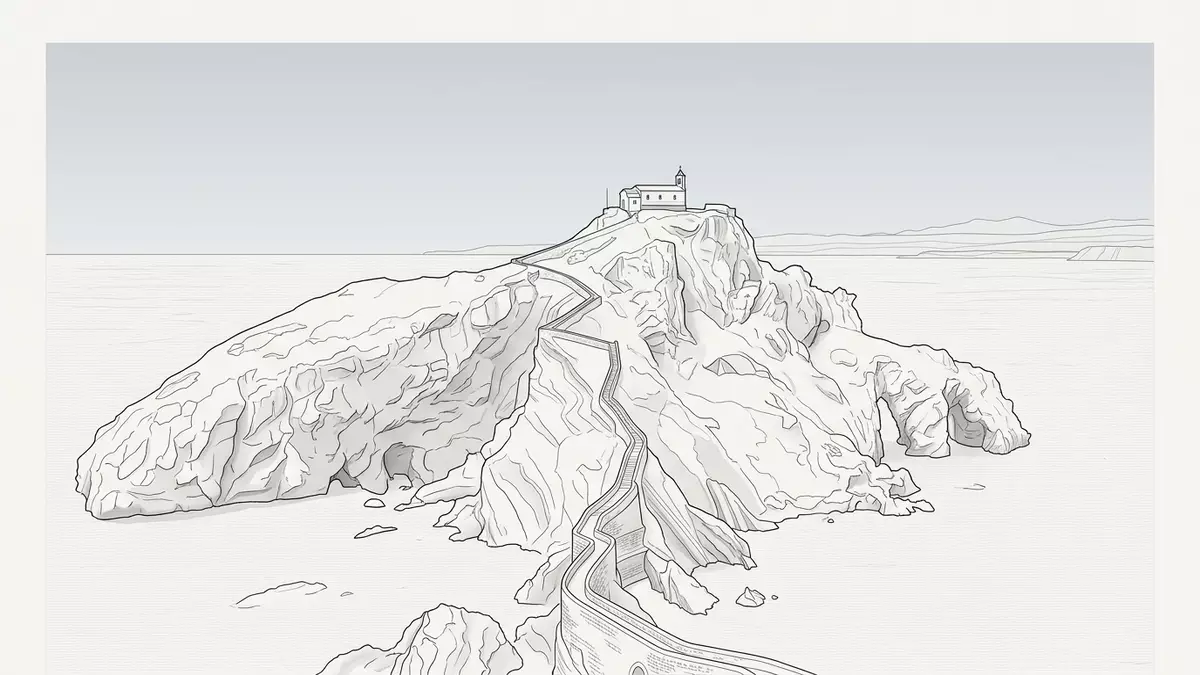
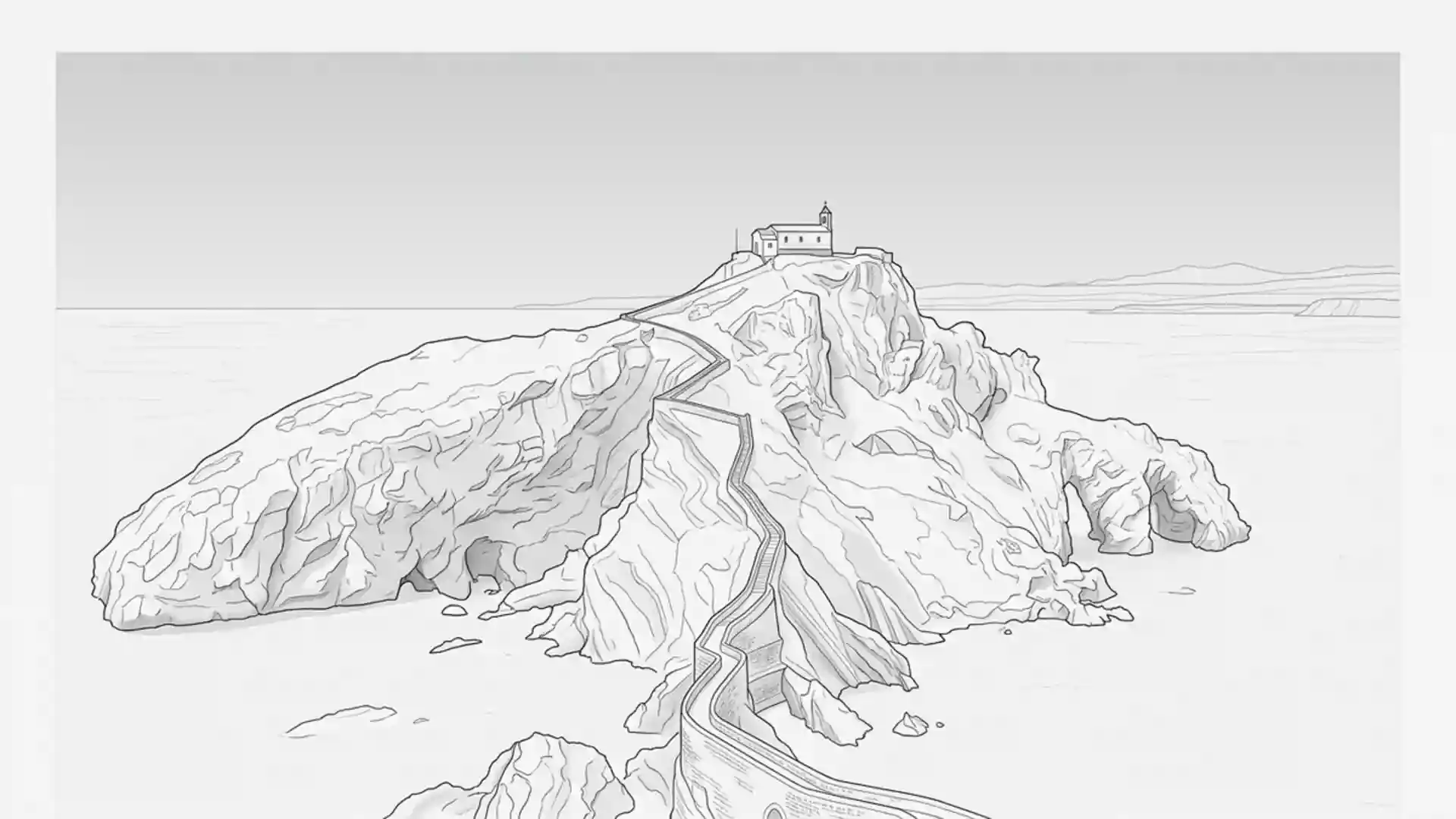
On the rugged Biscay coastline near Bermeo in Spain’s Basque Country, Gaztelugatxe presents a striking combination of rock, sea and faith: a small islet linked to the mainland by a long stone stairway leading to a solitary hermitage at the summit. The sanctuary dedicated to Saint John the Baptist crowns the highest point of this sea?washed outcrop, and the entire approach, from the clifftop down to the bridge and up the steps, forms a continuous built path across Atlantic swells and pale limestone.
A Basque islet between Bermeo and Bakio
Gaztelugatxe lies off the northern coast of Spain, on the Bay of Biscay, belonging to the municipality of Bermeo in the Basque Autonomous Community.an islet on the coast of the Bay of Biscay It sits between the coastal towns of Bermeo and Bakio, forming part of a protected natural biotope that also includes the nearby islet of Akatz.San Juan de Gaztelugatxe and Aketze
The name Gaztelugatxe comes from Basque and has been interpreted as “castle rock” or “inaccessible castle”, a reflection of the way the conical mass of stone rises steeply from the sea with its summit enclosed by walls and the small hermitage.castle rock or inaccessible castle The islet’s pale limestone contrasts with dark patches of vegetation and the deep water around it, while the mainland side is framed by cliffs cut by the road connecting Bermeo and Bakio.between the coastal towns of Bakio and Bermeo
The hermitage of Saint John on the summit
At the highest point of Gaztelugatxe stands a small hermitage dedicated to Saint John the Baptist, known in Spanish as San Juan de Gaztelugatxe.a hermitage dedicated to John the Baptist The shrine is traditionally dated to the tenth century, with archaeological finds suggesting that religious use on the site may reach back into the ninth century.hermitage that dates from the 10th century Over the centuries the building has suffered fires and attacks, leading to repeated rebuilding, and the present rectangular structure reflects these later reconstructions while keeping the long?established dedication to Saint John.the shrine dates from the 10th century
The hermitage rises above low walls and simple paved areas, with a bellcote over the entrance holding a bell that visitors ring, a gesture associated locally with wishes and the warding off of misfortune.a belfry that houses a bell Inside, the interior reflects the maritime culture of Biscay through fishing?related offerings, models of boats and paintings, connecting the saint’s protection with the communities of Bermeo and surrounding villages.deep roots in fishing
A stone path of hundreds of steps over the sea
The most distinctive feature of Gaztelugatxe is the way the islet is reached: a man?made stone bridge and stairway that link the rock to the mainland and climb in a series of curves up to the summit.a stone bridge built by man The route from the coast to the hermitage involves a descent from the clifftop area down towards sea level, crossing the solid bridge over the waves, and then ascending a long stairway laid out along the spine of the islet.descent from the mainland parking or viewpoint area
The stairway is marked by Stations of the Cross and counted at 241 steps in several descriptions, a figure that has become part of how visitors talk about the climb.The island has 241 steps Along the way, views open towards the open Bay of Biscay, the nearby Akatz islet and the battered cliffs of this stretch of Basque shore, while the stonework of the bridge and staircase shows how the route cuts across exposed rocks and small inlets.two rocky islets of typically pale limestone colour
Visiting Gaztelugatxe: what travellers from Western Europe should know
- Gaztelugatxe is reached from the coastal road between Bermeo and Bakio in northern Spain, with access paths leading down from the mainland side to the stone bridge over the sea.Travelling along the road between Bermeo and Bakio
- The approach to the hermitage involves a descent on foot along a coastal path, crossing the bridge and then climbing several hundred stone steps arranged in a steep stairway on the islet.after having exceeded two hundred and forty steps
- The terrain combines cobbled paths, exposed rock and sustained gradients, so sturdy footwear and readiness for uneven surfaces help when making the ascent and descent.
- The official language in this part of Spain is Spanish, alongside Basque, and the currency is the euro.
Searching for Gaztelugatxe on social platforms
These links open searches for Gaztelugatxe on each platform.
Frequently asked questions about Gaztelugatxe
Where is Gaztelugatxe located?
Gaztelugatxe is off the Bay of Biscay coast in Spain’s Basque Country, belonging to the municipality of Bermeo between the towns of Bermeo and Bakio.
What should visitors expect on the walk to the hermitage?
The visit involves descending from the mainland down coastal paths, crossing a stone bridge over the sea and climbing several hundred steep stone steps to the summit.
What makes Gaztelugatxe distinctive among coastal sites?
The combination of a medieval hermitage to Saint John on a small islet, reached entirely by a long stone stairway over Atlantic waves, gives Gaztelugatxe its distinctive character.