
Gateway of India rises above Mumbai’s harbourfront
Published on 09/24/2026 at 11:02 | Editorial responsibility: Rafael Müller, Editor-in-Chief AD HOC NEWS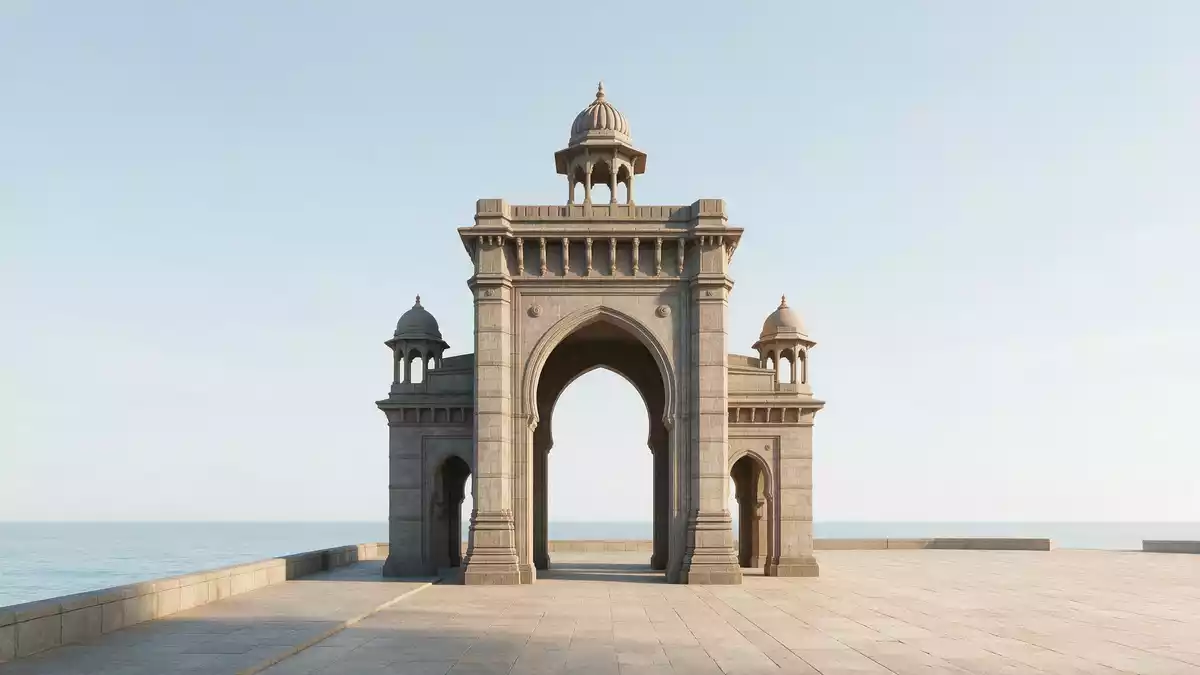
Gateway of India stands on Mumbai’s harbourfront as a broad yellow-basalt arch facing the Arabian Sea. George Wittet’s monument was completed in 1924, and its Indo-Saracenic design combines a monumental gateway with carved stone detail and an open central passage.
Gateway of India and the shape of Mumbai’s waterfront
The monument occupies Apollo Bunder, beside the waterfront in southern Mumbai. Its pale stone façade, projecting turrets and central dome form a strong architectural silhouette against the harbour.
Gateway of India is an arch-monument rather than an enclosed building. The central opening frames the water beyond, while the surrounding masonry carries bands, screens and sculpted ornament associated with Indo-Saracenic architecture. Yellow basalt gives the structure its distinctive surface and substantial appearance.
George Wittet’s Indo-Saracenic monument
Scottish architect George Wittet designed Gateway of India, with the final design approved in 1914. The building draws on sixteenth-century Gujarati architectural forms and combines Indian, Islamic and European elements.
The foundation stone was laid in 1911, marking a monument connected with the visit of King George V and Queen Mary to Mumbai. Their arrival took place on 2 December 1911, before the permanent structure had been completed. The finished arch opened in 1924, completed Gateway of India becoming part of the city’s ceremonial waterfront.
From imperial gateway to historical landmark
Gateway of India records a moment in British India, but its meaning also belongs to the history of independent India. The last British troops departed through the arch on 28 February 1948, after Indian independence.
The monument’s setting brings several layers of Mumbai together. The arch faces the Arabian Sea, the harbour lies beside it, and the surrounding district contains major colonial-era and commercial buildings. The nearby Taj Mahal Palace forms a separate landmark within the same waterfront scene.
Its material and form remain legible from close range. Basalt blocks shape the main body, reinforced concrete supports the structure, and carved details soften the heavy geometry. The result is a gateway that functions as architecture, memorial and urban meeting point.
Visiting Gateway of India: what travellers from Western Europe should know
- Gateway of India stands at Apollo Bunder in Colaba, southern Mumbai, beside the Arabian Sea. Road transport, taxis and local city services reach the Colaba waterfront.
- The approach is across a paved urban waterfront and includes steps around the monument. The central arch is viewed from an open public forecourt.
- The site lies beside Mumbai Harbour, with boat services and the Taj Mahal Palace in the surrounding waterfront district.
- The official language is Marathi and the currency is the Indian rupee.
- Entry requirements depend on your nationality; UK travellers can check the FCDO travel advice at gov.uk/foreign-travel-advice, Irish travellers the Department of Foreign Affairs at ireland.ie.
Searching for Gateway of India on social platforms
These links open searches for Gateway of India on each platform.
Frequently asked questions about Gateway of India
Where is Gateway of India?
Gateway of India stands at Apollo Bunder in Colaba, southern Mumbai, on the Arabian Sea waterfront.
What can visitors expect at the monument?
Visitors encounter an open basalt arch, carved architectural details, a harbour setting and views towards Mumbai’s waterfront landmarks.
What makes Gateway of India distinctive?
Its yellow-basalt construction, Indo-Saracenic design and 1924 completion give the monument its recognisable architectural character.


