
Gateway of India, Mumbai’s basalt arch on the Arabian Sea
Published on 08/29/2026 at 09:01 | Editorial responsibility: Rafael Müller, Editor-in-Chief AD HOC NEWS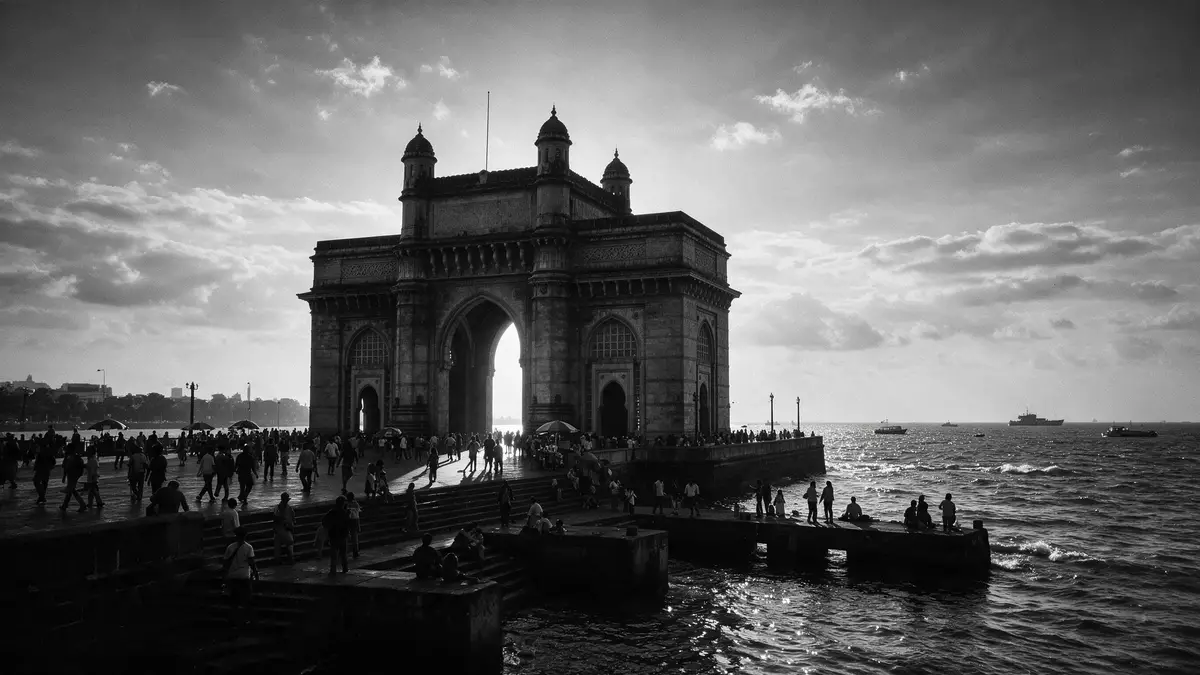
Gateway of India stands on Mumbai’s southern waterfront as a ceremonial basalt arch facing the Arabian Sea and the old harbour at Apollo Bunder. Completed in 1924 and designed by Scottish architect George Wittet in an Indo-Saracenic style, it has become one of the city’s most recognisable stone landmarks and a fixed point where sea, city and colonial history meet.
An Indo-Saracenic arch at Apollo Bunder
The monument rises from a paved plaza at Apollo Bunder in the Colaba district, with its landward side opening towards the streets and its seaward face aligned with the harbour. The central archway is framed by moulded piers and decorative bands, forming a single dominant opening through which visitors look towards the water and the boats moored beyond.The archway of the monument is 26 meters high and topped by a dome whose diameter is recorded at about 15 m (49 ft), giving the structure a compact but powerful profile against the sea.The central dome is about 15 meters in diameter
Indo-Saracenic architecture blends elements from Indian, Islamic and European traditions, and Gateway of India shows this mixture clearly on its yellow basalt and concrete surfaces.The arch is crafted from vibrant yellow basalt and concrete and decorated with carved motifs that echo both Muslim and Hindu patterns. Four corner turrets rise above the main body, while parapets and finials run along the roofline, giving the arch the silhouette of a small fort as much as a ceremonial gateway. At ground level, broad stone steps and platforms create a transition between the city’s traffic and the monument’s more formal space.
From royal landing place to symbol of Mumbai
Gateway of India was commissioned to mark the landing of King George V and Queen Mary at Apollo Bunder during their 1911 visit to India, a key ceremonial moment of British rule.The monument was built to commemorate the December 1911 landing of King George V and Queen Mary and the foundation stone was laid in the second decade of the twentieth century before work continued over several years.The monument was completed in 1924 and inaugurated in December that year on the waterfront in what was then Bombay.
George Wittet, who served as Consulting Architect to the Government of Bombay, set the monument firmly in the early twentieth-century taste for grand ceremonial arches while drawing on local building traditions.The Gateway of India, Mumbai, was designed by George Wittet and its completion in the 1920s coincided with wider political changes in India that would later give the arch a different meaning. It stands in front of the historic Taj Mahal Palace Hotel, forming a kind of stone threshold between the colonial seafront and the commercial streets behind, and has become a visual shorthand for Mumbai in photographs, films and travel literature.
Layout, surroundings and a day on the waterfront
Physically, Gateway of India is part of a broader ensemble of harbour structures, streets and open spaces at the southern tip of Mumbai. The paved open area around the monument is enclosed by low walls and railings, with views across the water to the boats that depart from the harbour and across to naval and commercial facilities on the far shore.The monument stands on the harbour front of Mumbai and marks a point where travellers arriving by sea once stepped onto land beneath its basalt arch. Behind it, Colaba’s streets lead towards other parts of South Mumbai, making the gateway an easy landmark to combine with nearby museums, markets and promenades.
Visitors approaching Gateway of India on foot cross the surrounding plaza, where the stone paving and the elevation of the arch create a clear focal point. The structure’s height of 26 m (85 ft) means it is visible from different angles along the waterfront, and the combination of carved details and strong geometric forms gives plenty of points of interest even on a short visit.The monument measures 26 meters high and the open space in front of it often frames the arch against the Arabian Sea, making the gateway as much a landscape feature as an object of architectural history.
Visiting Gateway of India: what travellers from Western Europe should know
- Gateway of India stands in South Mumbai’s Colaba district, on the waterfront at Apollo Bunder, opposite the Taj Mahal Palace Hotel and beside the harbour.
- The immediate area around the monument is level and paved, but reaching the base of the arch involves crossing wide open stone surfaces that can be exposed to sun and heat.
- Mumbai lies on India’s west coast; the official language is Hindi alongside regional languages, and the currency is the Indian rupee.
- Entry requirements depend on your nationality; UK travellers can check the FCDO travel advice at gov.uk/foreign-travel-advice, Irish travellers the Department of Foreign Affairs at ireland.ie.
Searching for Gateway of India on social platforms
These links open searches for Gateway of India on each platform.
Frequently asked questions about Gateway of India
Where is Gateway of India located in Mumbai?
Gateway of India stands at Apollo Bunder in the Colaba district of South Mumbai, on the city’s harbour front facing the Arabian Sea.
What can visitors expect when they reach Gateway of India?
Visitors find a large paved plaza, the basalt arch rising 26 m (85 ft) above it, and views across the harbour, with city streets and historic buildings close by.
What makes Gateway of India distinctive among Mumbai’s landmarks?
Its Indo-Saracenic basalt arch, association with the 1911 royal visit and seafront position at Apollo Bunder combine to make Gateway of India a defining image of Mumbai.


