
Gateway of India in Mumbai, where stone arch meets harbour
Published on 09/16/2026 at 14:56 | Editorial responsibility: Rafael Müller, Editor-in-Chief AD HOC NEWS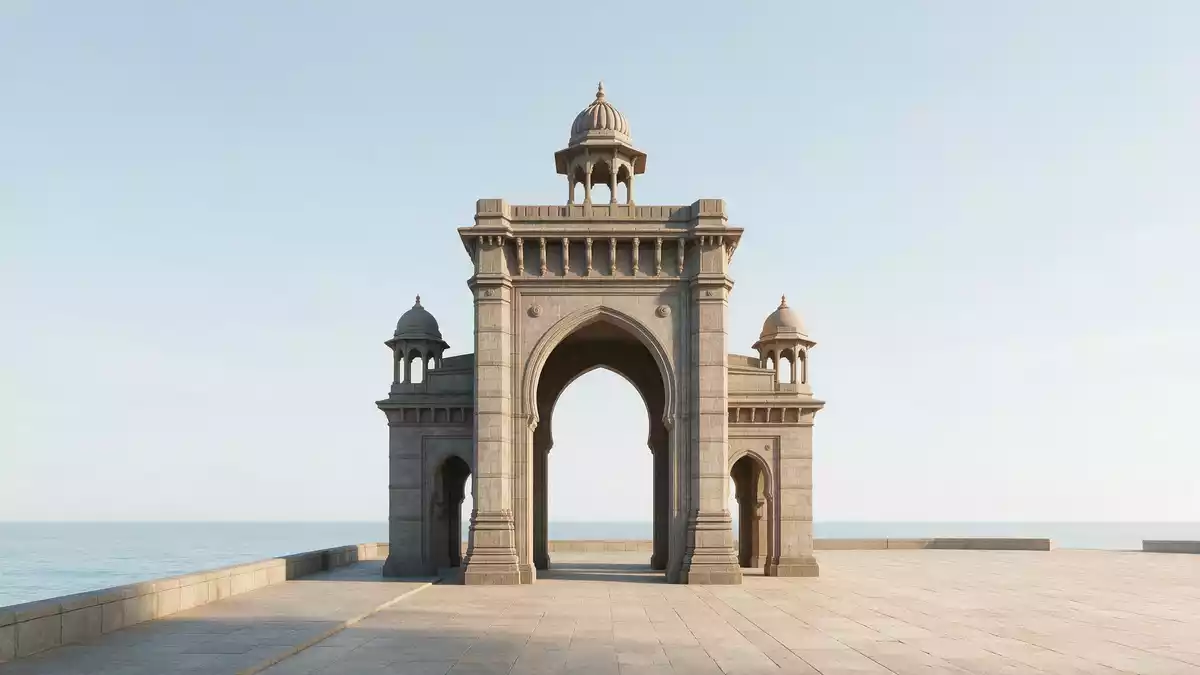
Gateway of India is a monumental stone arch on the waterfront of Mumbai, standing where the city meets the Arabian Sea at Apollo Bunder. Conceived in the early twentieth century and completed in 1924, it combines Indo-Saracenic design with local Gujarati influences in a single, ceremonial gateway facing the harbour.
An arch between city and sea
Gateway of India stands at Apollo Bunder, the historic pier area on the southern tip of Mumbai, with the harbour immediately in front and the city’s streets fanning out behind.Apollo Bunder on the Arabian Sea gave the monument its orientation, so the main elevation faces the water, forming a ceremonial landing point for visitors arriving by ship. From the plaza, the arch frames views of the bay and the constant movement of boats on the water.
The structure rises from a broad platform that steps down towards the harbour, with the main archway in the centre and smaller side openings set into thick piers on either side. Above the main opening a deep cornice runs horizontally, and small domed turrets project at the corners, marking the transition between the vertical mass of the piers and the sky. The whole composition reads as a single, freestanding gateway rather than part of a larger building, and its position on the reclaimed waterfront makes it a clear marker between land and sea.arch-monument on the waterfront
Colonial beginnings and dates in stone
The idea for Gateway of India was tied to the visit of King George V and Queen Mary to India for the Delhi Durbar in December 1911, when they landed at Apollo Bunder on their way through Bombay.the 1911 royal landing at Apollo Bunder The foundation stone was laid in March 1913, and construction of the main structure began later in the decade once land reclamation and foundations were complete.construction started in March 1913 The monument was completed and inaugurated in 1924, giving Bombay a new ceremonial entrance that tied imperial ritual to the city’s harbourfront.
Gateway of India was designed by George Wittet, a Scottish architect who served as Consulting Architect to the Government of Bombay and was responsible for several major public buildings in the city.George Wittet as architect He worked in an Indo-Saracenic style, combining elements from Hindu and Islamic architecture with European composition. The gateway commemorates the visit of King George V and Queen Mary and later gained a further historical layer when the last British troops stationed in India departed through it in 1948, turning a colonially commissioned arch into a marker of the end of British rule.departure of British troops in 1948
Indo-Saracenic form in yellow basalt
Architecturally, Gateway of India is built in yellow basalt stone over a reinforced concrete structure, with the stonework giving the arch its colour and texture.yellow basalt stones over concrete The main arch rises to about 26 m (85 ft), with a central dome measuring around 15 m (50 ft) in diameter set back above the opening.26 m height and 15 m dome Decorative bands run around the arch and the dome, and carved motifs on the spandrels and panels reflect Gujarati and Islamic patterns, including stylised floral forms and slender projections that recall minaret-like profiles.
The style is described as Indo-Saracenic, a British colonial design language that blends Indian and Islamic motifs with elements of Gothic Revival massing.eclectic Indo-Saracenic style In Gateway of India this is visible in the pointed form of the main arch, the clustered decorative details at the top of the piers, and the series of small domed kiosks that punctuate the parapet line. The plan of the monument is relatively compact, focusing on the central opening and its flanking passages, so the architectural interest lies in the elevations and profiles rather than in a complex interior. Stone balustrades, moulded plinths and carved panels give the surfaces depth, while the overall mass remains legible as a single arch aligned with the harbour.
Visiting Gateway of India: what travellers from Western Europe should know
- Gateway of India stands at Apollo Bunder on the southern seafront of Mumbai, close to the tip of the city’s peninsula and facing the harbour.
- The monument is reached along level pavements from nearby streets, with broad steps and a stone platform leading down towards the water.
- The official language is Hindi and the currency is the Indian rupee.
- Entry requirements depend on your nationality; UK travellers can check the FCDO travel advice at gov.uk/foreign-travel-advice, Irish travellers the Department of Foreign Affairs at ireland.ie.
Searching for Gateway of India on social platforms
These links open searches for Gateway of India on each platform.
Frequently asked questions about Gateway of India
Where is Gateway of India located in Mumbai?
Gateway of India stands at Apollo Bunder on the southern seafront of Mumbai, at the edge of the harbour where the city meets the Arabian Sea.
What should visitors expect when they come to Gateway of India?
Visitors encounter a freestanding stone arch on a broad platform by the water, with level access from surrounding streets and open views across the harbour.
What makes Gateway of India distinctive among Mumbai’s landmarks?
The combination of yellow basalt Indo-Saracenic architecture, its 1924 completion as a royal commemorative arch and its position facing the harbour gives Gateway of India a particular character in Mumbai.


