
Gateway of India and Mumbai's basalt arch
Published on 09/12/2026 at 06:50 | Editorial responsibility: Rafael Müller, Editor-in-Chief AD HOC NEWS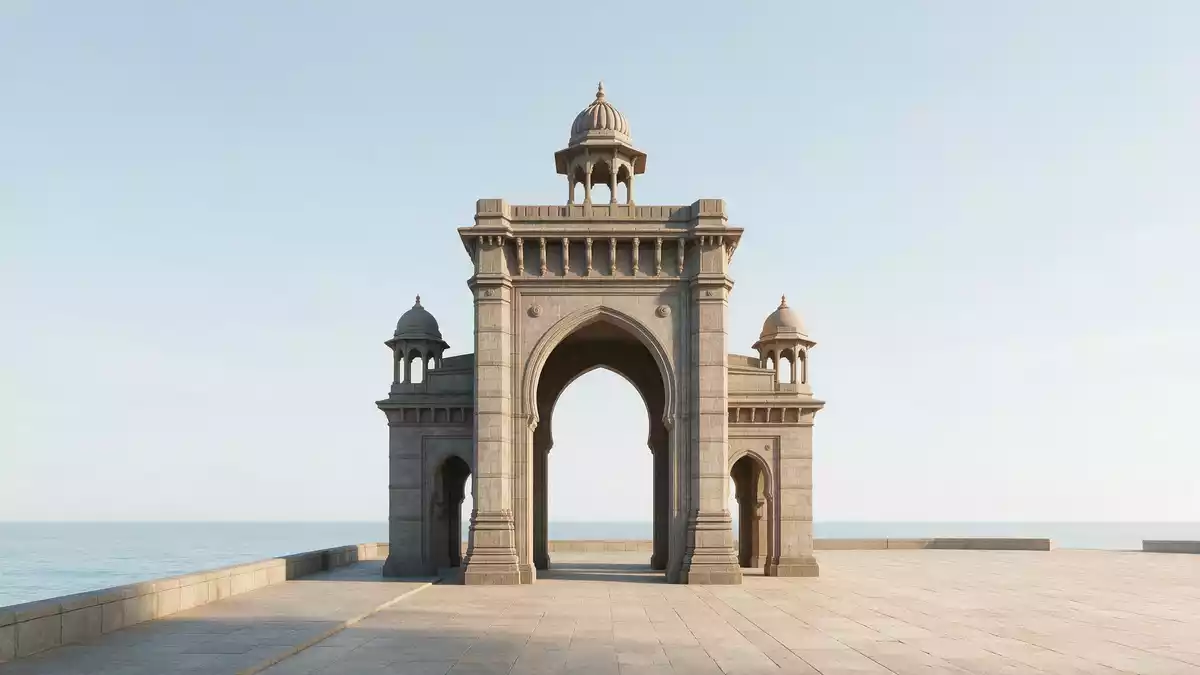
Gateway of India rises on Mumbai’s waterfront as a yellow basalt arch completed in 1924. Designed by George Wittet, it stands in the Indo-Saracenic style and remains one of the city’s clearest colonial-era landmarks.George Wittet
George Wittet’s arch on Apollo Bunder
The monument stands at Apollo Bunder, facing the Arabian Sea, and its scale makes the composition easy to read from the promenade. Yellow basalt, reinforced concrete and carved stone latticework give the structure a layered surface that carries Indian and Islamic motifs within a British-built public monument.yellow basalt and concrete
Its form is an arch with a central dome and turrets, a profile that is distinct from the surrounding waterfront buildings. The monument was completed in 1924, and the date belongs to the period when Mumbai’s harbourfront was being remade into a ceremonial urban edge.completed in 1924
Indo-Saracenic detail in stone
Gateway of India combines a monumental arch with surface ornament that rewards close looking. The stone latticework, domed crown and turrets sit beside the broad opening, creating a composition that feels formal rather than delicate.
George Wittet’s name is tied to the monument’s identity, and the arch belongs to the wider Indo-Saracenic current of the early twentieth century. That style drew on Indian and Islamic forms while using the ordered massing favoured by British architects in India.Indo-Saracenic style
The harbourfront setting and later life
The setting matters because the arch faces open water, with ferries and promenades making it part of Mumbai’s working harbour edge. The monument is also linked with the city’s ceremonial history, and it became a departure point in the final phase of British rule in India.
Its role changed after independence, when it remained a public landmark rather than a imperial gateway. A statue of Shivaji stands opposite, adding another historical layer to the same open stretch of waterfront.Shivaji
Visiting Gateway of India: what travellers from Western Europe should know
- The monument stands in South Mumbai at Apollo Bunder. The nearest rail access named in tourist information is Mumbai Central Railway Station, and Chhatrapati Shivaji Maharaj International Airport is the airport named for the city.
- The arch is an outdoor stone structure beside the harbour. Its broad opening, steps and paved surroundings make the waterfront edge part of the visit.
- English is widely used in Mumbai, alongside Marathi and Hindi. The currency is the Indian rupee.
- Ferries leave from the waterfront area towards Elephanta Island, whose cave temples are a separate UNESCO-listed site.
Searching for Gateway of India on social platforms
These links open searches for Gateway of India on each platform.
Frequently asked questions about Gateway of India
Where is Gateway of India?
It stands at Apollo Bunder in South Mumbai, on the edge of the harbour. The arch faces the Arabian Sea and anchors the waterfront beside the city’s ferry activity.
What does a visit reveal?
The place gives a close view of an early twentieth-century monumental arch, its yellow basalt surface and its harbour setting. The open forecourt, steps and sea-facing position define the experience.
What makes it distinctive?
The combination of George Wittet’s design, the 1924 completion date and the Indo-Saracenic vocabulary gives it a strong identity. The arch, dome, turrets and carved stone details make the profile immediately recognisable.


