
Gandantegchinlen Monastery, the great place of complete joy in Ulaanbaatar
Published on 08/28/2026 at 07:17 | Editorial responsibility: Rafael Müller, Editor-in-Chief AD HOC NEWS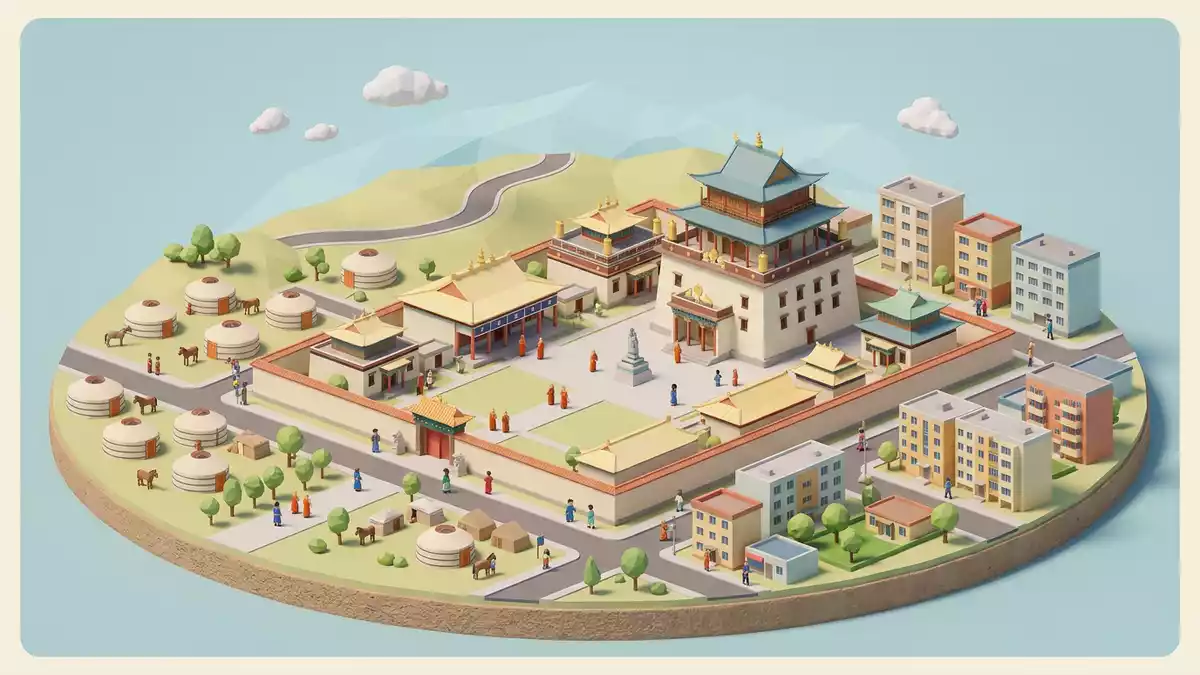
Gandantegchinlen Monastery in Ulaanbaatar, often shortened to Gandan Monastery, is a major centre of Mongolian Buddhism where temple halls, courtyards and colleges cluster on a hillside west of the city centre. Its name translates as “the great place of complete joy”, and the complex has served as the principal monastery of the Gelug order in Mongolia since the nineteenth century.
A hillside monastery shaped by Buddhism and history
Gandantegchinlen Monastery stands in the Bayangol district of Ulaanbaatar, on a rise that gives its temples a clear presence above surrounding streets and apartment blocks.Bayangol district location The Mongolian name “Gandantegchinlen khiid” is often shortened in everyday use to “Gandan”, and the monastery functions as both a religious institution and a landmark in the city’s western quarters.central monastery of Buddhism
The monastery complex grew during the nineteenth century, with sources giving founding dates in the early decades of that century, and it is closely linked to the Jebtsundamba Khutuktu, the reincarnate lama who served as spiritual head of Mongolian Buddhism.established in the nineteenth century During the socialist period it was the only functioning monastery in the country for many years, with religious activity permitted there under tight state control while most other monasteries were closed.sole functioning monastery under socialism
Temples, colleges and the monumental Avalokite?vara
The most striking single feature of Gandantegchinlen Monastery is the towering statue of Avalokite?vara, known locally as Megjid-Janraiseg, which rises inside a main temple hall.26.5-metre Avalokite?vara statue This image of the bodhisattva of compassion stands over 26 m (around 87 ft) high, making it one of the tallest indoor religious statues recorded in the world.tallest indoor statue record The statue is gilded and set with thousands of precious stones, and its vertical scale dominates the interior space, drawing attention upward to the painted ceiling and surrounding gallery.
The original Megjid-Janraiseg statue was created in the early twentieth century and later dismantled and melted down during the Stalinist repressions in the late 1930s, when religious artefacts across Mongolia were destroyed.destruction of the original statue After the end of the Soviet period, the Avalokite?vara image was rebuilt in the 1990s with donations from across Mongolia, reinstating a central focus of worship that had been absent for decades.rebuilding in 1996 funded by donations Around the main temple, the complex includes multiple shrine halls and assembly spaces, as well as monastic colleges that teach Buddhist philosophy, ritual and related disciplines.teaching monastery with Buddhist university
Courtyards, prayer wheels and city surroundings
Gandantegchinlen Monastery extends across several courtyards where stupas, prayer wheels and smaller chapels stand among paved walks and patches of open ground. Visitors pass between painted façades, brightly coloured rooflines and sculpted details that reflect Tibetan Buddhist iconography adapted to Mongolian building traditions.complex of shrines and halls The setting on Dalkha Hill places the monastery slightly above the main commercial streets, and glimpses of city traffic and apartment blocks frame the religious structures, emphasising how monastic life and urban growth share the same space.location on Dalkha Hill northwest of Sükhbaatar Square
Inside the complex, the layout reflects its role as a working monastery. Assembly halls house chanting and ritual, while colleges and accommodation buildings serve the resident monks and studentslargest monastery housing monks. The combination of tall temple volumes, smaller side chapels and outdoor spaces gives Gandantegchinlen Monastery a layered character: some areas feel like quiet study compounds, others like ceremonial grounds marked by large stupas and lines of prayer wheels.
Visiting Gandantegchinlen Monastery: what travellers from Western Europe should know
- Gandantegchinlen Monastery stands in the Bayangol district on Dalkha Hill, north-west of central Ulaanbaatar; it can be reached on foot from Sükhbaatar Square or by city bus and taxi services that serve the Gandan neighbourhood.
- Within the complex, access between temples and courtyards involves walking over paved surfaces and climbing short flights of steps; interior staircases in some towers and galleries are narrow and may feel steep.
- The monastery sits at the elevation of Ulaanbaatar’s urban basin rather than on a high mountain, but winter brings sub-zero temperatures and snow to the city, so surfaces in the courtyards can be icy in the coldest months.
- Gandantegchinlen Monastery is part of a wider cluster of religious and cultural sites in the city; Sükhbaatar Square, the National Museum of Mongolia and various other institutions lie within walking distance for visitors combining several stops.
- The official language is Mongolian and the currency is the tugrik; entry requirements depend on your nationality, UK travellers can check the FCDO travel advice at gov.uk/foreign-travel-advice, Irish travellers the Department of Foreign Affairs at ireland.ie.
Searching for Gandantegchinlen Monastery on social platforms
These links open searches for Gandantegchinlen Monastery on each platform.
Frequently asked questions about Gandantegchinlen Monastery
Where is Gandantegchinlen Monastery located?
Gandantegchinlen Monastery stands on Dalkha Hill in the Bayangol district of Ulaanbaatar, north-west of Sükhbaatar Square in Mongolia’s capital.
What should visitors expect on a visit?
Visitors encounter a working Buddhist monastery with large temple halls, monastic colleges, open courtyards and the towering indoor statue of Avalokite?vara.
What makes Gandantegchinlen Monastery distinctive?
Its combination of historical significance, role as Mongolia’s main Gelug monastery and the rebuilt 26 m Avalokite?vara statue gives the complex a distinctive presence in Ulaanbaatar.


