
Gandantegchinlen Monastery and its towering Avalokitesvara
Published on 09/01/2026 at 13:12 | Editorial responsibility: Rafael Müller, Editor-in-Chief AD HOC NEWS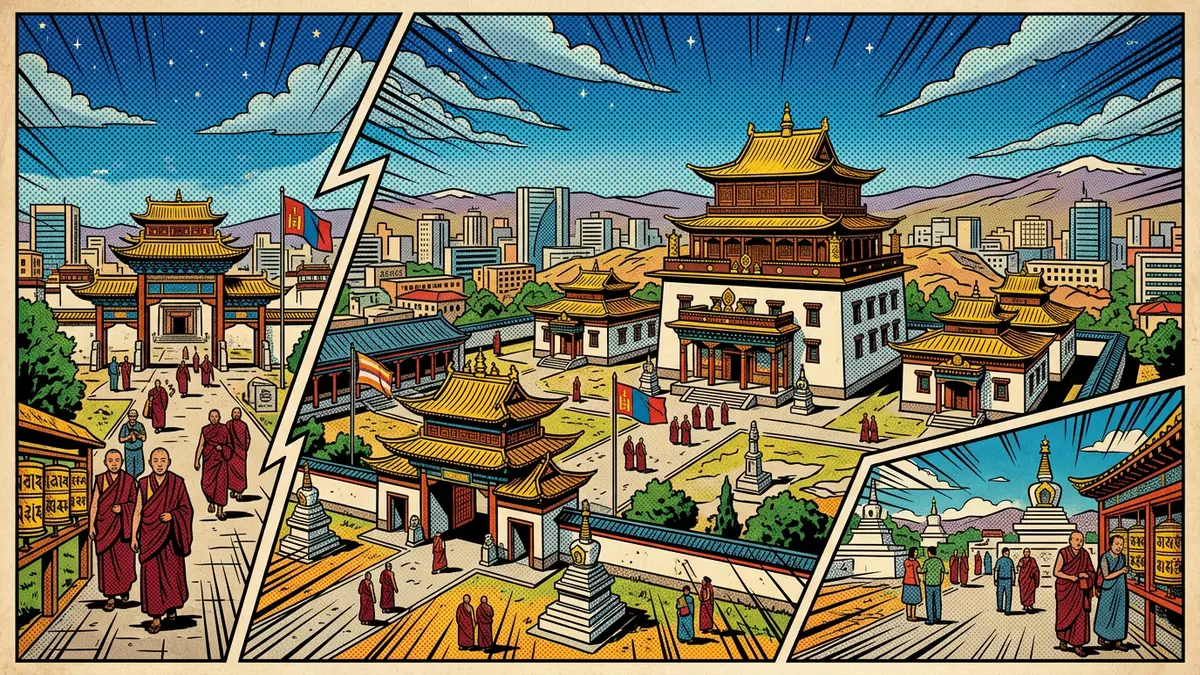
Gandantegchinlen Monastery in Ulaanbaatar is one of the most prominent centres of Buddhism in Mongolia, known both for its long history and for a towering gilded statue of Avalokitesvara that fills a main temple hall. The complex took shape during the nineteenth century as a major monastic centre linked to the Jebtsundamba Khutuktu, and later became the country’s only functioning monastery under socialist rule.
The great place of complete joy
The name Gandantegchinlen is a Tibetan phrase that translates as “the great place of complete joy”, and the monastery is built in a Tibetan-style tradition within the Mongolian capital of Ulaanbaatar.Tibetan-style monastery It stands on a rise west of the city centre, and its cluster of temples and colleges forms a distinct religious quarter within the expanding urban landscape.
The development of Gandantegchinlen Monastery is closely associated with the Jebtsundamba Khutuktu, the reincarnate lama who served as spiritual head of Mongolian Buddhism.Jebtsundamba Khutuktu In the early nineteenth century a new monastic school and temple complex bearing the name Gandan was established, named in honour of Ganden Monastery in Lhasa, and further buildings in masonry were added over the following decades.new monastery named Gandan As colleges for philosophy and ritual teaching grew up around it, the site took on the role of principal monastery of the Gelug order in Mongolia.
Architecture shaped by Mongolian and Tibetan traditions
Walking into Gandantegchinlen Monastery brings a mixture of Mongolian and Tibetan architectural forms, with timber and masonry halls arranged around courtyards and side alleys.combined architectural styles Roofs with upturned eaves and brightly painted wooden brackets sit alongside more massive temple structures, and the complex includes separate shrine halls, assembly spaces and monastic colleges devoted to different aspects of Buddhist learning.
The monastery’s role as a centre of education is long established: by the beginning of the twentieth century, thousands of monks lived and studied here in colleges devoted to Buddhist philosophy, astrology and medicine.monastic education centre Despite later political upheavals, this academic character still shapes the way the complex is organised, with teaching spaces, prayer halls and residential buildings forming a layered religious environment in the city.
Repression, survival and revival
In the late 1930s, during anti-religious persecutions in Mongolia, Gandantegchinlen Monastery was closed and much of its fabric was damaged or destroyed.closure during persecutions Many monks were dispersed, and religious life across the country was violently suppressed.
The site gained a new role during the socialist period when it was reopened in 1944 under tight state control and became the only officially operating Buddhist monastery in Mongolia.only active monastery under socialism While most other monasteries remained closed, Gandantegchinlen Monastery served as a showcase of religious practice, with limited numbers of clergy permitted to reside and perform rituals, preserving a thread of Buddhist continuity that later helped fuel a broader religious revival after democratisation.
The Avalokitesvara statue: vertical scale in a temple interior
The most striking single feature of Gandantegchinlen Monastery is a giant statue of Avalokitesvara, known locally as Migjid Janraisig, which rises inside one of the main temple halls.Avalokitesvara statue height The figure stands around 26.5 m (about 87 ft) tall, placing it among the tallest indoor religious statues recorded in the world and giving the hall a dramatic sense of vertical scale.tallest indoor statue
The statue is gilded and set with thousands of precious stones, and its towering form is framed by painted walls and upper galleries within the temple.gilded statue with stones Visitors entering the hall see the bodhisattva of compassion rising past hanging banners towards the decorated ceiling, with the surrounding space organised around this single monumental image. The original statue, created in the early twentieth century and later dismantled during the Stalinist purges, was rebuilt in 1996 with donations from across Mongolia, reinstating a central focus of worship that had been absent for decades.rebuilding in 1996
Visiting Gandantegchinlen Monastery: what travellers from Western Europe should know
- Gandantegchinlen Monastery stands to the west of Ulaanbaatar’s central districts and is reached over city streets by road vehicles or local public transport.
- The monastery complex includes courtyards and temple interiors connected by paved paths and stairways, with some halls reached via steps and narrow doorways.
- The surrounding city districts include residential neighbourhoods and other civic buildings, and the monastery’s elevated position offers views towards central Ulaanbaatar.
- The official language is Mongolian and the currency is the tugrik.
- Entry requirements depend on your nationality; UK travellers can check the FCDO travel advice at gov.uk/foreign-travel-advice, Irish travellers the Department of Foreign Affairs at ireland.ie.
Searching for Gandantegchinlen Monastery on social platforms
These links open searches for Gandantegchinlen Monastery on each platform.
Frequently asked questions about Gandantegchinlen Monastery
Where is Gandantegchinlen Monastery and what kind of site is it?
Gandantegchinlen Monastery is a Tibetan-style Buddhist monastic complex west of central Ulaanbaatar, serving as a major religious and educational centre in Mongolia.
What can visitors expect when they enter the monastery complex?
Visitors encounter a series of temples, colleges and courtyards, including a main hall dominated by a towering gilded statue of Avalokitesvara rising towards the decorated ceiling.
What makes Gandantegchinlen Monastery distinctive among Buddhist sites?
Its combination of Mongolian and Tibetan architectural forms, its role as the sole officially operating monastery in socialist Mongolia, and its giant Avalokitesvara statue together give it a distinctive character.


