
Gamcheon Munhwa Maeul, Busan’s hillside maze of colour and art
Published on 08/23/2026 at 10:08 | Editorial responsibility: Rafael Müller, Editor-in-Chief AD HOC NEWS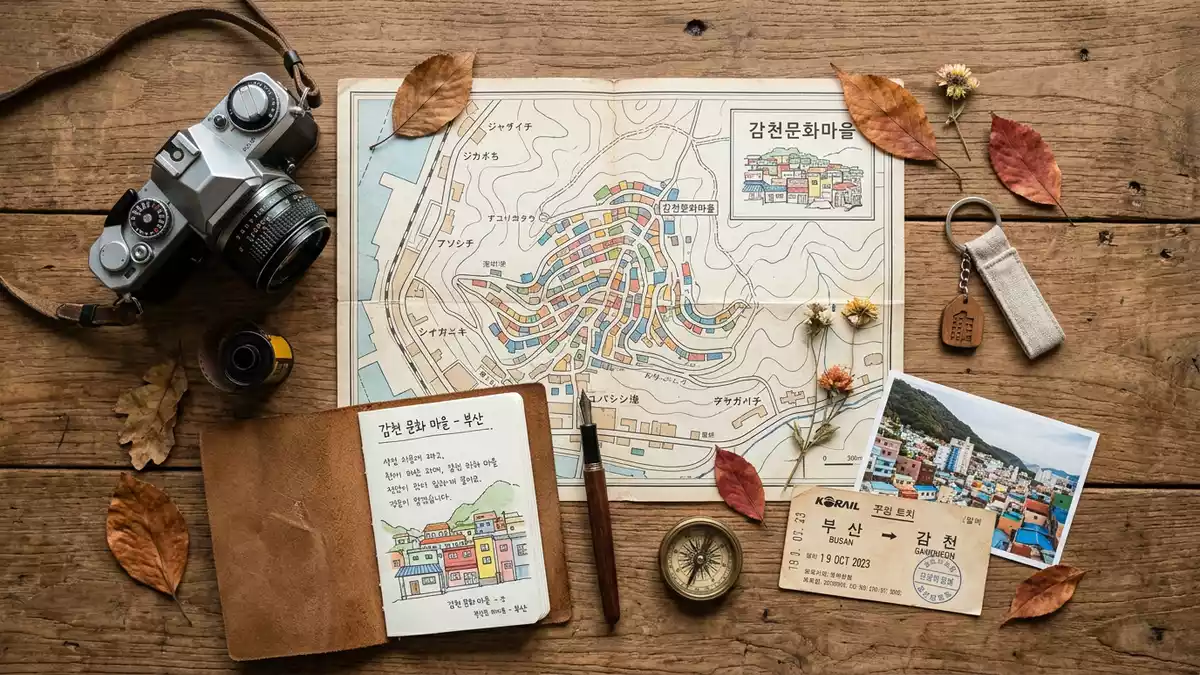
On the steep western slopes of Busan, Gamcheon Munhwa Maeul spreads across the hillside in tightly packed tiers of houses, stairways and alleys painted in bright colours. Once a compact settlement for war refugees in the early 1950s, it has grown into a neighbourhood where everyday life and contemporary art share the same maze of terraces and lanes.
A terraced village shaped by the hillside
Gamcheon Munhwa Maeul occupies a mountainside in Saha-gu, a district on the south-western side of Busan, facing towards the port and the sea. The houses step up the slope in rows, forming a layered silhouette that recalls the stepped settlements of other mountainous regions. They are built close to one another on narrow plots, with flat roofs and simple forms that follow the gradient of the land rather than a regular street grid.Gamcheon Village was built during the 1920s and 1930s as a working-class area, with the Busan city administration directing residents to this secluded hillside while keeping them near the harbour and industrial zones.
Access inside the neighbourhood is largely on foot. Stepped lanes and staircases climb between the terraces, sometimes turning sharply to work around existing buildings and small courtyards. The multi-tier layout was planned so that houses on one level do not completely block sightlines or daylight for those behind them, giving the village a characteristic appearance of stacked dwellings overlooking the lower slopes and, in places, views towards Busan’s port.Houses piled on the hillside were arranged so that no house blocks the one behind it, creating a distinctive communal form.
From refugee settlement to cultural village
The modern story of Gamcheon Munhwa Maeul is rooted in the Korean War of the early 1950s. As fighting pushed northwards and inland, Busan became a major refuge for displaced people from other parts of the Korean Peninsula.Busan became a major refuge for displaced people during the Korean War. Thousands of families arrived with few possessions and limited options for housing, and the steep hillsides above the port offered space where they could establish new homes.
In 1955 around 800 families settled in Gamcheon, many of them associated with Taegeukdo, an ascetic religious community within the wider Jeungsanism tradition.Around 800 families moved to the village in 1955, contributing to the growth of a Taegeukdo community. Over the following decades this hillside remained a low-income area, with simple houses in wood and later more permanent materials, basic infrastructure and a population that aged as younger residents departed for other parts of Busan. The temple and meeting places of Taegeukdo at the upper levels of the village continued to mark the religious origins of the settlement.
Artworks woven into everyday streets
The transformation into Gamcheon Munhwa Maeul as a cultural village began with an art-led regeneration project in 2009, when students, artists and local residents were invited to decorate the neighbourhood.In 2009 students, artists and residents decorated the village as part of the Village Art Project. The initiative encouraged painting facades in bright colours, adding murals to retaining walls and stairways, and installing sculptures and small galleries inside disused houses.
Visitors walking the alleys encounter painted fish along walls, stylised figures on stair risers and free-standing sculptures in tiny squares between houses.Dozens of works of art, including murals and sculptures, were installed in the village. Some artworks occupy interior spaces: former dwellings converted into exhibition rooms, cafés or craft shops, often retaining the scale of the original house. Others sit on roofs and corners, visible from several levels of the terraces. This layering of art within a still-inhabited residential area is one of the defining experiences of Gamcheon Munhwa Maeul.
Visiting Gamcheon Munhwa Maeul: what travellers from Western Europe should know
- Gamcheon Munhwa Maeul lies in Saha-gu in the south-west of Busan, above the port. It is reached from central Busan by city bus services and local roads that climb into the hillside neighbourhood.
- Once inside the village most movement is on foot along stepped lanes and staircases. The gradients are steep in places, and some stairways extend for several flights between the terraced levels.
- The official language is Korean and the currency is the South Korean won.
- Entry requirements depend on your nationality; UK travellers can check the FCDO travel advice at gov.uk/foreign-travel-advice, Irish travellers the Department of Foreign Affairs at ireland.ie.
Searching for Gamcheon Munhwa Maeul on social platforms
These links open searches for Gamcheon Munhwa Maeul on each platform.
Frequently asked questions about Gamcheon Munhwa Maeul
Where is Gamcheon Munhwa Maeul in Busan?
Gamcheon Munhwa Maeul is in Saha-gu, a district on Busan’s south-western side, on a steep hillside above the port and harbour areas.
What should visitors expect on a visit?
Visitors can expect stepped streets, terraced houses, numerous murals and sculptures woven into residential lanes, and views across the lower slopes of Busan.
What makes Gamcheon Munhwa Maeul distinctive among Busan’s districts?
The combination of its Korean War refugee origins, the Taegeukdo religious heritage and the later art-led regeneration gives the village a character that differs from Busan’s flat coastal districts.


