
Galle Fort’s stone streets and sea walls in Galle
Published on 08/27/2026 at 09:11 | Editorial responsibility: Rafael Müller, Editor-in-Chief AD HOC NEWS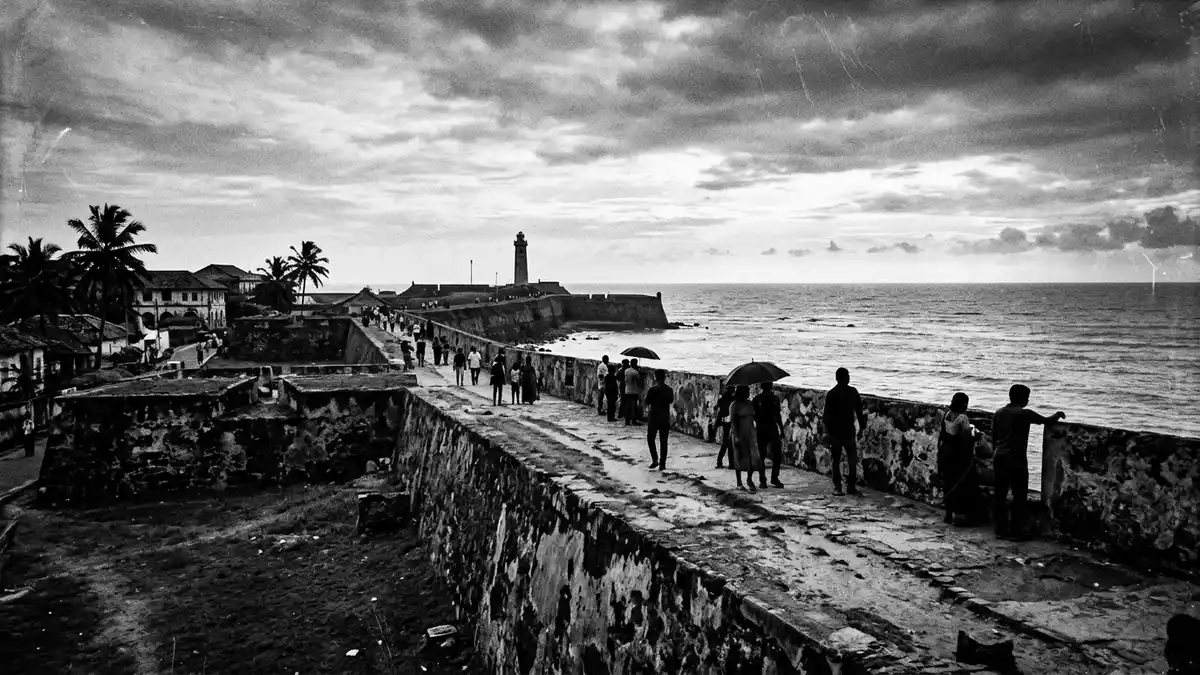
On the south-west coast of Sri Lanka, Galle Fort forms a walled headland where stone ramparts encircle a lived-in town of streets, houses and sea views. First fortified by the Portuguese in the late sixteenth century and reshaped by Dutch and British rulers, it is now inscribed by UNESCO as the Old Town of Galle and its Fortifications, a rare coastal stronghold where European masonry and South Asian town life occupy the same small peninsula.
Ramparts above the Indian Ocean
Galle Fort stands on a rocky promontory that projects into the Indian Ocean, its walls following the outline of the headland and enclosing an old town behind them.Old Town of Galle and its Fortifications The fortifications form a continuous ring of stone and coral, with bastions projecting towards the sea and the landward side cut off from the rest of Galle by a broad defensive line.granite and coral rampart
Walking the ramparts, the immediate impression is of height above the water and the sweep of the coastline beyond the fort. The walls step around corners in long straight runs, punctuated by bastions that stand above the rocks and surf. On the landward side the fort faces the modern city of Galle, with a clear change from dense contemporary streets outside to the lower skyline of the enclosed town within the walls.
From Portuguese outpost to UNESCO World Heritage Site
The first European fortification on this headland was built by the Portuguese in 1588, when they strengthened Galle as a harbour on the south-western coast.Portuguese founded the fort in 1588 In 1640 the Dutch East India Company took control of Galle after a hard-fought siege and began a comprehensive rebuilding of the defences, enclosing the entire peninsula with heavier ramparts and a more regular street plan inside.developed successively by Portuguese, Dutch and British
In 1796 British forces took over Galle Fort and retained it as a southern administrative centre, adding features such as a clock tower and lighthouse while leaving much of the Dutch-era layout intact.British took over in 1796 The cultural value of this layered colonial town, where streets, churches and houses from different European powers stand alongside Sri Lankan buildings, was recognised in 1988 when UNESCO inscribed the Old Town of Galle and its Fortifications on the World Heritage List.Designated as a UNESCO World Heritage Site in 1988
A lived-in town behind the walls
Inside the ramparts, Galle Fort is laid out as a small town, with straight streets crossing each other at right angles and lined by houses, civic buildings and religious sites.street grid that still defines the fort today Dutch-period houses with colonnaded verandas stand close to more recent structures, and churches and mosques lie within walking distance of one another. The scale remains low, with most buildings rising only a few storeys, so the ramparts and bastions are visible from many of the streets.
The fort’s streets carry both everyday life and reminders of the colonial past, from old administrative buildings to small squares close to the walls. Several bastions are accessible on foot, offering views along the ramparts and down into the enclosed streets and courtyards. The combination of domestic houses, civic structures and defensive walls gives Galle Fort the character of a compact town that has grown within a fixed stone outline over several centuries.outstanding example of a fortified colonial city
Visiting Galle Fort: what travellers from Western Europe should know
- Galle Fort stands in the coastal city of Galle on Sri Lanka’s south-west coast, on a headland that projects into the Indian Ocean and forms a distinct walled district.
- The walls and streets involve a significant amount of walking on stone surfaces, with ramps and steps on the bastions and changes in level between the ramparts and the streets below.
- The official language is Sinhala and the currency is the Sri Lankan rupee. Entry requirements depend on your nationality; UK travellers can check the FCDO travel advice at gov.uk/foreign-travel-advice, Irish travellers the Department of Foreign Affairs at ireland.ie.
Searching for Galle Fort on social platforms
These links open searches for Galle Fort on each platform.
Frequently asked questions about Galle Fort
Where is Galle Fort located?
Galle Fort stands on a headland in the coastal city of Galle in southern Sri Lanka, projecting into the Indian Ocean and enclosed by stone ramparts.
What can visitors expect inside the fort?
Visitors find a small town of straight streets, low houses, religious buildings and bastions, all contained within the fort’s walls and shaped by Portuguese, Dutch and British periods.
What makes Galle Fort distinctive?
Galle Fort combines intact coastal ramparts, a grid of streets and buildings from several colonial eras, and its recognition as the Old Town of Galle and its Fortifications on the UNESCO World Heritage List.


