
Fuzimiao in Nanjing, where Confucius meets the Qinhuai River
Published on 08/19/2026 at 22:41 | Editorial responsibility: Rafael Müller, Editor-in-Chief AD HOC NEWS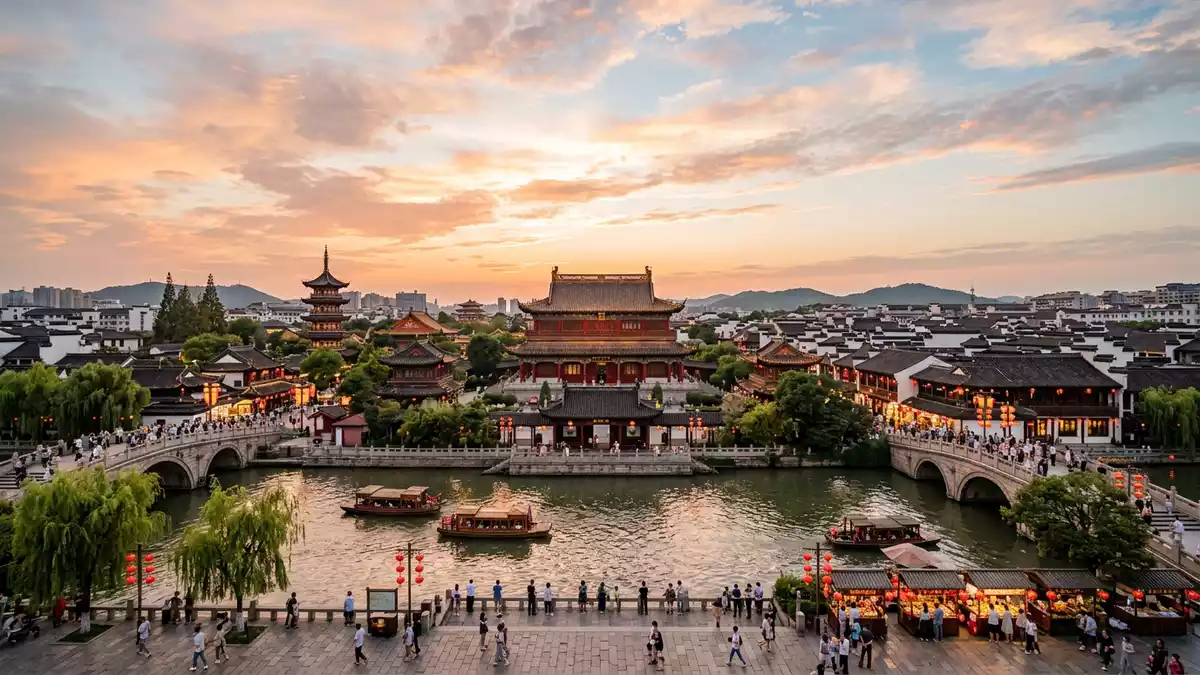
Fuzimiao in Nanjing brings together a Confucian temple, former imperial examination halls and a lively riverside district along the Qinhuai River, creating a single continuous urban scene. The complex, rebuilt in 1034 during the Song dynasty, links the ritual world of Confucius with the commercial streets that frame the river.
Confucius, examinations and the heart of Fuzimiao
The core of Fuzimiao is the Confucius Temple dedicated to the philosopher and teacher Confucius, whose ideas shaped imperial education across China.The Confucius Temple in Nanjing The sanctuary was rebuilt in 1034 under the Song dynasty after earlier structures on the site, giving the present layout a firmly eleventh-century origin.built in 1034 under the Song dynasty
Within the complex stands Dacheng Hall, the main ceremonial hall of the temple and the space where Confucius is venerated in Nanjing.Dacheng Hall of Fuzimiao is the main building The wider Fuzimiao area also includes the Jiangnan Examination Hall, once part of the system that selected scholars for official posts through rigorous Confucian examinations.a tripartite entity consisting of the Confucius Temple, the Imperial Academy and the Imperial Examination Hall Together, temple and halls show how ritual, learning and state power were intertwined along this stretch of the Qinhuai River.
Qinhuai River, Gongyuan Street and the lantern-lit waterfront
Fuzimiao occupies a prominent position on the north bank of the Qinhuai River in Nanjing’s Qinhuai District, facing the water and its bridges.On the north bank of the Qinhuai River in Qinhuai District, Nanjing The complex stands by Gongyuan Street, a thoroughfare that takes its name from the examination compound and frames the approach to the temple buildings.Gongyuan Street on the northern bank of the Qinhuai River
The river itself has become part of the experience of Fuzimiao, with piers and embankments set among the temple roofs and shopfronts. Boats travel this stretch of the Qinhuai, passing under historic bridges and giving passengers a view of the eaves and gateways along the waterfront.Qinhuai River Cruise After dark, the riverside facades and walkways are illuminated, and the reflections of lights emphasise the tight relationship between the watercourse and the built fabric of the district.the temple buildings light up and the night market comes alive
From imperial halls to modern city district
The temple and examination compound at Fuzimiao developed through the Song, Yuan, Ming and Qing dynasties, with successive renovations and extensions linking the Confucius Temple, Imperial Academy and Imperial Examination Hall into a large complex.through the Song, Yuan, Ming and Qing dynasties the complex was continuously renovated and expanded In the nineteenth century the Taiping Rebellion devastated Nanjing, and much of the historic fabric of the Confucius Temple area was rebuilt afterwards.the temple complex dates from 1034, although most buildings were rebuilt after the Taiping Rebellion
As a city district, Fuzimiao brings together temple courtyards, museum spaces, riverfront promenades and commercial streets, all within walking distance of one another.Fuzimiao is the name of the temple, and it also referrers to the surrounding area The combination of historic architecture and a functioning neighbourhood makes it a place where the legacy of Confucian learning is read directly in the fabric of the city.
Visiting Fuzimiao: what travellers from Western Europe should know
- Fuzimiao lies in Nanjing’s Qinhuai District on the north bank of the Qinhuai River, around Gongyuan Street, and is reached by metro lines serving Fuzimiao and Sanshanjie stations.
- The district is built around pedestrian streets and river embankments, so visiting involves walking on paved streets, promenades and temple courtyards with steps and changes in level.
- The official language is Chinese and the currency is the Chinese yuan.
- Entry requirements depend on your nationality; UK travellers can check the FCDO travel advice at gov.uk/foreign-travel-advice, Irish travellers the Department of Foreign Affairs at ireland.ie.
Searching for Fuzimiao on social platforms
These links open searches for Fuzimiao on each platform.
Frequently asked questions about Fuzimiao
Where is Fuzimiao located?
Fuzimiao is in Qinhuai District in the city of Nanjing, on the north bank of the Qinhuai River around Gongyuan Street.
What can visitors expect at Fuzimiao?
Visitors encounter the Confucius Temple complex, former imperial examination halls, museums, riverside promenades and commercial streets concentrated in a compact historic district.
What makes Fuzimiao distinctive among Confucius temples?
Fuzimiao stands out through its combination of a major Confucius Temple, extensive examination halls and a riverfront setting integrated into a wider urban district.


