
Fuzimiao in Nanjing, where Confucian ritual meets the Qinhuai River
Published on 08/30/2026 at 12:58 | Editorial responsibility: Rafael Müller, Editor-in-Chief AD HOC NEWS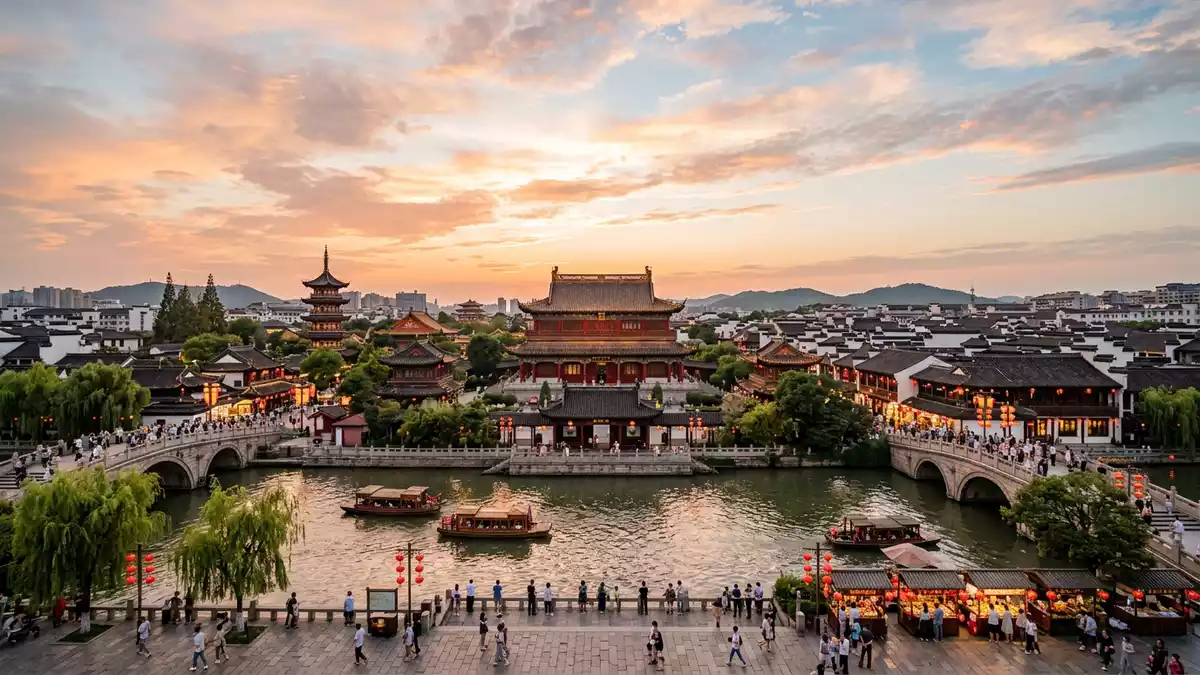
Fuzimiao in Nanjing is a Confucian temple complex and riverside district where ritual architecture, imperial examination halls and the Qinhuai River meet in a single continuous scene from Chinese history. Rooted in the intellectual world shaped by Confucius and developed under the Song dynasty in 1034, it gathers courtyards, halls and streets into a compact urban ensemble that still reflects the rhythms of imperial scholarship.
Confucius, the Song dynasty and an academic quarter by the river
The story of Fuzimiao centres on the philosopher Confucius, whose teachings on ethics, learning and social order shaped education and government across imperial China. In Nanjing, these ideas took architectural form in a Confucian temple and academic quarter on the banks of the Qinhuai River, where ritual spaces stood alongside institutions of study and examination.The Confucius Temple in Nanjing was initially built in 1034 during the Song dynasty, giving the site an eleventh-century foundation that anchored Confucian worship within the life of the city.The area around the temple grew out of earlier institutions of the Imperial University established along the Qinhuai, tying Fuzimiao directly to the training of scholars.
Across the centuries the complex passed through the Song, Yuan, Ming and Qing dynasties, and with each era the buildings were repaired, extended or rebuilt after fires and wars.The present halls largely follow reconstructions from the Qing dynasty in the nineteenth century, with further restoration work from the late twentieth century shaping the complex that stands by the river today.Throughout these changes, Fuzimiao remained closely linked to Confucian learning and the imperial academy, making this part of Nanjing a long-standing focus of scholarship.
Dacheng Hall, courtyards and the architecture of ritual
Within the walled precinct of Fuzimiao, the architectural focus is Dacheng Hall, the grand ceremonial hall dedicated to Confucius.Dacheng Hall serves as the main space where the philosopher is venerated in Nanjing, and its central position on the main axis underlines its ritual importance. Visitors pass through gateways and across open courtyards before reaching the hall, a sequence that reflects traditional Chinese temple and palace planning.Axes, courtyards and gates organise the complex into a series of framed spaces that lead towards the sanctuary.
The halls and galleries are built in timber with tiled roofs and decorated details characteristic of Ming and Qing architecture.Later reconstructions gave the ensemble an appearance aligned with architectural styles from the Ming and Qing dynasties, with painted beams, bracket sets and rooflines that echo other ceremonial buildings from those periods. One notable feature is a long screen wall dating from the sixteenth century, which stands as a monumental backdrop within the complex and exemplifies the use of walls as surfaces for both decoration and symbolism.The screen wall at Fuzimiao dates from 1575 and links the present site to the craftsmanship of the late Ming era.
Examination halls, Qinhuai River and a riverside district
Beyond the temple precinct itself, Fuzimiao forms part of a larger architectural and urban complex that includes the Jiangnan Examination Hall and an imperial academy.The examination compound once hosted imperial examinations based on Confucian classics, selecting scholars for official posts in a system that shaped administrative life across the empire. In Nanjing this meant that the streets around Fuzimiao filled with candidates travelling to sit written tests that could change the course of their lives.
Geographically, Fuzimiao occupies a prominent position on the north bank of the Qinhuai River in Qinhuai District, with its gates and bridges facing the water.The complex stands on Gongyuan Street, a thoroughfare named after the examination halls that frame the approach to the temple buildings.Along the river, the temple and halls form part of the Fuzimiao–Qinhuai scenic belt, where historic architecture lines the embankments. Temple courtyards, bridges, examination halls and commercial streets together create a layered picture of how ritual, learning and trade have shared the same riverside setting in Nanjing.
Visiting Fuzimiao: what travellers from Western Europe should know
- Fuzimiao lies on the north bank of the Qinhuai River in Qinhuai District, Nanjing, centred on Gongyuan Street, which leads directly into the temple and examination complex.
- The temple precinct and nearby examination halls are linked by courtyards, gateways and covered walkways, and moving between them involves crossing steps and uneven stone paving.
- Fuzimiao is integrated into a wider urban district, so temple courtyards sit close to busy riverside streets and bridges along this stretch of the Qinhuai River.
- The official language is Chinese and the currency is the renminbi (yuan).
- Entry requirements depend on your nationality; UK travellers can check the FCDO travel advice at gov.uk/foreign-travel-advice, Irish travellers the Department of Foreign Affairs at ireland.ie.
Searching for Fuzimiao on social platforms
These links open searches for Fuzimiao on each platform.Frequently asked questions about Fuzimiao
Where is Fuzimiao in Nanjing?
Fuzimiao stands on the north bank of the Qinhuai River in Qinhuai District, Nanjing, with its main entrances along Gongyuan Street.
What can visitors expect to see at Fuzimiao?
Visitors encounter a Confucian temple complex centred on Dacheng Hall, courtyards framed by traditional halls, remnants of imperial examination buildings and a dense riverside streetscape.
What makes Fuzimiao distinctive among Confucian temples?
Fuzimiao combines a Confucius temple, an imperial academy and examination halls with a riverside district, reflecting the close relationship between ritual, education and urban life in Nanjing.


