Fujian Tulou in Yongding: communal earthen fortresses
Published on 08/30/2026 at 13:43 | Editorial responsibility: Rafael Müller, Editor-in-Chief AD HOC NEWS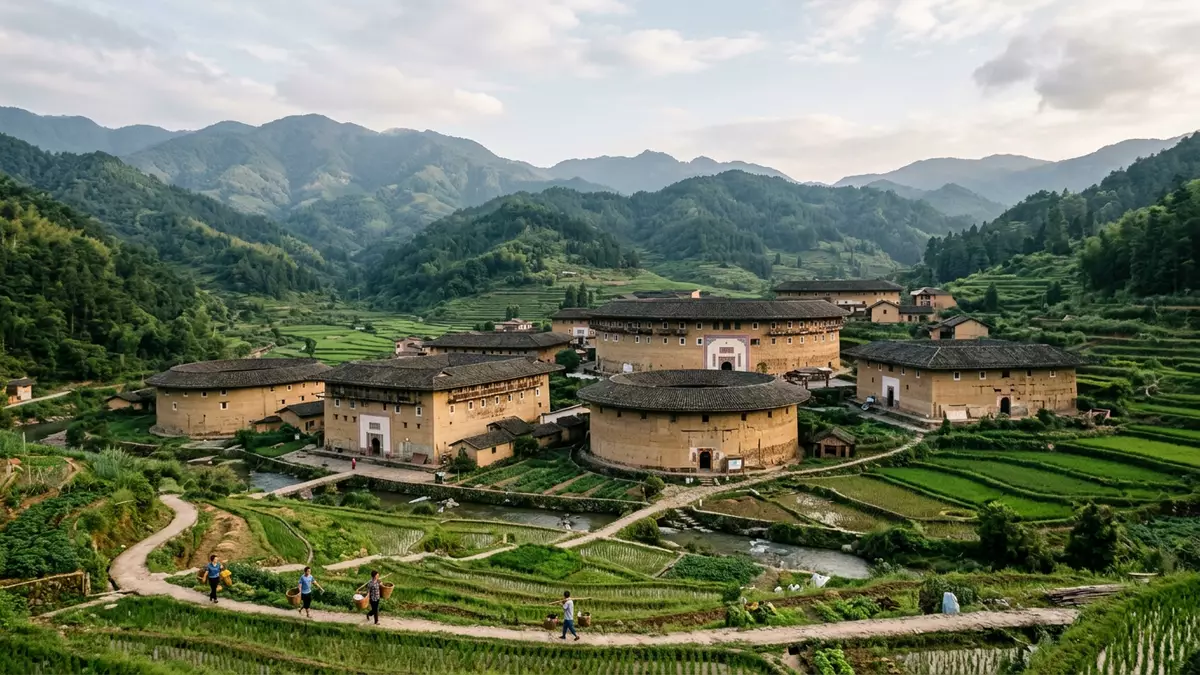
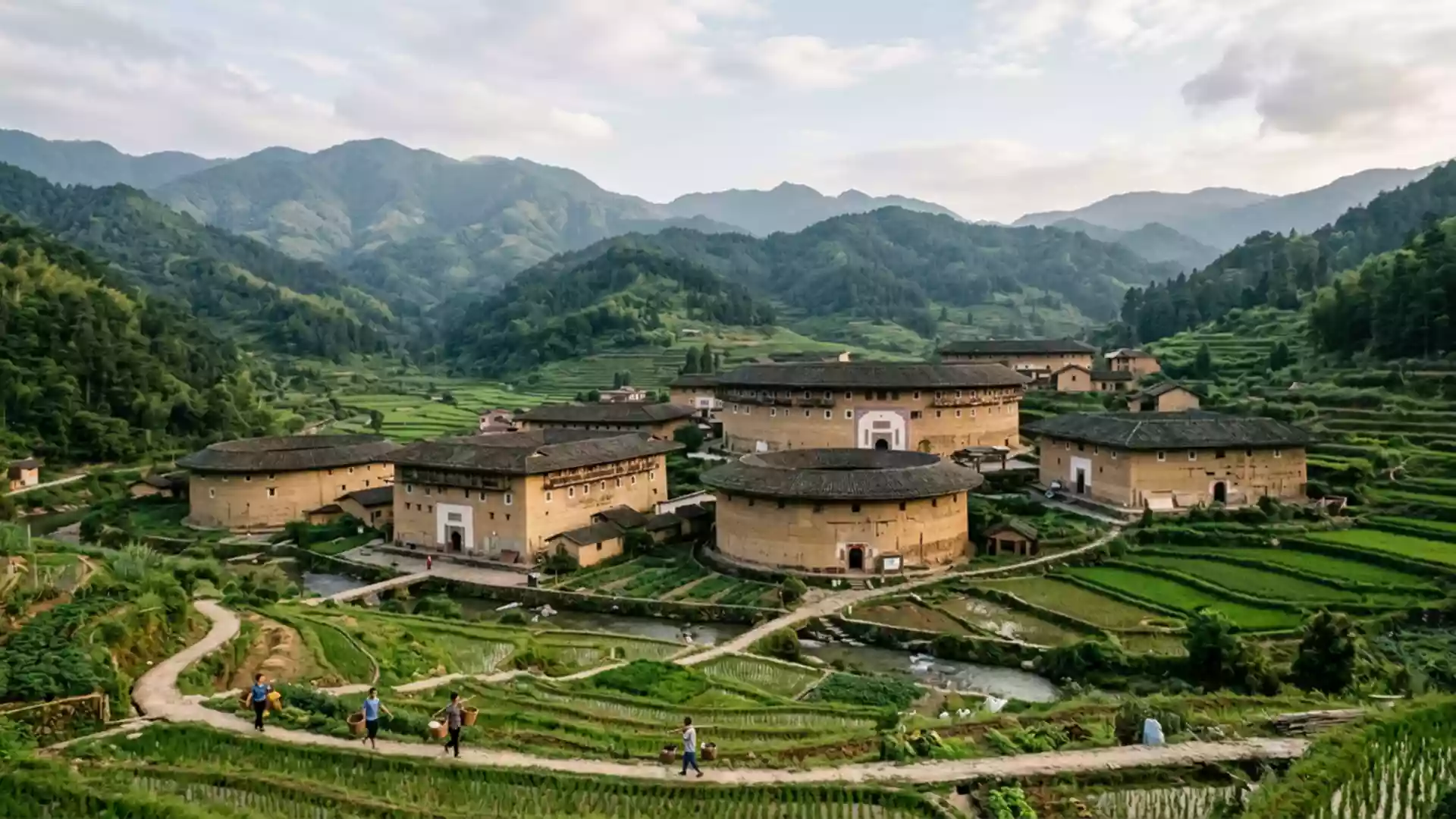
Fujian Tulou in Yongding are monumental communal dwellings built in rammed earth, rising like fortress-villages in the mountain valleys of south-western Fujian in China. Their multi-storey walls encircle inward-looking courtyards, creating self-contained worlds where generations of Hakka clans have lived under one roof.
Earthen architecture on a monumental scale
Fujian Tulou are recognised by UNESCO as a World Heritage cultural property comprising 46 earthen buildings constructed between the fifteenth and twentieth centuries in south-western Fujian province.World Heritage cultural property These structures stand several storeys high and are laid out along circular or square floor plans around a central open courtyard, with thick outer walls of rammed earth and very limited openings at the lower levels.earthen houses several storeys high Tulou of this kind are scattered throughout the mountainous interior of Fujian, but Yongding County contains some of the most representative clusters.
The basic material of Fujian Tulou is compacted earth, reinforced with timber and local stone where needed, forming massive perimeter walls that once served a defensive role for the communities inside.rammed earth dwellings The interior galleries, staircases and dwellings are framed in timber, stacked in tiers that ring the courtyard, so that each clan branch occupies its own vertical slice. The result is a single enclosed volume that functions as a complete village, with shared halls, ancestral shrines and storage spaces arranged around the communal centre.
Yongding’s tulou clusters and their setting
Within Yongding County, several tulou clusters have been inscribed as part of the World Heritage property, including the Chuxi Tulou cluster in Xiayang township.Chuxi Tulou cluster These clusters sit in narrow valleys and on gentle slopes along rivers such as the Ting and Yongding, surrounded by terraces of rice, tea and tobacco fields that extend up the hillsides.set amongst rice, tea and tobacco fields Earthen buildings appear in compact groups here, sometimes arranged at slightly different elevations, so that their upper tiers look out across both the central courtyard and the wider agricultural landscape.
Yongding lies within Longyan City in the south-west of Fujian, in the mountainous belt that borders Guangdong province. The valleys where the tulou stand are reached by roads that follow river courses, linking market towns with outlying villages. In several scenic areas, such as those described by Fujian provincial tourism authorities, tulou complexes are presented together with their surrounding countryside, with named ensembles like the Fujian Tulou King Area and the Fujian Tulou Prince Area showcasing particularly large or elaborate buildings.Fujian Tulou (Yongding) Scenic Area
Communal life and defensive design
Fujian Tulou were built as communal residences and defensive structures for extended Hakka clans, functioning as village units enclosed within a single building.housed a whole clan The inward-facing layout, with a single monumental entrance opening onto the courtyard, reflects this dual role: the central space serves festivals, meetings and daily interaction, while the continuous ring of dwellings above creates a protective shell. Timber galleries run along each level, with staircases linking floors vertically rather than cutting across the courtyard, reinforcing the separation between the quiet interior and the massive outer wall.
Construction techniques for Hakka tulou in Yongding are recognised as part of China’s national intangible cultural heritage, preserving knowledge of how to raise tall rammed-earth walls that remain stable over generations.Hakka Tulou construction techniques Many of the Yongding tulou are square in plan, while circular variants are less common and tend to cluster along specific river basins.square and circular variants Across Fujian, there are thousands of tulou still standing; Yongding has a particularly dense concentration, with earthen buildings forming a defining feature of its rural landscape.more than 23,000 tulou in Yongding
Visiting Fujian Tulou: what travellers from Western Europe should know
- Fujian Tulou in Yongding lie in the mountainous interior of south-western Fujian province, with tulou clusters such as Chuxi reached from Yongding town along valley roads.
- The terrain around the tulou combines narrow village streets with uneven earth paths and steps between levels, and the interiors are accessed by staircases rising through several storeys.
- Yongding is part of Longyan City in Fujian, and the surrounding countryside includes rivers, terraced fields and small market towns that can be combined with a visit to tulou clusters.
- The official language is Chinese and the currency is the renminbi (yuan).
- Entry requirements depend on your nationality; UK travellers can check the FCDO travel advice at gov.uk/foreign-travel-advice, Irish travellers the Department of Foreign Affairs at ireland.ie.
Searching for Fujian Tulou on social platforms
These links open searches for Fujian Tulou on each platform.
Frequently asked questions about Fujian Tulou
Where are Fujian Tulou located?
Fujian Tulou are found in the mountainous interior of south-western Fujian province in China, particularly across Yongding County, Nanjing County and Hua’an County.
What should visitors expect inside a tulou?
Inside a Fujian Tulou, visitors encounter a central open courtyard enclosed by tall earthen walls, with tiers of timber-built dwellings and galleries stacked around the perimeter.
What makes Fujian Tulou distinctive among traditional dwellings?
Fujian Tulou are distinctive because they combine multi-storey rammed-earth construction with an inward-facing village layout, housing extended clans within a single fortified circular or square building.