Fujian Tulou in Yongding as earthen communal fortresses
Published on 09/15/2026 at 06:33 | Editorial responsibility: Rafael Müller, Editor-in-Chief AD HOC NEWS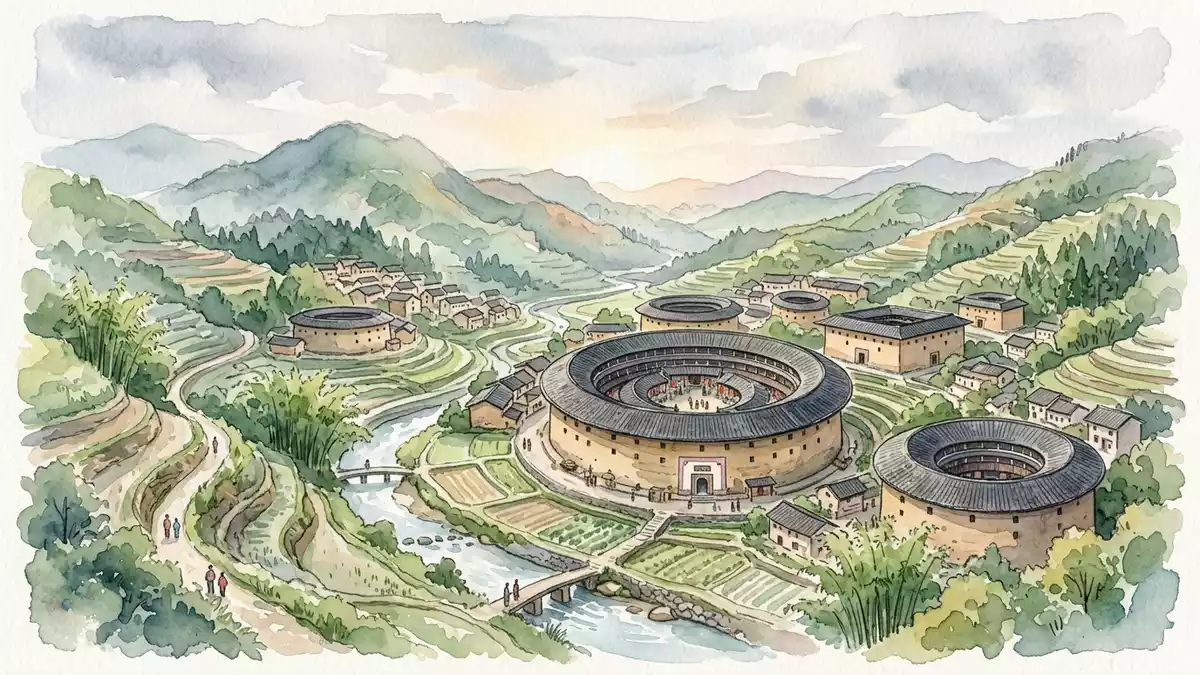
Fujian Tulou in Yongding are monumental earthen residential buildings where extended families have lived together behind thick rammed-earth walls in the hills of south-western China. Built in the mountainous interior of Fujian province between the fifteenth and twentieth centuries, these fortified dwellings form part of the Fujian Tulou ensemble recognised as a UNESCO World Heritage Site in 2008.
Earthen fortresses in Fujian’s uplands
Fujian Tulou are concentrated in inland counties such as Yongding, Nanjing and Hua’an in south-western Fujian, a region of valleys, terraced fields and low mountains away from the Taiwan Strait.Fujian Tulou comprises 46 earthen residential buildings distributed across these counties, each forming a distinct cluster within the rural landscape.Built between the fifteenth and twentieth centuries, the tulou were created as communal residences for clans in the mountainous regions of south-eastern China.
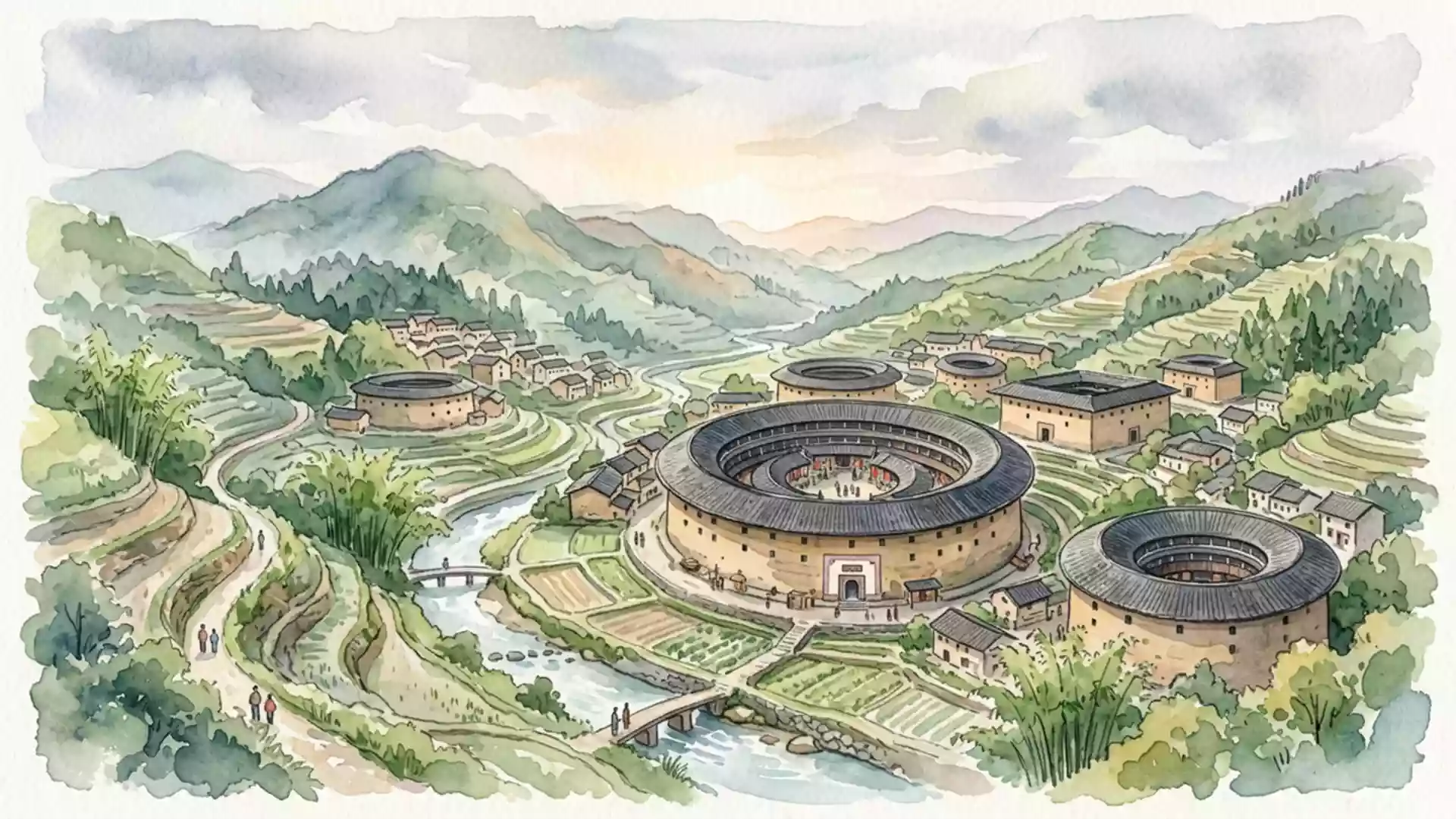
In Yongding, tulou sit among rice terraces, vegetable plots and wooded slopes, forming compact settlements where architecture and landscape are closely interwoven.The Chuxi Tulou cluster in Yongding County is an example of such a settlement, with several tulou grouped around fields and paths that follow the contours of the valley. From a distance, the thick earth walls and timber upper levels read as broad bands of warm colour against the green hills.
Rammed-earth construction and communal life
The defining material of Fujian Tulou is rammed earth, compacted between formwork to create thick load-bearing walls reinforced with timber, stone and other local materials.The term tulou combines the Chinese characters for “earth” and “multi-storey house”, and it refers to multi-storey collective dwellings built with rammed earth and wood. Exterior walls rise several storeys and have few openings at the lower levels, which enhances the defensive character of these structures.
Inside, Fujian Tulou are arranged as serial housing units that line the inner perimeter, usually in stacked storeys around a central courtyard.Each tulou can house hundreds of people, with individual family units occupying vertical bays that include rooms on several levels. Timber galleries, staircases and covered walkways link these units, while the central space remains open for shared activities, ancestral halls, wells and sometimes small subsidiary buildings.
World Heritage status and Yongding clusters
Fujian Tulou were inscribed on the UNESCO World Heritage List at the thirty-second session of the World Heritage Committee in 2008 as cultural property number 1113.The World Heritage inscription highlights their communal living and defensive organisation and notes their harmonious relationship with the surrounding environment. The property includes 46 multi-storey earthen houses constructed between the twelfth and twentieth centuries, spread over a belt of about 120 km in south-western Fujian province.These structures are described as large fortified buildings that integrate residential, social and protective functions.
Within Yongding, tulou have been organised into scenic areas that showcase some of the most prominent buildings and clusters.The Fujian Tulou (Yongding) Scenic Area includes notable buildings such as Chengqi Building and Zhencheng Building, which are often described using royal metaphors because of their size and form. These landmark tulou stand among many other earthen dwellings scattered through Yongding’s valleys, reflecting variations in plan, height and decoration while sharing the same basic construction principles.
Visiting Fujian Tulou: what travellers from Western Europe should know
- Fujian Tulou are located in Fujian province in south-eastern China, with Yongding County lying inland from the Taiwan Strait and west of the coastal city of Xiamen; rail services run to Yongding Station and road connections link the county to regional transport networks.
- The terrain around Yongding’s tulou clusters is hilly, with paths and village lanes that often follow slopes and steps between levels, so visiting the buildings involves walking on uneven ground and using staircases inside multi-storey earthen structures.
- Within Yongding, tulou are grouped in rural settlements with terraced fields and small rivers, and some clusters lie a short walk from village centres where local services and facilities are concentrated.
- The official language is Chinese and the currency is the renminbi (yuan).
- Entry requirements depend on your nationality; UK travellers can check the FCDO travel advice at gov.uk/foreign-travel-advice, Irish travellers the Department of Foreign Affairs at ireland.ie.
Searching for Fujian Tulou on social platforms
These links open searches for Fujian Tulou on each platform.
Frequently asked questions about Fujian Tulou
Where are Fujian Tulou in Yongding located?
Fujian Tulou in Yongding are in the inland part of Fujian province in south-eastern China, in a mountainous region west of Xiamen and inland from the Taiwan Strait.
What should visitors expect when exploring Fujian Tulou?
Visitors encounter large multi-storey rammed-earth buildings organised around central courtyards, with interior timber galleries, staircases and communal spaces within rural settlements of fields and hills.
What makes Fujian Tulou distinctive among historic dwellings?
Fujian Tulou are distinctive because they combine thick earthen defensive walls, multi-storey collective housing for extended families and an integration with terraced agricultural landscapes recognised in their UNESCO World Heritage status.