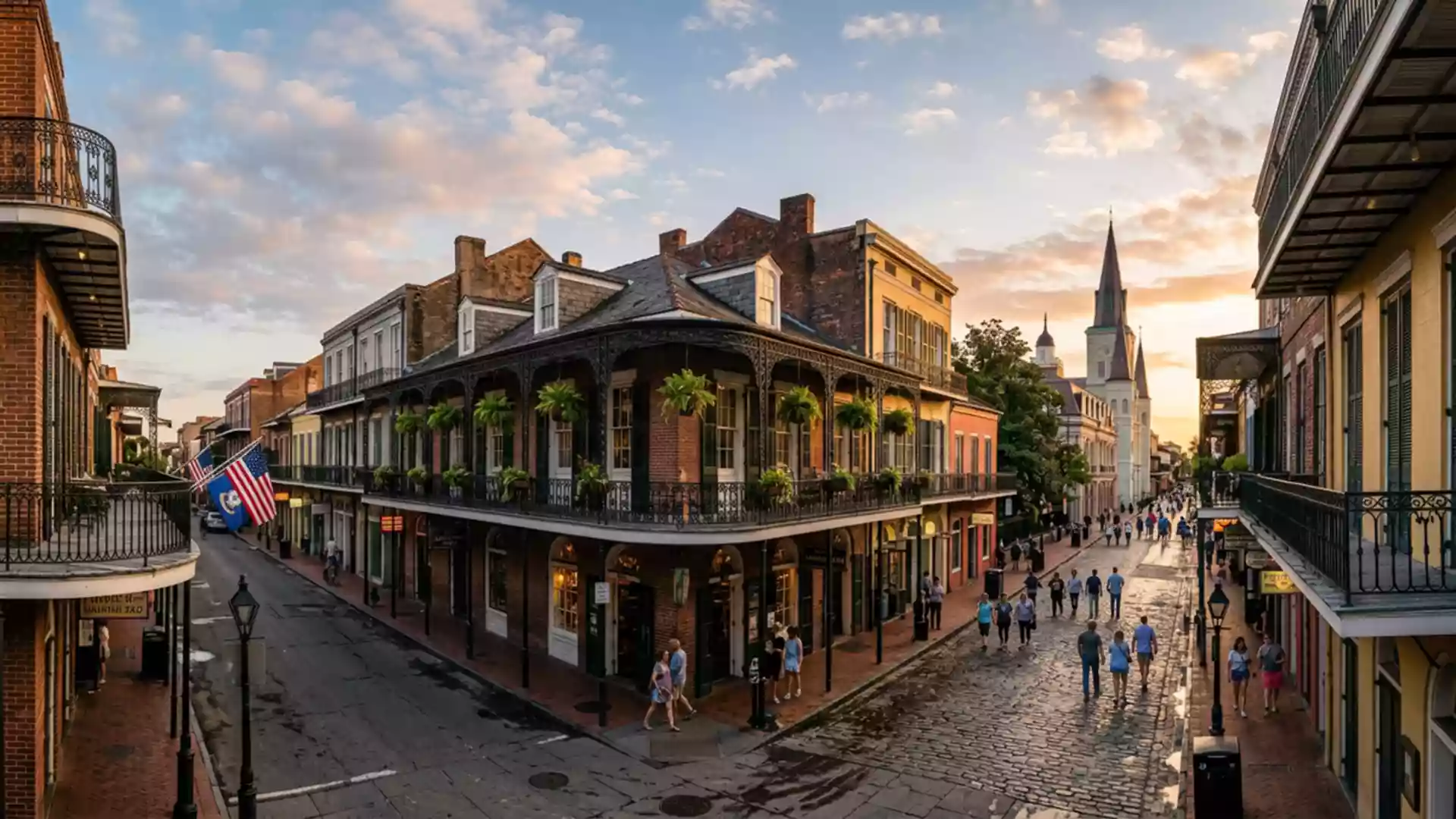
French Quarter streets where Spanish and Creole New Orleans meet
Published on 09/04/2026 at 12:25 | Editorial responsibility: Rafael Müller, Editor-in-Chief AD HOC NEWS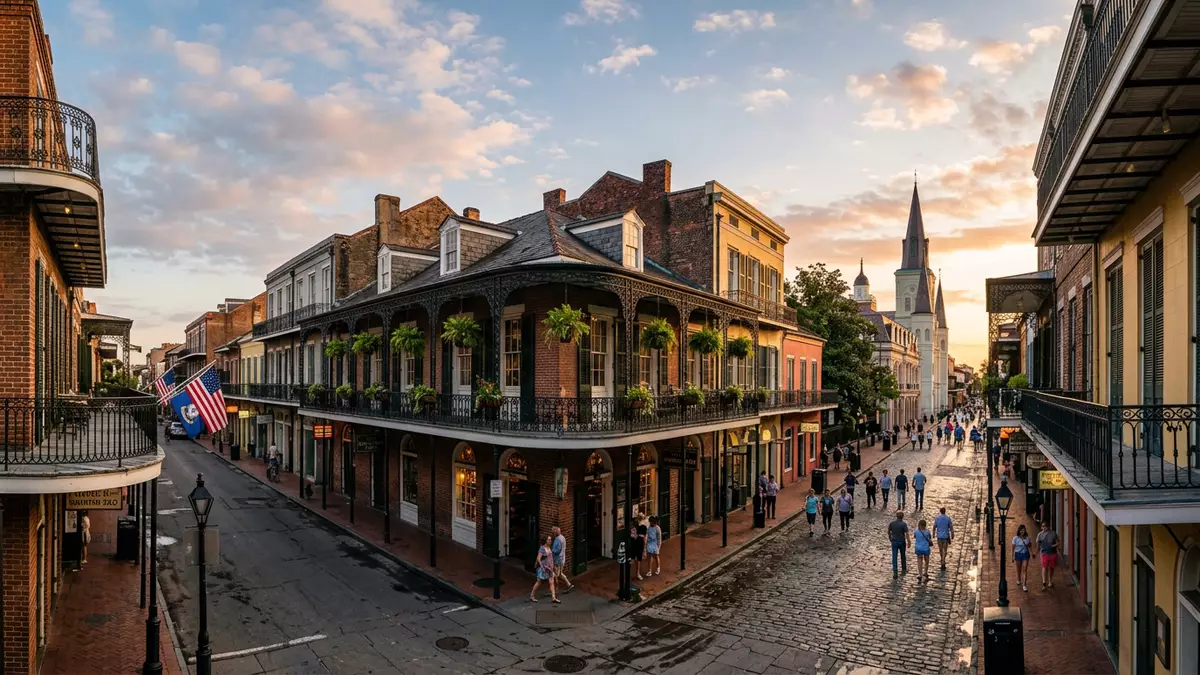
French Quarter is the original urban core of New Orleans, laid out in the early eighteenth century and later reshaped by Spanish and Creole builders into the dense historic district seen today.Founded in 1718, the neighbourhood sits beside the Mississippi River and carries a formally recognised status as a National Historic Landmark.The Vieux Carré concentrates much of the city’s colonial and nineteenth-century architecture within a tight grid of streets.
From colonial square to protected historic district
The story of French Quarter begins with Jean-Baptiste Le Moyne de Bienville, who established the French colonial settlement of Nouvelle-Orléans in 1718 and ordered a compact street plan a few years later.Bienville’s grid focused on a central square that became Jackson Square and gave the neighbourhood its French name Vieux Carré, or “Old Square”. Over the eighteenth century New Orleans passed from French to Spanish rule, and two devastating fires in 1788 and 1794 destroyed most of the early wooden buildings.Late eighteenth-century fires prompted strict new regulations and a rebuilding programme in brick and stucco.
The built fabric visible in French Quarter today largely dates from the late eighteenth and nineteenth centuries, reflecting the Spanish authorities’ fire codes and the Creole architecture that developed under American rule.Most structures were erected after 1800, with a particularly intense wave of construction in the decades before the American Civil War. Recognition of the district’s historic value brought legal protection in the twentieth century: in 1936 a local historic district was established, and in 1965 the Vieux Carré Historic District was designated a National Historic Landmark.National Historic Landmark designation helps to preserve the streetscape against large-scale alteration.
Architecture of wrought iron, courtyards and Creole townhouses
The most striking feature of French Quarter is the mix of architectural influences expressed in a compact area: French colonial foundations, Spanish rebuilding in brick and stucco, Caribbean inflections and nineteenth-century American styles.French, Spanish, Creole and American styles sit side by side in the form of Creole cottages, double shotgun houses and multi-storey masonry townhouses. Many facades carry balconies and galleries edged with cast or wrought iron, creating shaded upper terraces above the pavements and giving the streets their characteristic layered appearance.Balconies and courtyards often conceal planted inner yards behind high walls.
Key buildings anchor this ensemble. St. Louis Cathedral, facing Jackson Square, is a Roman Catholic cathedral with roots in the eighteenth century and is commonly described as the oldest continuously operating cathedral in the United States.St. Louis Cathedral stands alongside the Cabildo and the Presbytère, important civic buildings of the Spanish period. Nearby, the Old Ursuline Convent, completed in 1752, represents one of the best-preserved examples of French colonial architecture in the Mississippi River valley.Old Ursuline Convent adds an earlier layer to a district otherwise dominated by later Creole and Greek Revival structures.
A compact grid between river and modern city
French Quarter occupies a defined rectangle of land between the Mississippi River and the modern downtown of New Orleans. Common descriptions place the district between Canal Street and Esplanade Avenue along the riverfront, extending inland towards Rampart Street.Boundaries of the Quarter cover several dozen blocks laid out in a regular grid. Streets run parallel and perpendicular to the river, creating straight vistas broken by church towers, civic buildings and the occasional open square.
The neighbourhood’s position beside the Mississippi shaped New Orleans as a port and trading centre, and the riverfront still forms a clear edge to the historic streets.Location by the river Within the grid, blocks vary in size but retain the original eighteenth-century logic, with narrow plots and buildings aligned close to the street. Courtyards, passageways and carriage entrances provide access to interior spaces, creating a layered sequence from pavement to private rooms that reflects colonial urban habits.
Visiting French Quarter: what travellers from Western Europe should know
- French Quarter lies in central New Orleans, beside the Mississippi River and close to Canal Street, and is reached easily on foot from many downtown locations.
- The historic streets are largely flat but paved, with kerbs and occasional uneven surfaces, and several landmark buildings include internal staircases between different floor levels.
- Jackson Square, St. Louis Cathedral and the surrounding streets form a compact area where pedestrians share space with vehicles on relatively narrow carriageways.
- The official language is English and the currency is the US dollar.
- Entry requirements depend on your nationality; UK travellers can check the FCDO travel advice at gov.uk/foreign-travel-advice, Irish travellers the Department of Foreign Affairs at ireland.ie.
Searching for French Quarter on social platforms
These links open searches for French Quarter on each platform.Frequently asked questions about French Quarter
Where is French Quarter located within New Orleans?
French Quarter occupies the original street grid of New Orleans beside the Mississippi River, between Canal Street and Esplanade Avenue and towards Rampart Street.
What can travellers expect on a visit to French Quarter?
Travellers encounter narrow historic streets lined with Creole townhouses, Spanish-influenced balconies and courtyards, anchored by landmarks such as St. Louis Cathedral and Jackson Square.
What makes French Quarter distinctive among historic districts?
The district combines an eighteenth-century colonial street plan with later Spanish, Creole and American architecture, concentrated in a compact grid protected as a National Historic Landmark.