
French Quarter, New Orleans: wrought iron, courtyards and creole streetscapes
Published on 09/15/2026 at 06:18 | Editorial responsibility: Rafael Müller, Editor-in-Chief AD HOC NEWS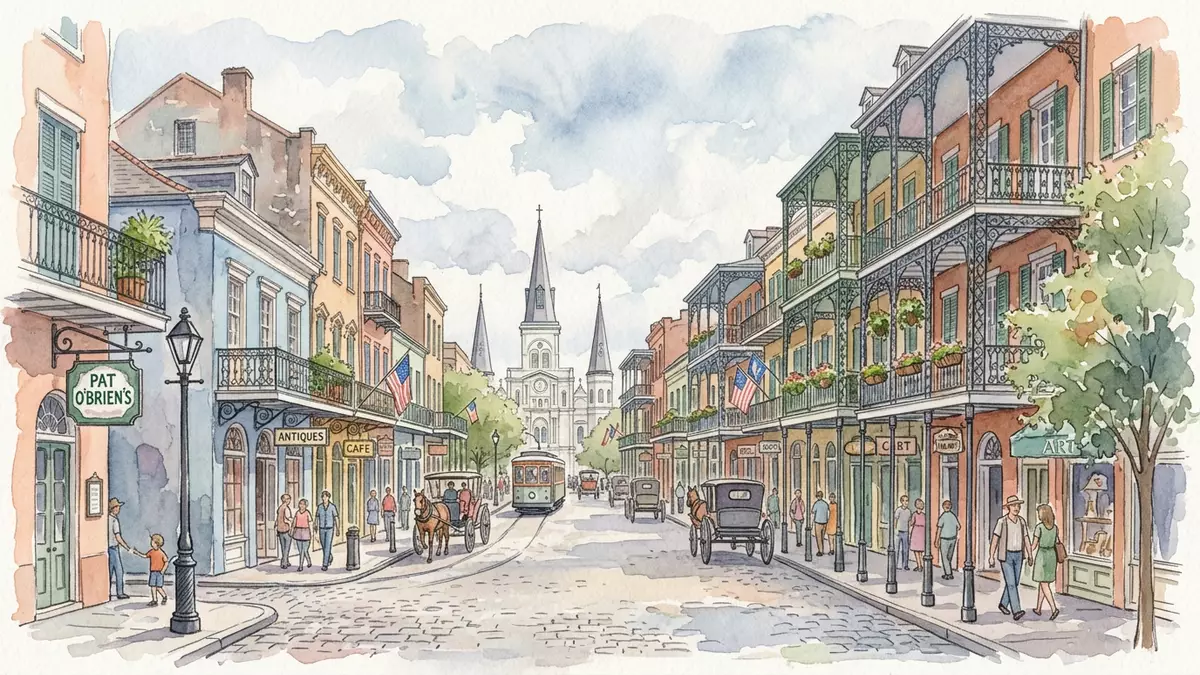
French Quarter in New Orleans, also known as the Vieux Carré, is the city’s original neighbourhood laid out in the early eighteenth century along the Mississippi River, with dense streets of historic townhouses and courtyards defining its character.Founded in 1718 by French colonists, it later gained protection as a National Historic Landmark district and remains one of the most recognisable historic quarters in the United States.The French Quarter designation as a National Historic Landmark dates from 1965.
The original footprint of New Orleans along the Mississippi
French Quarter occupies the river-side core of New Orleans, roughly bounded by Canal Street, Rampart Street, Esplanade Avenue and the Mississippi, forming a compact grid of around eighty-five blocks that still match the city’s colonial plan.The Vieux Carré is described as bounded by Canal, Rampart, Esplanade and the river and this area aligns with the original layout devised shortly after the foundation of New Orleans in the 1720s.Bienville worked with engineers in 1721–22 on a French military-style street plan.
The grid produces short blocks and narrow streets, with buildings fronting directly onto pavements and a sequence of cross streets leading from the river edge inland towards Rampart Street. Within this area sit prominent landmarks including Jackson Square and St Louis Cathedral, a Roman Catholic cathedral whose continuous use as a place of worship is often highlighted in accounts of the district’s history.The Preservation Resource Center notes that the Quarter contains the oldest Roman Catholic cathedral in continuous use in the nation and that the neighbourhood retains the original footprint of New Orleans.
From colonial plan to nineteenth-century streetscapes
The outward French identity of French Quarter is rooted in its foundation era, but most of the buildings seen along its streets date from the nineteenth century rather than the earliest colonial period.Research on construction dates in the Quarter indicates that more than three quarters of structures were built between 1800 and 1899, with a particularly dense phase of building between the Battle of New Orleans in 1815 and the start of the American Civil War in 1861.Accounts of New Orleans architecture note that many of the Quarter’s structures date from the first half of the nineteenth century.
Large fires in 1788 and 1794 destroyed much of the wooden housing stock from the French colonial era, and rebuilding under Spanish administration brought in brick construction, stuccoed walls and stricter building codes aimed at reducing the risk of further conflagration.Descriptions of the Quarter’s building history emphasise the shift from early wooden houses to masonry structures after late eighteenth-century fires, while balconies and galleries with wrought iron and later cast iron railings became defining features of façades facing the street.
Wrought iron, courtyards and creole architecture
Walkers in French Quarter encounter rows of townhouses and commercial buildings with balconies projecting over the pavements, supported by posts or cantilevered from upper storeys, and lined with intricate ironwork that gives many streets their characteristic lacy appearance.Guides to the district repeatedly highlight its Spanish and French architecture and the use of wrought iron balconies, while accounts of architectural origin in the Quarter stress the combination of French, Spanish, Creole, African and American elements.Analyses of the neighbourhood’s architecture describe a blend of French, Spanish, Creole and American influences.
Behind many façades lie planted courtyards enclosed by walls and neighbouring buildings, screened from the street and offering internal light to rooms around them, a pattern associated with both Spanish and creole townhouses in the region. Roofs often follow steep or hipped forms inherited from French and Spanish colonial practice, while thick masonry walls and covered galleries along upper floors provide shade over the street and pavements below. Within individual buildings, doorways and interior passages frequently lead from the public frontage back to semi-private outdoor spaces, and the combination of galleries, shuttered windows and iron railings gives the streetscape a layered depth when viewed from ground level.
Visiting French Quarter: what travellers from Western Europe should know
- French Quarter sits on the Mississippi’s riverbank in the centre of New Orleans, bordered by Canal Street to the west and Esplanade Avenue to the east, with Rampart Street marking its inland edge.
- The street grid is compact and walkable, with narrow pavements, uneven surfaces in places and occasional kerbs or steps between roadway and building entrances that require attention on foot.
- Within the district, Jackson Square and St Louis Cathedral form a central ensemble, while streets such as Bourbon Street and Chartres Street run through rows of historic buildings with balconies and galleries.
- The official language is English and the currency is the United States dollar.
- Entry requirements depend on your nationality; UK travellers can check the FCDO travel advice at gov.uk/foreign-travel-advice, Irish travellers the Department of Foreign Affairs at ireland.ie.
Searching for French Quarter on social platforms
These links open searches for French Quarter on each platform.Frequently asked questions about French Quarter
Where is French Quarter located within New Orleans?
French Quarter occupies the historic core of New Orleans beside the Mississippi River, framed by Canal Street, Esplanade Avenue and Rampart Street in the downtown area.
What should visitors expect on a visit to French Quarter?
Visitors encounter a compact grid of streets lined with nineteenth-century masonry buildings, iron balconies, hidden courtyards and civic spaces including Jackson Square and St Louis Cathedral.
What makes French Quarter distinctive among historic districts?
French Quarter combines an eighteenth-century colonial street plan with later creole and Spanish-influenced architecture, producing streetscapes of wrought iron galleries and enclosed courtyard houses not commonly found elsewhere in the United States.


