
Freedom Trail and the red line through Boston
Published on 08/28/2026 at 09:13 | Editorial responsibility: Rafael Müller, Editor-in-Chief AD HOC NEWS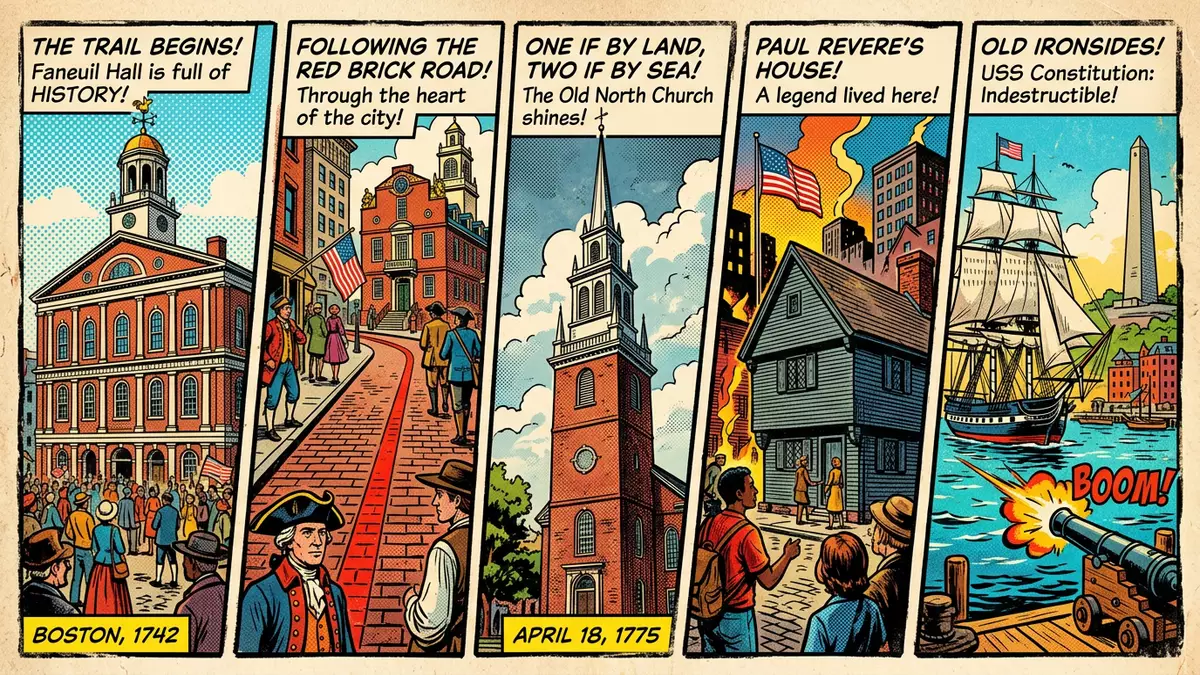
Freedom Trail in Boston is a 2.5-mile route through the city’s historic core, marked by a red line and linked with 16 sites from the revolutionary era. It begins at Boston Common and reaches the Bunker Hill Monument, passing churches, burial grounds, meeting houses and a ship along the way2.5-mile route16 sites.
The red line across historic Boston
The Freedom Trail works as a single route rather than a scatter of separate monuments. Its painted line gives the city’s older districts a clear thread, and the sequence of stops includes Boston Common, Faneuil Hall, the Old North Church and the USS ConstitutionBoston CommonUSS Constitution.
That line also gives the trail a strong visual identity at street level. The route crosses Downtown Boston, the North End and Charlestown, linking civic buildings with burial grounds and military memory in a single urban walkDowntown Boston.
Revolutionary sites along the route
The trail is closely tied to the American Revolution and Boston’s colonial past. It includes places associated with meetings, protest, printing, worship and burial, so the route reads like a compact map of the city’s political and civic life in the eighteenth centuryAmerican Revolution.
Several stops carry especially familiar names. Park Street Church, Granary Burying Ground, Old South Meeting House, Old State House and Paul Revere House all sit within the route, making the Freedom Trail a dense sequence of landmarks rather than a single monumentPaul Revere HousePark Street Church.
How the Freedom Trail took its present form
The trail was dedicated in 1951 under Mayor John Hynes, after the idea was promoted by journalist Bill Schofield. Its red line came later, and the route was extended in 1972 to include Bunker Hill Monument and the USS ConstitutionJohn Hynes1972.
That history explains why the Freedom Trail feels both planned and cumulative. It is a civic route with a visible line, but its meaning comes from the sequence of places it joins and from the historical layers those places preservecivic route.
Visiting Freedom Trail: what travellers from Western Europe should know
- The trail runs through central Boston and can be followed on foot along city streets. It links Downtown Boston, the North End and Charlestown, with Boston Common as a key starting point.
- The route is an urban walk with pavements, crossings and a continuous line to follow. Several stops are burial grounds, churchyards, meeting houses and a naval site, so the setting changes from block to block.
- English is the official language and the currency is the US dollar.
- Conditions on the trail change with the seasons; local visitor services and park information points provide practical guidance.
Searching for Freedom Trail on social platforms
These links open searches for Freedom Trail on each platform.
Frequently asked questions about Freedom Trail
Where is Freedom Trail?
Freedom Trail runs through Boston, Massachusetts, from Boston Common to the Bunker Hill Monument. It passes through Downtown Boston, the North End and Charlestown.
What does a visit involve?
It is a walk through the city on marked streets and sidewalks, with historic stops spread along the route. The experience combines churches, burial grounds, civic buildings and a ship.
What makes Freedom Trail distinctive?
The route is defined by its red line and by the way it gathers many central Boston landmarks into one historical sequence. John Hynes, Bill Schofield and the 1951 dedication belong to its story as well.


