
Frederiksborg Slot and its Renaissance setting in Hilleröd
Published on 09/24/2026 at 11:53 | Editorial responsibility: Rafael Müller, Editor-in-Chief AD HOC NEWS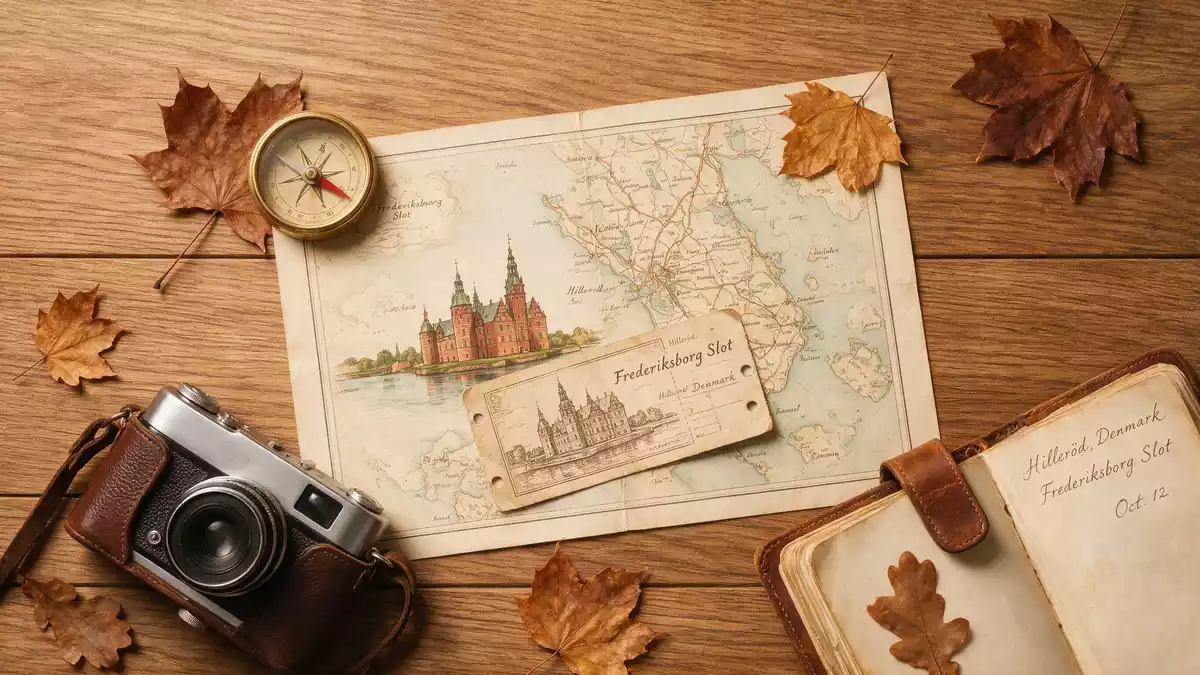
Frederiksborg Slot rises from small islands in Castle Lake at Hilleröd, Denmark. Red brick, pale sandstone and copper roofs form a Renaissance palace whose rooms now hold the Museum of National History.
Frederiksborg Slot on Castle Lake
Water surrounds the castle on its island setting, separating the palace buildings from Hilleröd’s streets. Bridges connect the approach with the castle grounds, while the lake provides a clear view of the red façades, stepped gables and tall spires.
The complex is built in the Dutch Renaissance style. Its materials are immediately legible: red brick walls, light sandstone details and copper-clad roofs and spires. The palace is arranged around courtyards, with the main buildings grouped across the castle islands.
From Frederik II to Christian IV
Frederik II acquired Hillerødsholm in 1560 and established the first Frederiksborg buildings. His son, Christian IV, replaced much of that complex with the palace associated with his reign.
Construction of the present Renaissance castle began in the early seventeenth century and reached completion in 1625. Hans van Steenwinckel the Younger was the final architect, following work by the Steenwinckel family. The result is a large royal residence with elaborate façades and a chapel integrated into the palace.
Christian IV ruled Denmark and Norway from 1588 to 1648. Frederiksborg belongs to the period when Dutch and Flemish Renaissance forms shaped royal architecture in Denmark. Its scale, brickwork and decorative stonework place it within that architectural language.
Fire, reconstruction and the museum
A major fire damaged Frederiksborg Slot in 1859. The Castle Church and Audience Chamber survived, while much of the interior required reconstruction. The surviving rooms preserve parts of the older palace, and restored areas recreate the richness of its Renaissance and Baroque interiors.
Brewer J. C. Jacobsen proposed a national history museum for the castle. The Museum of National History was established in 1878 and has occupied Frederiksborg Slot since that year. Its collections include portraits, history paintings, furniture and applied art covering five centuries of Danish history.
The chapel is among the most distinctive surviving interiors. The Audience Chamber preserves a Baroque interior associated with Christian V’s period. Together, these rooms show the contrast between ceremonial royal architecture and the museum’s later historical role.
Visiting Frederiksborg Slot: what travellers from Western Europe should know
- Frederiksborg Slot is in Hilleröd, north of Copenhagen, on Castle Lake. The S-train runs directly to Hilleröd Station from central stations in Copenhagen, and the castle is reached from the station through the town.
- The castle stands on islands linked by bridges. The approach includes paved paths, bridges and interior staircases across a large palace complex.
- The official language is Danish and the currency is the Danish krone.
- Hilleröd’s town centre lies beside the castle lake, with the historic palace and its gardens forming the principal landmark around the water.
Searching for Frederiksborg Slot on social platforms
These links open searches for Frederiksborg Slot on each platform.
Frequently asked questions about Frederiksborg Slot
Where is Frederiksborg Slot?
Frederiksborg Slot is in Hilleröd on the Danish island of Zealand. It stands on islands in Castle Lake, north of Copenhagen.
What can visitors expect inside?
The palace contains the Museum of National History, with portraits, history paintings, furniture and applied art. The Castle Church and Audience Chamber preserve important historic interiors.
What makes Frederiksborg Slot distinctive?
Its island setting combines water, red-brick Renaissance architecture and copper roofs. Christian IV’s seventeenth-century palace also carries a later museum function established in 1878.


