
Frauenkirche in Dresden and its great stone dome
Published on 09/04/2026 at 06:14 | Editorial responsibility: Rafael Müller, Editor-in-Chief AD HOC NEWS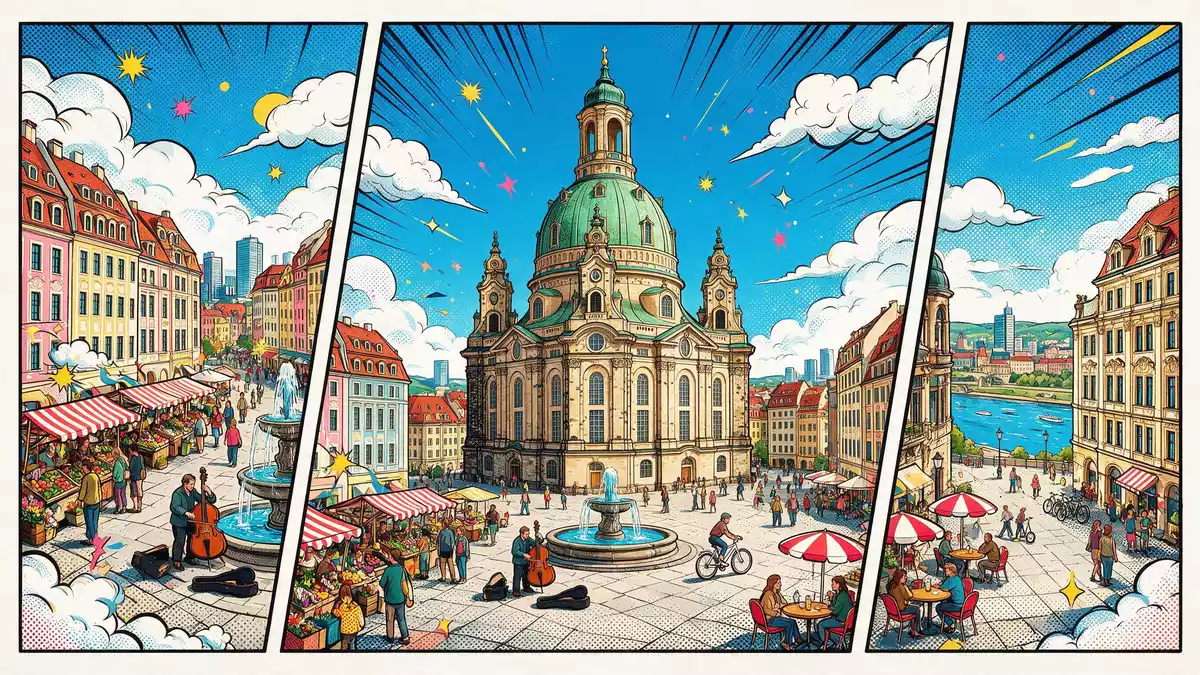
Frauenkirche in Dresden is a Lutheran Baroque church whose broad sandstone dome, long known as the “Stone Bell”, rises above the Neumarkt square and anchors the city’s historic skyline. Built in the eighteenth century under the architect George Bähr and reconstructed after wartime destruction in the early twenty-first century, it combines a centralised plan with tiered galleries around a light-filled interior.
A Baroque Lutheran church at the heart of Dresden
Frauenkirche stands in Dresden’s Altstadt on the Neumarkt, a historic square a short walk from the Elbe river embankments and the former royal palace. The church is dedicated to Mary as “Our Lady”, a tradition that reaches back to earlier churches on this site long before the current Baroque building was conceived.earlier churches on this site The present stone structure was raised between 1726 and 1743 as a Lutheran parish church for the rapidly growing Saxon capital.built between 1726 and 1743
The city council of Dresden commissioned George Bähr, then the city’s master builder, to design a new church that reflected the Protestant understanding of worship at the height of the Baroque era.city council of Dresden commissioned George Bähr His design adopts a centralised layout with the altar, pulpit, baptismal font and organ all drawn into a common visual field, placing preaching and music at the centre of the interior. The building quickly became a prominent feature of Dresden’s cityscape and remained so for around two centuries.
The Stone Bell: dome and architecture
The most striking external feature of Frauenkirche is its large masonry dome, known locally as the “Stone Bell”. Formed from sandstone and crowned by a stone lantern, this broad structure rises above the church’s stacked body and gives the building its distinctive silhouette against the Dresden sky.stone lantern above the dome Historic descriptions and modern guides alike emphasise the dome’s scale, which dominated the skyline of the city for more than 200 years and made Frauenkirche one of the best-known Protestant churches of the Baroque period.dominated the skyline for over 200 years
Seen from the Neumarkt, the church presents layered volumes: a robust base with entrances on several sides, rising into a central block encircled by windows and galleries, and culminating in the dome with its lantern. Inside, the plan brings the congregation around the central space on multiple levels, with galleries that look down towards the altar and organ. Historic accounts record that Gottfried Silbermann built an organ for Frauenkirche in 1736 and that Johann Sebastian Bach played an inaugural recital, underlining the church’s importance in the musical life of eighteenth-century Saxony.Silbermann organ and Bach recital in 1736
Destruction, reconstruction and memory in stone
Frauenkirche’s Baroque structure withstood conflicts in the eighteenth and nineteenth centuries, including the Seven Years’ War and fighting around Dresden in 1813.withstood conflicts in the eighteenth and nineteenth centuries In February 1945, Allied air raids on Dresden led to intense fires in the city centre, and the church, although initially standing amid the ruins, eventually collapsed as the heat weakened the dome and supporting walls.collapsed after the bombing of Dresden in February 1945 For decades the rubble remained on the Neumarkt as a visible reminder of the destruction, with some surviving stones later incorporated into the rebuilt structure.
Calls for reconstruction gathered pace in the late twentieth century, and work on rebuilding Frauenkirche began in the early 1990s. The project used archived drawings, photographs and surviving fragments to reproduce Bähr’s Baroque design closely, while employing contemporary engineering for stability. The reconstructed church was completed and consecrated in 2005, returning the Stone Bell dome and centralised interior to Dresden’s skyline and restoring the architectural ensemble of the Neumarkt.reconstruction between 1994 and 2005
Visiting Frauenkirche: what travellers from Western Europe should know
- Frauenkirche stands on the Neumarkt in Dresden’s Altstadt, south of the Elbe river and close to landmarks such as the Residenzschloss and the Kulturpalast; Dresden’s main railway station connects the city with regional and long-distance trains.
- The church interior is reached from the Neumarkt via entrances that lead into a broad nave with multiple gallery levels; the upper viewing areas and the dome involve staircases with a significant number of steps.
- The Frauenkirche is in Germany, where the official language is German and the currency is the euro.
- Entry requirements depend on your nationality; UK travellers can check the FCDO travel advice at gov.uk/foreign-travel-advice, Irish travellers the Department of Foreign Affairs at ireland.ie.
Searching for Frauenkirche on social platforms
These links open searches for Frauenkirche on each platform.
Frequently asked questions about Frauenkirche
Where is Frauenkirche located in Dresden?
Frauenkirche stands on the Neumarkt square in Dresden’s Altstadt, close to the Elbe river and other historic buildings in the former royal quarter.
What can visitors expect inside Frauenkirche?
Visitors encounter a centralised Baroque interior with tiers of galleries around the nave, a prominent altar and organ, and the sense of space created by the rising dome above.
What makes Frauenkirche distinctive among churches in Germany?
Its combination of Lutheran Baroque architecture, the large Stone Bell dome in sandstone, and its documented destruction and later reconstruction give Frauenkirche a particular place in German church history.


