
Fontana di Trevi: Rome’s theatrical Baroque stage of water and stone
Published on 09/19/2026 at 08:37 | Editorial responsibility: Rafael Müller, Editor-in-Chief AD HOC NEWS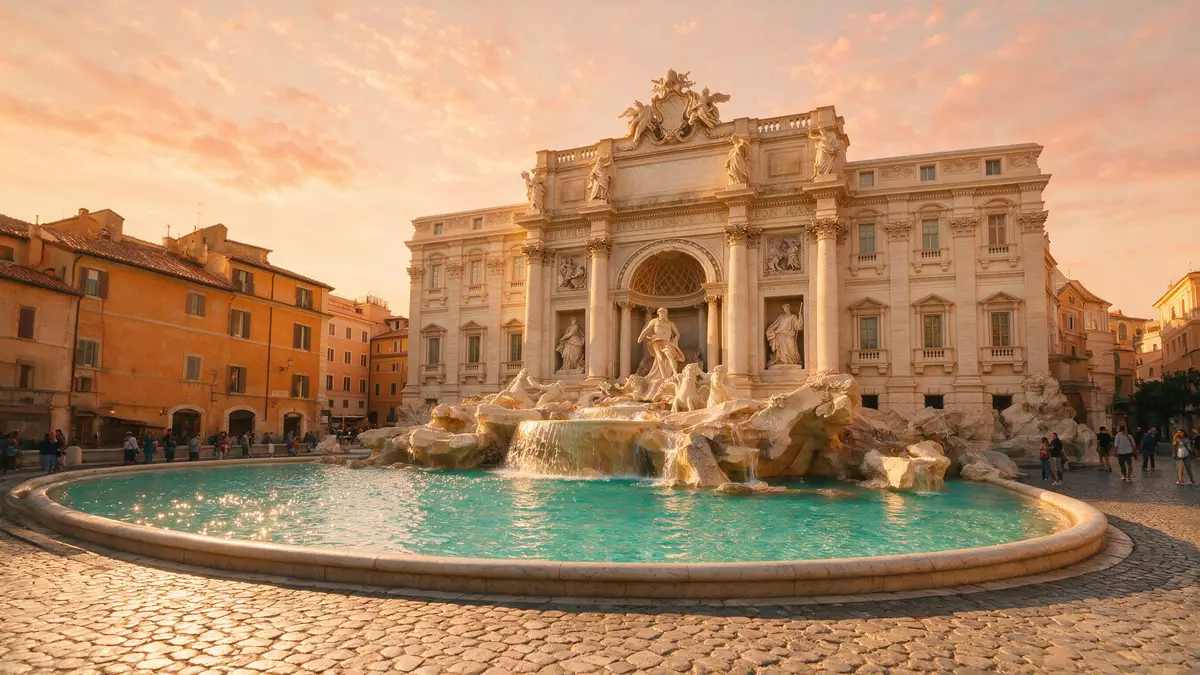
Fontana di Trevi in Rom is an eighteenth?century Baroque fountain that turns the façade of Palazzo Poli into a vast stage of water, sculpture and carved stone. Rising more than 26 m (86 ft) and stretching close to 50 m (164 ft) across the narrow piazza, it forms a monumental wall of architecture and flowing water at the end of a small street rather than the centre of a grand square. Designed in the eighteenth century by the Roman architect Nicola Salvi and completed by Giuseppe Pannini in 1762, it anchors the restored line of the ancient Aqua Virgo aqueduct and binds imperial engineering to Baroque spectacle.
Architecture carved into a palace façade
Fontana di Trevi is not a freestanding basin in the middle of a piazza; it is built directly against the rear façade of Palazzo Poli, turning the palace wall into a combined architectural and sculptural backdrop. The fountain’s composition is dominated by a central triumphal arch framed by giant columns, with further architectural elements extending across the width of the palace front to create a continuous stone landscape.Palazzo Poli Beneath the architectural framework spreads a rocky mass cut into terraces, ledges and projecting plinths, over which water cascades into the main pool at street level.
The fountain is a late Baroque design, conceived after a papal competition held in 1730 and begun in 1732, when Nicola Salvi won the commission and set out the basic scheme that visitors see today.competition in 1730 Salvi’s project integrates palace architecture, a triumphal arch and a sculptural programme that seems to grow out of the stone. After his death in 1751, Giuseppe Pannini oversaw the completion of the work and brought the design to its final form in 1762, keeping the dominant façade?and?fountain concept intact.completed in 1762
Oceanus, allegories and the language of Baroque Rome
At the centre of Fontana di Trevi, beneath the high arch, stands a large figure of Oceanus, personification of the world’s waters, riding a shell?shaped chariot drawn by two sea horses led by tritons. One horse is shown calm and restrained, the other rearing and energetic, a pairing that gives the central group a sense of movement even when viewed from a distance.Oceanus in a shell chariot Flanking the main arch, two large niches hold personifications of Abundance and Salubrity, each standing on a pedestal above carved rock, with further reliefs above them recounting episodes tied to the aqueduct’s history.
The sculptural ensemble extends across the width of the fountain, with carved vegetation, smaller figures and heraldic emblems woven into the stone. Inscriptions record the papal patrons connected with the work, including Pope Clement XII, who launched the competition that brought Salvi his commission.Clement XII’s role The entire programme combines mythological figures, allegories of water and health, and heraldry into a single façade, so that visitors reading the stone encounter ancient gods and early modern papal authority in one scene.
Ancient water, Baroque city
The story of Fontana di Trevi reaches back to ancient Rome, when the Aqua Virgo aqueduct carried water into the city under Marcus Vipsanius Agrippa in 19 BC to supply his baths at the Campus Martius.Aqua Virgo in 19 BC That aqueduct’s revived line, known as Acqua Vergine, terminates at Fontana di Trevi, so the fountain marks the end point of a water supply with roots in the age of Augustus. The name “Trevi” refers to the meeting of three streets at the site, with the fountain occupying the inner end of a wedge?shaped space in the Trevi district.
The fountain visible in Rom today was constructed between 1732 and 1762 as part of a broader eighteenth?century reshaping of the city, when papal patrons sponsored major works that linked ancient infrastructure with Baroque display.construction 1732–1762 Earlier fountains on the site were removed to make way for Salvi’s more ambitious design, which fuses palatial architecture and monumental sculpture into a single urban landmark at the end of the aqueduct.
Visiting Fontana di Trevi: what travellers from Western Europe should know
- Fontana di Trevi stands in the Trevi district of Rom, a short walk south of Piazza di Spagna and east of Via del Corso, in a compact urban block behind Palazzo Poli.
- The approach to the fountain is along narrow streets that open suddenly into the small piazza; the pavement around the basin is on a gentle slope with low steps leading closer to the water.
- The fountain’s architectural backdrop rises several storeys, so viewing points range from the edge of the basin at street level to higher perspectives from neighbouring windows and balconies.
- The official language is Italian and the currency is the euro.
Searching for Fontana di Trevi on social platforms
These links open searches for Fontana di Trevi on each platform.
Frequently asked questions about Fontana di Trevi
Where is Fontana di Trevi in Rom?
Fontana di Trevi stands in the Trevi district of Rom, attached to the rear façade of Palazzo Poli in a small piazza reached by narrow streets.
What should visitors expect when they arrive?
Visitors encounter a tall Baroque façade of stone, sculpture and flowing water filling almost an entire side of the piazza, with a gently sloped pavement and low steps around the basin.
What makes Fontana di Trevi distinctive among Rome’s fountains?
Its integration of a palace front, triumphal arch, large mythological figures and revived ancient aqueduct into one continuous wall of water and stone gives Fontana di Trevi an unusually theatrical presence.


