
Fontana di Trevi: Rome’s grand Baroque water theatre
Published on 09/17/2026 at 15:10 | Editorial responsibility: Rafael Müller, Editor-in-Chief AD HOC NEWS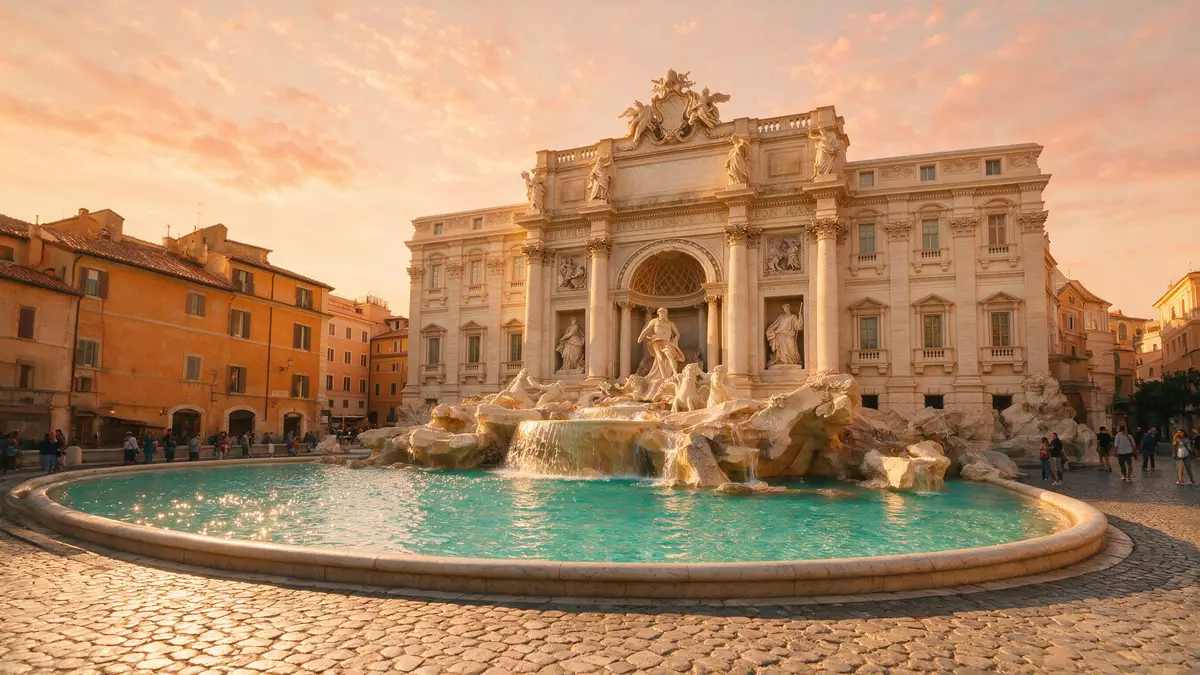
In the Trevi district of Rom, Fontana di Trevi transforms an ordinary urban corner into a monumental water theatre, fusing architecture and sculpture into a single Baroque façade. Designed by the Roman architect Nicola Salvi in the eighteenth century and completed in 1762, the fountain turns the back of Palazzo Poli into a cliff-like backdrop for cascading water and carved figures, anchored to the ancient Aqua Virgo aqueduct that has supplied this part of Rome since 19 BC.
A palace wall turned into a Baroque stage
Fontana di Trevi is not a freestanding structure in a square but a fountain built directly against the rear façade of Palazzo Poli in the Trevi rione, so the palace itself becomes part of the composition.Palazzo Poli in the Trevi district The façade rises above the basin like a cliff, its architectural orders framing niches and ledges while water pours down over sculpted rock at the base. Travertine stone forms much of the architectural setting, with statues and reliefs in pale marble set against it, so the whole surface reads as a carefully staged rock face rather than a conventional building front.Travertine stone façade
The composition takes the form of a late Baroque scenography: a central triumphal arch frames the main figure, flanked by columns and secondary niches, with the palace windows and cornices absorbed into the design. Rising more than 26 m (about 86 ft) and extending close to 50 m (around 164 ft) across the square, the façade dominates the confined space, so the small piazza feels entirely filled by stone and water.Height and width of the fountain The urban junction where three streets meet — the “tre vie” that gave the district its name — funnels views towards the fountain, making the palace wall appear as a natural terminus to the approach.
From Aqua Virgo to eighteenth-century marble drama
The story of Fontana di Trevi is closely tied to the Aqua Virgo, an aqueduct completed in 19 BC under Marcus Vipsanius Agrippa to bring water from springs near Salone to central Rome.Aqua Virgo aqueduct completed in 19 BC The aqueduct’s revived form, known as Acqua Vergine, still feeds the fountain, so ancient hydraulic infrastructure lies behind the Baroque spectacle on the surface.Terminal point of Aqua Virgo The decision to place a monumental fountain at this terminus turned a functional water outlet into a symbol of Rome’s layered history, linking imperial engineering to papal urban projects.
An earlier fountain on this site was removed in the seventeenth century, and a competition for a new design in the early eighteenth century produced Nicola Salvi’s scheme, chosen in 1732 under Pope Clement XII.Competition won by Nicola Salvi in 1732 Construction began that year and continued for about three decades; after Salvi’s death in 1751, Giuseppe Pannini oversaw the completion, with sculptor Pietro Bracci responsible for the central Oceanus group in the final years before the inauguration in 1762.Construction between 1732 and 1762 The result is a fountain that captures the theatrical, dynamic qualities of Baroque architecture while standing at the intersection of ancient and early modern Rome.
Oceanus, horses and allegories in stone and water
The focal point of Fontana di Trevi is the large central niche, where the sea god Oceanus stands in a shell-like chariot, flanked by powerful horses and Tritons guiding them across the sculpted rock. Pietro Bracci executed this group in marble between the late 1750s and early 1760s, working from earlier models to create the figure that now commands the composition.Oceanus group sculpted by Pietro Bracci The horses contrast in temperament — one rearing, one calmer — while the Tritons handle them with robust physicality, so the base of the niche reads as a moving sea scene even though everything is stone.
On either side of the central arch stand personifications of Abundance and Health, carved by Filippo della Valle, each set within its own architectural frame and associated with carved reliefs above that illustrate aspects of the aqueduct’s story.Allegorical figures beside Oceanus Below, the water spreads out into a wide pool, spilling over artificial rock formations that appear to grow from the palace base. The contrast between structured columns and rough stone, between static marble figures and flowing water, embodies the late Baroque interest in combining architecture, sculpture and landscape into one unified set piece.
Visiting Fontana di Trevi: what travellers from Western Europe should know
- Fontana di Trevi stands in the Trevi district of Rom, south-east of Piazza di Spagna; it is reached on foot from central streets and nearby metro stations.
- The approach from surrounding lanes leads directly to the fountain’s basin, with the stone square dropping slightly towards the water and steps and ledges built into the palace side.
- The area around the fountain is a compact urban space enclosed by buildings, so views are taken from short distances and the façade fills much of the field of vision.
- Italy’s official language is Italian and its currency is the euro.
Searching for Fontana di Trevi on social platforms
These links open searches for Fontana di Trevi on each platform.
Frequently asked questions about Fontana di Trevi
Where is Fontana di Trevi in Rom?
Fontana di Trevi stands in the Trevi district of Rome, built against the façade of Palazzo Poli in a small square where three streets meet.
What should visitors expect when seeing the fountain?
Visitors encounter a large Baroque façade filled with marble figures and flowing water, with the palace wall and basin occupying most of the compact piazza.
What makes Fontana di Trevi distinctive among Rome’s fountains?
The fountain’s integration into a palace façade, its eighteenth-century Baroque scenography and its connection to the ancient Aqua Virgo aqueduct give it a layered architectural and historical character.


