
Fontana di Trevi in Rom: stone theatre of water and myth
Published on 08/28/2026 at 07:02 | Editorial responsibility: Rafael Müller, Editor-in-Chief AD HOC NEWS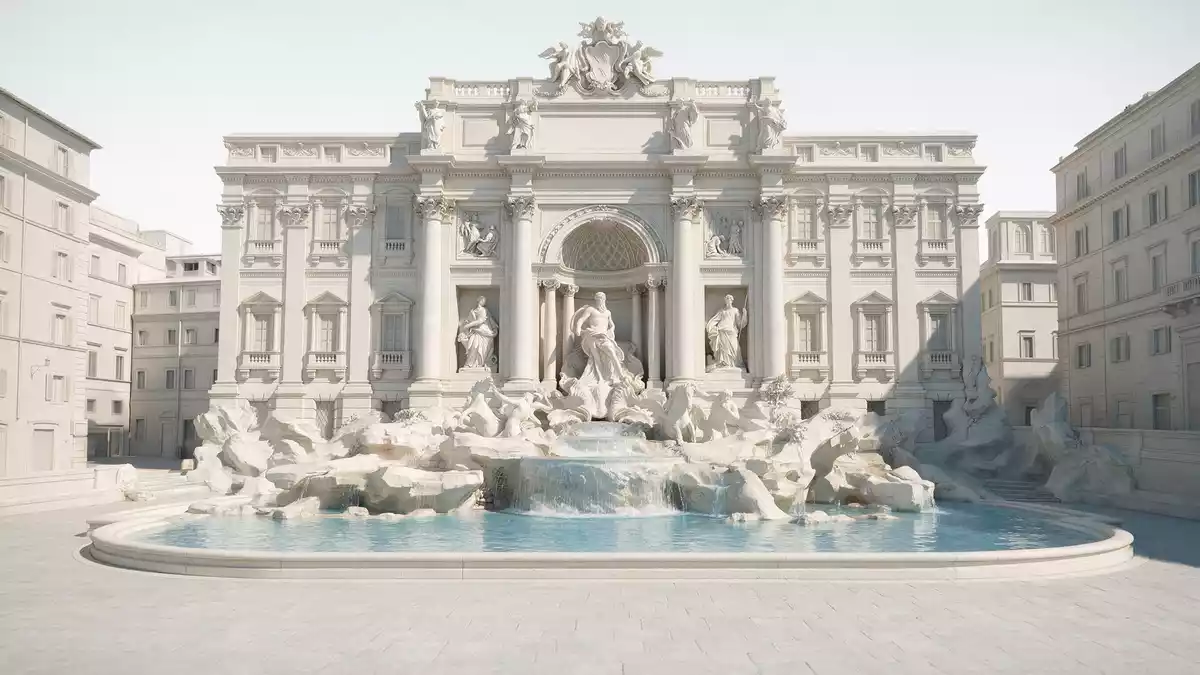
Fontana di Trevi in Rom is less a standalone fountain than a full stone theatre, where cascading water, mythological sculpture and an 18th-century palace façade merge into one monumental scene. Rising against the rear of Palazzo Poli and completed in 1762 after decades of work led by architect Nicola Salvi, it marks the urban endpoint of the ancient Aqua Virgo aqueduct first laid out in 19 BC.
A Baroque façade that became a fountain
Fontana di Trevi follows the late Baroque tradition of turning architecture itself into a stage, drawing the entire façade of Palazzo Poli into the composition rather than placing a basin discreetly in front of it.late Baroque tradition The building front is organised around a central triumphal arch framed by colossal columns, with niches and ledges carved into travertine and other stone to support figures, shields and floral reliefs.central triumphal arch Instead of a neat boundary between “fountain” and “palace”, the water appears to surge directly out of the architecture, turning a residential block into a public spectacle.
Construction began in 1732, after Pope Clement XII commissioned a grand new display to celebrate the Aqua Virgo and the junction of streets known as tre vie in the Trevi district of Rom.commissioned by Clement XII Nicola Salvi’s winning design wrapped the entire piazza-facing wall in sculpture and stone, and work continued beyond his death in 1751 under Giuseppe Pannini, who oversaw the final phase and inauguration in 1762.construction 1732–1762 The result is a fountain that feels as embedded in the fabric of the city as any church or palazzo, yet reads at street level as a single, unified artwork.
Oceanus, allegories and rocky cascades
The sculptural programme at Fontana di Trevi centres on a figure of Oceanus, the personification of the world’s waters, standing in a niche beneath the main arch and flanked by allegorical figures and horses.Oceanus at the centre Oceanus stands on a shell chariot, drawn by two hippocamps, one calm and one rearing, each guided by a Triton. Together they suggest the changing moods of the sea, while the surrounding reliefs and statues narrate themes of abundance, health and the taming of natural forces. Above the main group, an inscription honours Clement XII, and further up the façade heraldic emblems and carved trophies continue the mixture of civic statement and mythological display.
Below, the rocky formations are carved in high relief, with protruding ledges and rugged stone forms that appear to emerge from the building itself, channelled into a broad basin that fills most of the piazza edge.rocky formations and basin Water spills over multiple levels, breaking into streams and sheets before collecting in the pool, where the pale stone and clear flow create a strong contrast with the tight masonry of the surrounding streets. The sound and movement of the water complete the composition, adding a continuous layer to the statues and architecture without needing any mechanical spectacle beyond gravity and the aqueduct supply.
Aqua Virgo and the junction of tre vie
Fontana di Trevi occupies the end point of Aqua Virgo, an ancient Roman aqueduct built by Marcus Vipsanius Agrippa in 19 BC to bring water into the city and particularly to his baths near the Pantheon.Aqua Virgo built by Agrippa In Rom the revived aqueduct is known as Acqua Vergine, and for centuries it has supplied water to the fountain, linking the 18th-century Baroque display to engineering laid down in the time of Augustus. The name “Trevi” itself is commonly associated with tre vie, the three streets that meet at the small Piazza di Trevi, making the fountain both a hydraulic terminus and a urban focus point.tre vie junction
Because the fountain is set onto the narrow Piazza di Trevi and anchored to Palazzo Poli, it feels almost enclosed by buildings even while it celebrates the wider water system of Rom.Palazzo Poli and piazza The meeting of ancient aqueduct, 18th-century stone work and continuous modern use gives Fontana di Trevi a layered character: part functioning city infrastructure and part crafted stage for allegory, where the architecture remains inseparable from the water it frames.
Visiting Fontana di Trevi: what travellers from Western Europe should know
- Fontana di Trevi stands in the Trevi district of Rom, Italy, on Piazza di Trevi, with its façade attached to Palazzo Poli and streets approaching from several directions.
- The site is reached on foot through narrow streets of the historic centre; the final approaches involve short slopes and steps around the basin edge.
- Rom’s official language is Italian and the currency is the euro.
Searching for Fontana di Trevi on social platforms
These links open searches for Fontana di Trevi on each platform.
Frequently asked questions about Fontana di Trevi
Where is Fontana di Trevi located in Rom?
Fontana di Trevi is situated on Piazza di Trevi in the Trevi district of Rom, attached to the rear façade of Palazzo Poli in the historic centre.
What should visitors expect when approaching the fountain?
Visitors walk through narrow streets that open suddenly onto the basin and façade, with steps and short slopes around the edge but no broad open square.
What makes Fontana di Trevi distinctive among Rom’s fountains?
Fontana di Trevi uses the palace façade of Palazzo Poli as its backdrop, combining Baroque architecture, large-scale sculpture and Aqua Virgo water into one integrated composition.


